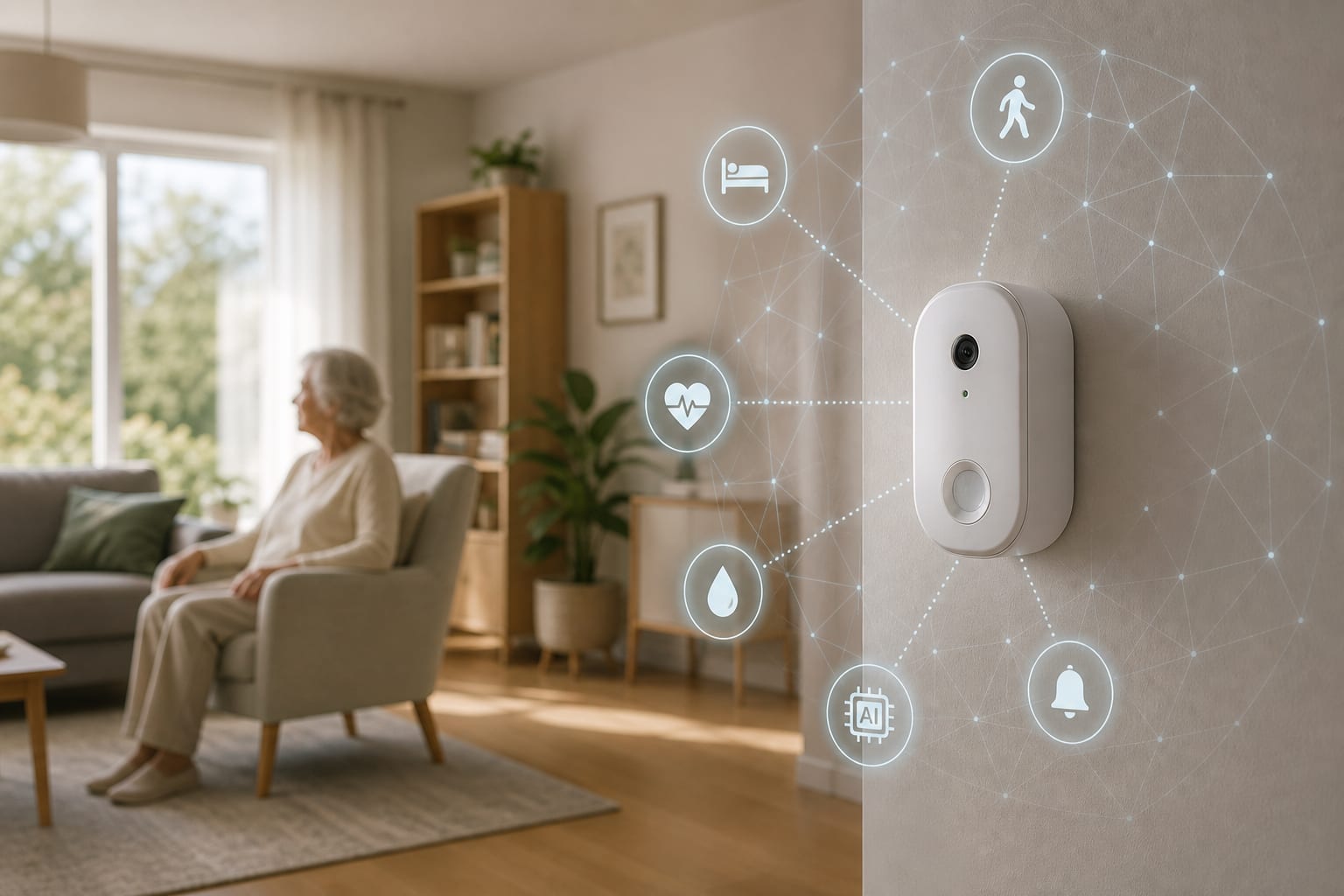
Can Smart Monitoring Technologies Enhance Home Safety for Seniors?
-
By
-
Jenna Congdon
-
August 21, 2026
Clinical Report: Can Smart Monitoring Technologies Enhance Home Safety for Seniors?
Overview
AI-enabled remote monitoring may enhance home safety for seniors by providing continuous observation and alerts regarding health and safety. Comprehensive Healthcare at Home (CHAH) combines in-home nursing with AI surveillance.
Background
As populations age rapidly in developed countries, many older adults prefer to remain in their homes, increasing the demand for safe, home-based care. Aging at home presents challenges, including the risk of falls and social isolation.
Data Highlights
No numerical data available in the source material.
Key Findings
- AI-enabled monitoring can support safe aging at home through continuous observation.
- CHAH combines in-home nursing with AI surveillance.
- Falls affect 1 in 3 adults over 65 in Canada, accounting for 85% of injury-related hospitalizations.
- AI algorithms can predict risks of falls and infections.
- Conventional monitoring systems are limited in their ability to anticipate medical events.
Clinical Implications
Healthcare providers should consider integrating AI-powered monitoring technologies into care plans for older adults living at home. These systems may facilitate earlier interventions and improve health outcomes by continuously monitoring patients' conditions.
Conclusion
AI-powered remote monitoring may enhance safety for seniors aging at home.
Related Resources & Content
- retinal physician, Home Monitoring, 2014 -- Home Monitoring
- Journal of Medical Internet Research (JMIR), Frailty-Based Remote Monitoring in Older Adults With Heart Failure: Conceptual Framework for Adaptive Digital Health Strategies, 2026 -- Frailty-Based Remote Monitoring
- Frontiers in Psychiatry, Detection of depression risk among older adults using home-deployed socially assistive robots: a real-world study, 2026 -- Detection of depression risk
- DIGITAL HEALTH, Unveiling the potential of digital twins in homecare: A reflexive thematic analysis of older adults’ views, 2026 -- Digital Twins in Homecare
- Efficacy and Safety of Hospital-at-Home versus Traditional Hospital Care in Older Patients: A Systematic Review and Meta-Analysis of Randomized Controlled Trials - PMC, 2026 -- Hospital-at-Home vs Traditional Care
- Outcomes Associated With Hospital at Home vs Traditional Inpatient Stay | Geriatrics | JAMA Network Open
- Acute Hospital Care at Home Data Release Fact Sheet | CMS
- Effectiveness Evaluation of Smart Home Technology in Preventing and Detecting Falls in Community and Residential Care Settings for Older Adults: A Systematic Review and Meta-Analysis
- Efficacy and Safety of Hospital-at-Home versus Traditional Hospital Care in Older Patients: A Systematic Review and Meta-Analysis of Randomized Controlled Trials - PMC
- Assessment of an automated telesurveillance system on the incidence of serious falls in nursing homes (TELEHPAD): Randomized controlled trial - ScienceDirect
- Device based monitoring in digital care and its impact on hospital service use | npj Digital Medicine
- Establishing global standards on wearable technology for measuring mobility in ageing populations: an international consensus exercise | Age and Ageing | Oxford Academic
- Practice Standards for Acute Hospital Care at Home - PubMed
- American Geriatrics Society Position Statement: Telehealth Policy for Older Adults
- Medical Ethics Issues: Position Papers & Resources | ACP
- Ethics and governance of artificial intelligence for health
Based on findings from:
Can Intelligent Monitoring Help Older Adults Live Safely at Home Longer?
Jenna Congdon. Journal Of Medical Internet Research, 2026.
https://www.jmir.org/2026/1/e109278
This content is an AI-generated, fully rewritten summary based on a published scholarly article. It does not reproduce the original text and is not a substitute for the original publication. Readers are encouraged to consult the source for full context, data, and methodology.