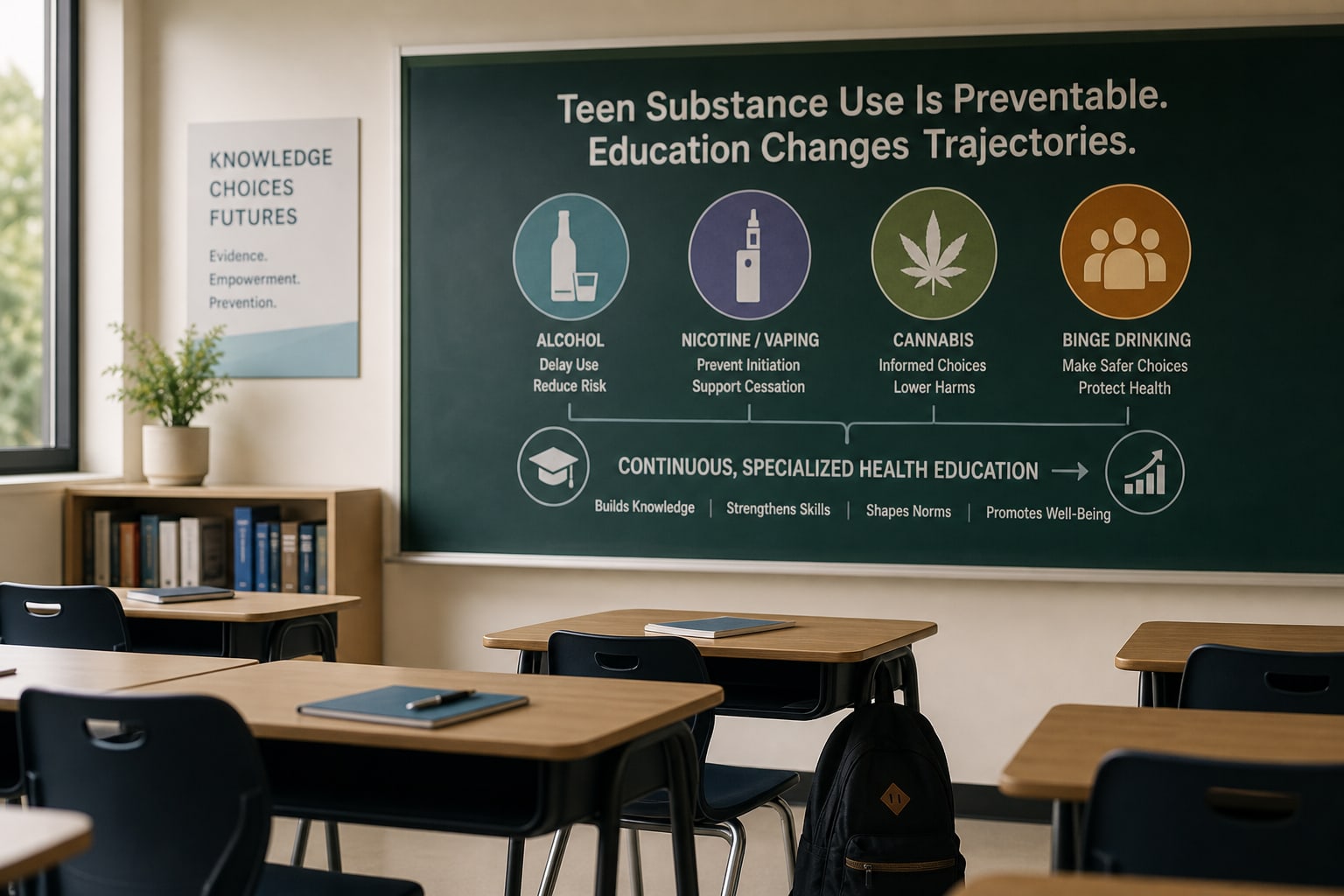
Continuous Access to Specialized Health Education in High Schools and Its Impact on Teen Substance Use
-
By
-
Brennan Davis
-
Levi Eoin Davis
-
July 9, 2026
Continuous Access to Specialized Health Education in High Schools and Its Impact on Teen Substance Use
Overview
This study evaluates the association between sustained availability of a dedicated health course in California high schools and adolescent substance use prevalence.
Background
Adolescent substance use is a significant public health issue, contributing to morbidity and mortality in the U.S. Schools serve as a critical platform for prevention, yet the effectiveness of routine health education in reducing substance use remains underexplored.
Data Highlights
This study utilized data from the California Healthy Kids Survey (CHKS) and annual course lists from the University of California Office of the President (UCOP) to assess substance use prevalence among high school students from 2017 to 2024.
Key Findings
- Sustained availability of a dedicated health course is hypothesized to correlate with lower prevalence of adolescent substance use behaviors.
- The study employed a difference-in-differences design to analyze the impact of health course availability on substance use outcomes.
- Data were collected from students in grades 9 and 11, focusing on alcohol, marijuana, and vaping behaviors.
- California law mandates instruction on substance use, but does not specify the delivery method, allowing for variability in implementation.
- Observational design was used due to the infeasibility of randomizing schools for course availability.
Clinical Implications
The findings may inform school health policies and highlight the importance of structured health education in addressing adolescent substance use. Schools may consider maintaining dedicated health courses as a strategy for substance use prevention.
Conclusion
Further research is needed to explore the associations between health education and adolescent substance use.
Related Resources & Content
- BMC Psychiatry, 2025 -- Alcohol use among adolescents in eight sub-Saharan African countries: evidence from the Global School-based student health survey (2012–2017) using the socio-ecological model
- Journal of Medical Internet Research, 2026 -- Toward Participatory Precision Health With Co-Designed Recommendations: Systematic Review of Just-in-Time Adaptive Interventions in Adolescents and Young Adults
- Open Forum Infectious Diseases -- Outcomes of HIV Care Continuum in Latin American and Caribbean Adolescents and Young Adults: Links to Depression and Substance Use
- Reported use of most drugs remains low among U.S. teens | National Institutes of Health (NIH)
- Health Education Curriculum Analysis Tool (HECAT) | Adolescent and School Health | CDC
- Open Forum Infectious Diseases — Investigating the Relationships Among Polysubstance Use, Social Determinants of Health, and Mental Health Symptoms in Individuals Living with HIV
- Substance Use: Community Interventions involving Coalitions or Partnerships to Prevent Substance Use among Youth
- Tobacco Product Use Among Middle and High School Students — National Youth Tobacco Survey, United States, 2024
- Reported use of most drugs remains low among U.S. teens | National Institutes of Health (NIH)
- U.S. Overdose Deaths Decrease Almost 27% in 2024 | NCHS Pressroom | CDC
- Health Education Curriculum Analysis Tool (HECAT) | Adolescent and School Health | CDC
- E-Cigarettes and Similar Devices | Pediatrics | American Academy of Pediatrics
- K-12 Education: Most States Require Public Schools to Teach Substance Use Prevention | U.S. GAO
- Effectiveness of the Botvin High School LifeSkills Training Intervention on Adolescent Substance Use: A Cluster Randomized Trial - ScienceDirect
- An on-line school-based substance use harm reduction programme: The Illicit Project randomized controlled trial results - PubMed
- Effectiveness of School‐Based Resilience Interventions on Adolescent Tobacco, Alcohol, and Illicit Substance Use: A Meta‐Analysis - PMC
- Effectiveness of educational interventions in United States schools to prevent opioid-related harms: A systematic review - ScienceDirect
Based on findings from:
Sustained Availability of Dedicated High School Health Courses and Adolescent Substance Use
Brennan Davis, Levi Eoin Davis. Jama Network Open, 2026.
https://jamanetwork.com/journals/jamanetworkopen/fullarticle/2851450
This content is an AI-generated, fully rewritten summary based on a published scholarly article. It does not reproduce the original text and is not a substitute for the original publication. Readers are encouraged to consult the source for full context, data, and methodology.