Delayed intrabiliary migration of embolization material after hepatic arterial embolization: a case report - Report - MDSpire

Delayed Migration of Embolic Agents into the Biliary Tract Following Hepatic Arterial Embolization: A Case Study

  • By

  • Xiudi Chen

  • Yukun Ying

  • Hongwei Qian

  • Zhihong Shen

  • July 16, 2026

Share

Clinical Report: Delayed Migration of Embolic Agents into the Biliary Tract

Background

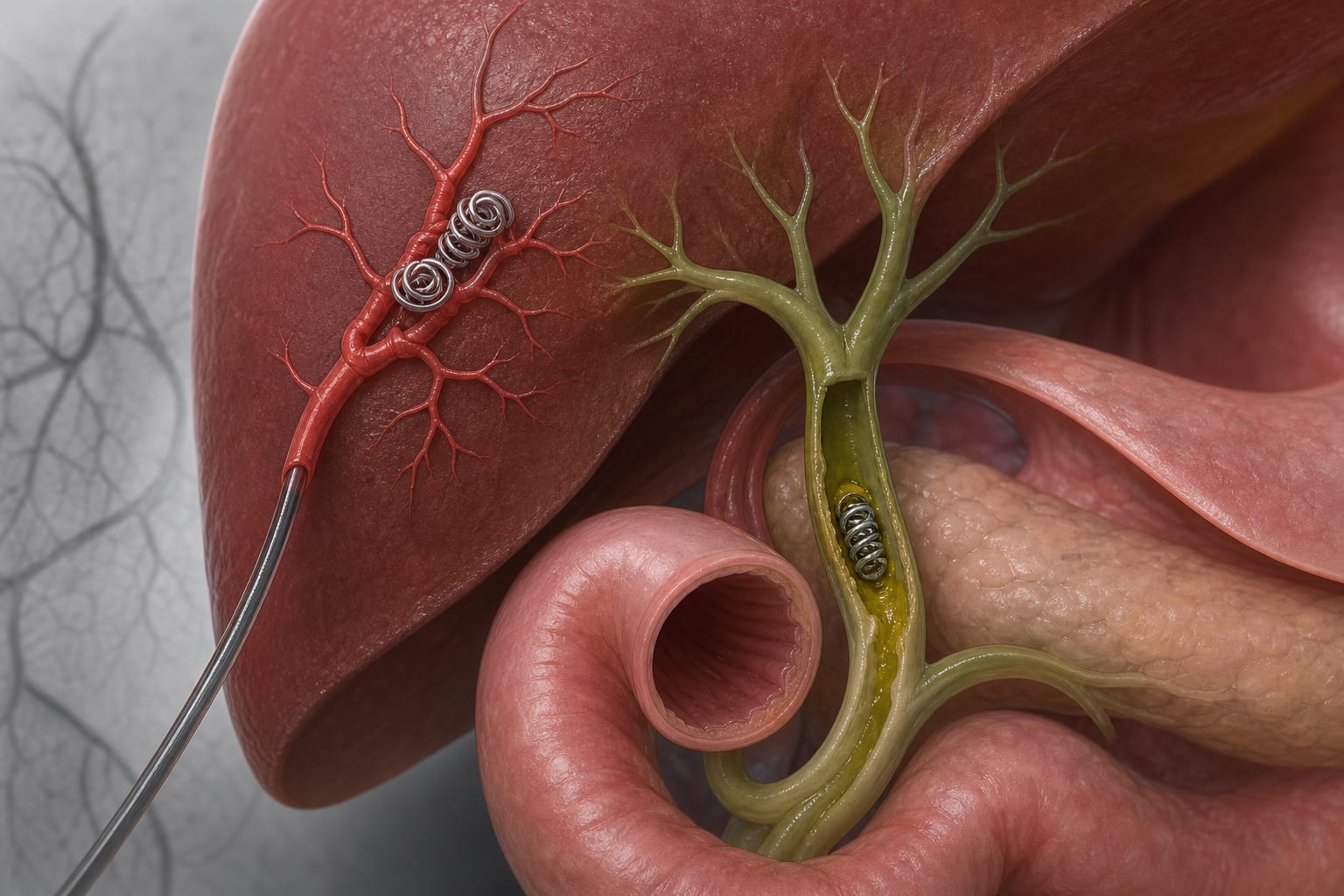
Transcatheter arterial embolization (TAE) is a common intervention for managing arterial bleeding in hepatobiliary surgery. While generally safe, complications such as delayed migration of embolization materials into the biliary system can lead to significant clinical issues, including recurrent cholangitis and biliary obstruction. Accurate diagnosis can be complicated by anatomical overlap and limitations in imaging techniques.

Data Highlights

No numerical data or trial data presented in the article.

Key Findings

  • A 73-year-old male developed recurrent biliary symptoms two years after TAE with metallic coils.
  • Initial imaging and ERCP failed to definitively localize the migrated coils due to anatomical overlap.
  • Partial extraction of a metallic wire was achieved during a later ERCP, confirming intrabiliary involvement.
  • Diagnostic challenges included metallic artifacts on imaging and the absence of clear filling defects during ERCP.
  • Repeated evaluations were necessary to address the patient's recurrent symptoms.

Clinical Implications

Careful monitoring and repeated evaluations may be necessary for patients presenting with recurrent biliary symptoms after TAE.

Conclusion

This case illustrates the gradual and diagnostically ambiguous nature of intrabiliary migration of embolization materials following hepatic arterial embolization.

Related Resources & Content

  1. European Radiology, 2024 -- Trans-arterial Embolization as a Treatment Option for Acute Lower Gastrointestinal Hemorrhage: A Multicenter Study
  2. Surgical Endoscopy, 2023 -- Outcomes of Proximal, Distal, and Combined Splenic Artery Embolization Techniques in Treating Blunt Splenic Injuries: Analysis of 202 Cases from a Single Trauma Facility
  3. Frontiers in Surgery, 2026 -- Predictive Factors for Post-Embolization Infarction and Long-Term Splenic Remodeling in Patients Undergoing Splenic Artery Aneurysm Embolization
  4. Frontiers in Surgery, 2026 -- Delayed hepatic artery pseudoaneurysm with arterioportal fistula after penetrating liver trauma successfully treated with coil embolization: a case report and focused literature review
  5. CIRSE Standards of Practice for the Endovascular Treatment of Visceral and Renal Artery Aneurysms and Pseudoaneurysms - PubMed
  6. Frontiers, 2026 -- Delayed Intrabiliary Migration of Embolization Material After Hepatic Arterial Embolization: A Case Report
  7. Diagnostic work-up of bile duct strictures: European Society of Gastrointestinal Endoscopy (ESGE) Guideline - PubMed
  8. CIRSE Standards of Practice for the Endovascular Treatment of Visceral and Renal Artery Aneurysms and Pseudoaneurysms - PubMed
  9. Frontiers | Delayed Intrabiliary Migration of Embolization Material After Hepatic Arterial Embolization: A Case Report
  10. Diagnostic work-up of bile duct strictures: European Society of Gastrointestinal Endoscopy (ESGE) Guideline - PubMed

Original Source(s)

Related Content