Ventricular Strain and Correlation with Cardiovascular Symptoms and Pulmonary Function Testing in Pediatric Patients with a History of COVID-19: Results from the Pediatric SARS-CoV-2 Long Term Outcomes Study - Report - MDSpire
Conexiant’s news site is now MDSpire News. Learn more
Advertisement
Ventricular Strain and Its Relationship with Cardiovascular Symptoms and Pulmonary Function in Children with Previous COVID-19: Findings from the Pediatric SARS-CoV-2 Long-Term Outcomes Study
Clinical Report: Ventricular Strain and Its Relationship with Cardiovascular Symptoms
Overview
This study evaluated postinfectious cardiac function and its relationship with symptoms in patients aged 0 to 21 years. Cardiac function did not differ between infected and uninfected participants at baseline or 12-month follow-up.
Background
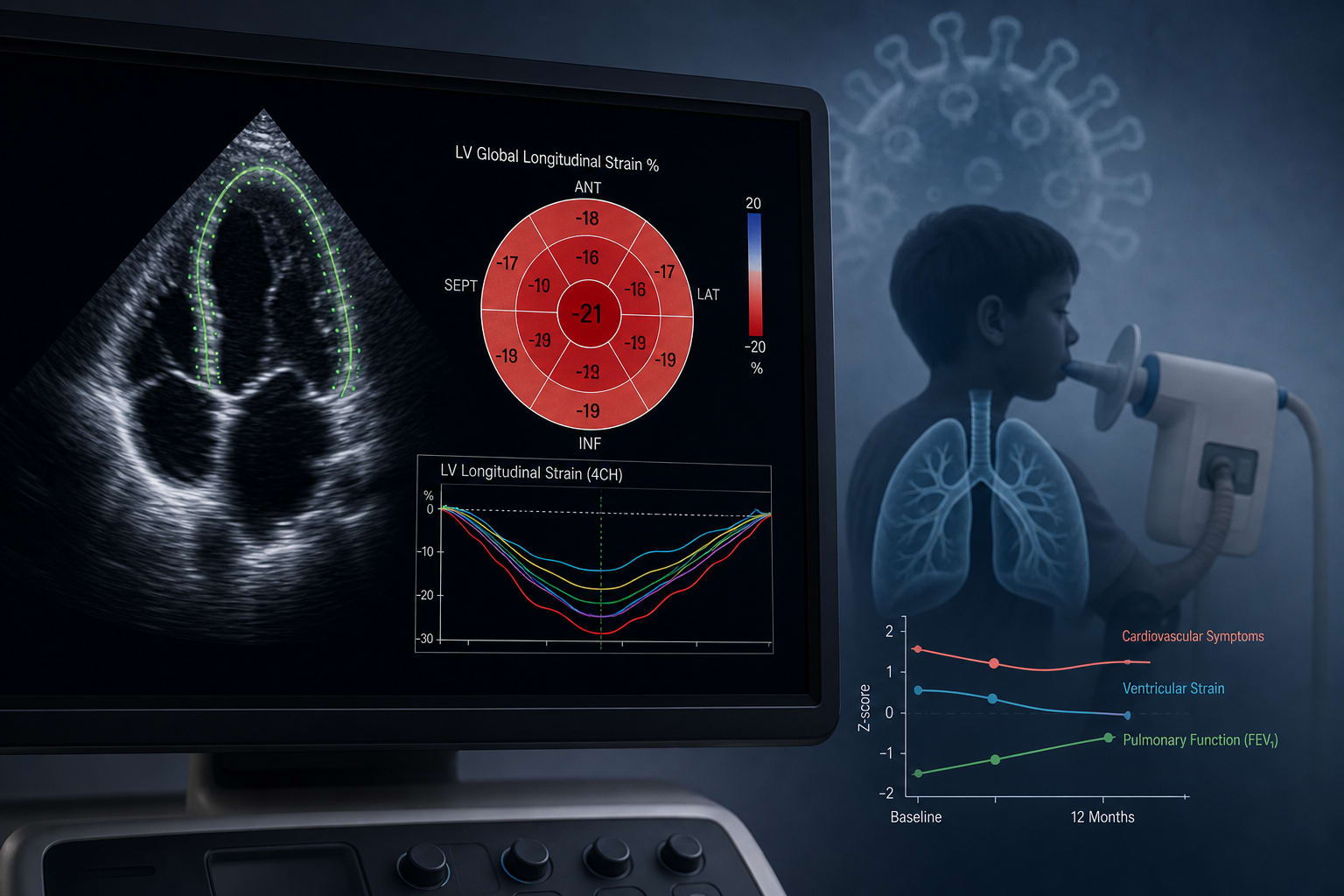
The Pediatric COVID-19 Outcomes Study was established to assess the long-term impact of COVID-19 in children. This analysis examined postinfectious cardiac function and its correlation with symptoms, along with associations between pulmonary function testing and right ventricular strain.
Data Highlights
Values below apply to participants with abnormal baseline measurements, available follow-up data, and improvement in the respective measure.
Measurement
Baseline
12-Month Follow-Up
FS (%)
25.7 ± 1.7
32.8 ± 1.1
Septal E/e′
10.2 ± 1.3
8.5 ± 1.7
Lateral E/e′
8.3 ± 1.3
6.7 ± 1.4
LV-GLS (%)
16.7 ± 2.7
−23.7 ± 3.5
RVFW-LS (%)
−18.9 ± 2.0
−26.1 ± 5.8
RVA4C-LS (%)
−17.1 ± 1.4
−22.3 ± 5.0
All reported improvements had P < .001.
Key Findings
Of 852 participants completing baseline visits, 830 were analyzed: 683 infected and 147 uninfected.
Among infected participants, 659 (96.6%) had mild COVID-19.
Cardiac function did not differ between infected and uninfected participants at baseline or 12 months.
Impaired function was rare. Several measures improved among participants with abnormal baseline values and available follow-up data.
Seventy-three initially uninfected participants crossed over after becoming infected. Most measured cardiac indices did not change significantly, although LV-GLS increased without considered clinical significance and one participant developed abnormal right ventricular strain measures.
Clinical Implications
Reported cardiac, constitutional, and respiratory symptoms were not associated with differences in left or right ventricular strain measures. Obstructive pulmonary function test results were associated with less negative right ventricular free-wall longitudinal strain at baseline and 12 months.
Conclusion
Cardiac dysfunction was rare, and cardiac function did not differ between infected and uninfected participants at baseline or 12 months. Ventricular strain measures also did not differ between infected participants with and without reported symptoms.
Related Resources & Content
Pediatric SARS-CoV-2 Long Term Outcomes Study
PECOS baseline cross-sectional analysis
Pediatric echocardiographic reference values
Pediatric ventricular strain reference values and Z-score equations
by Michael He, Thomas R. Burklow, Craig A. Sable, Stephanie R. Lacey, James E. Bost, Andrew J. Lipton, Anastassios C. Koumbourlis, Maggie E.S. Curry, Farokh Choodar, Malgorzata Lasota, Suhyoun Park, Mistir Dubale, Michael DiMaggio, Kevin B. Rubenstein, Karyl Barron, Gina A. Montealegre Sanchez, Roberta L. DeBiasi, Ashraf S. Harahsheh