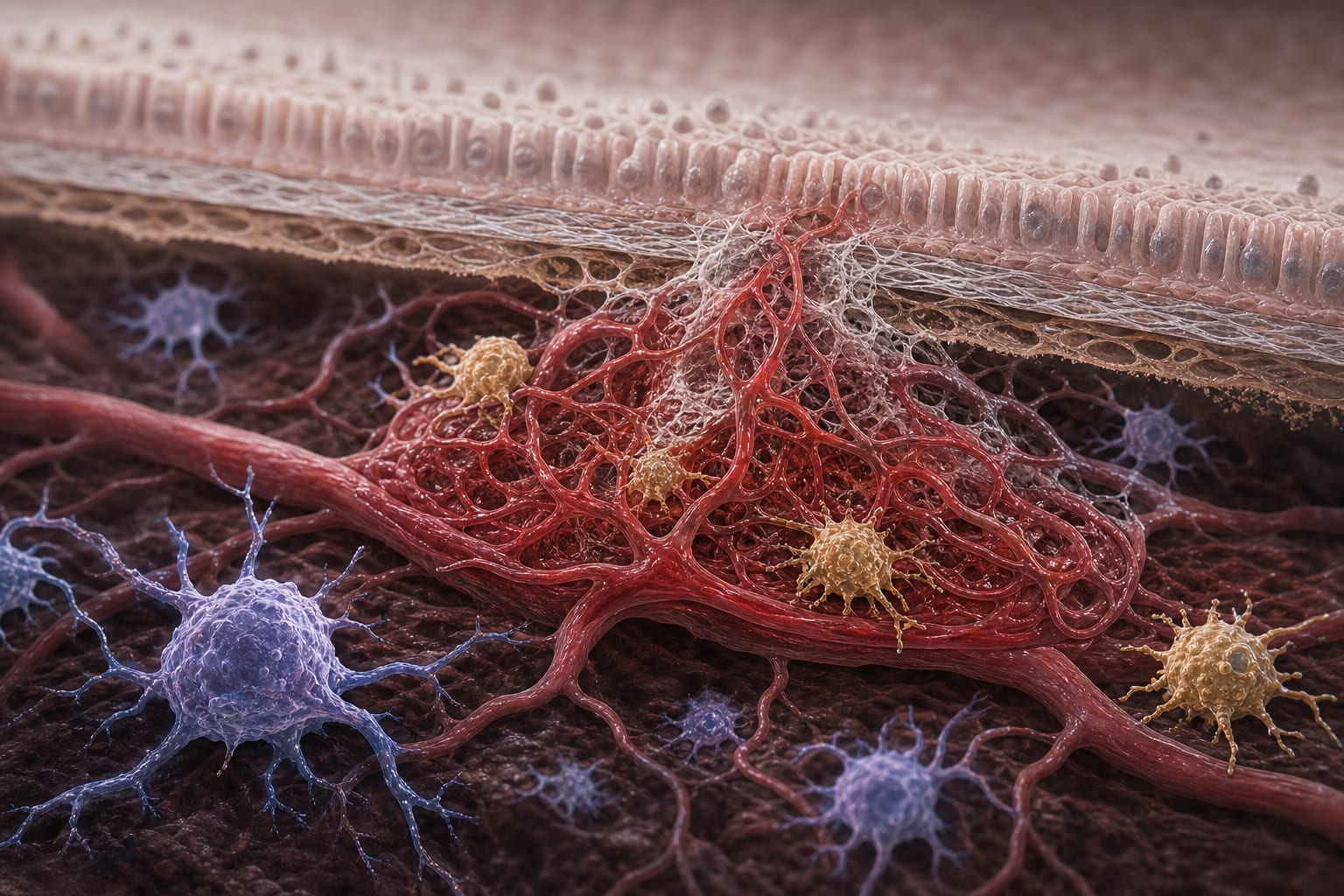
TGFβ Signaling in Endothelial Cells Influences Choroidal Neovascularization
Overview
This study investigates the role of endothelial TGFβ signaling in choroidal neovascularization (CNV) and its interaction with mononuclear phagocytes (MP). Loss of endothelial TGFβ signaling exacerbates CNV, but this effect can be rescued by MP depletion.
Background
Choroidal neovascularization (CNV) is a key feature of neovascular age-related macular degeneration (nAMD), leading to severe vision loss. The integrity of the blood-retinal barrier (BRB) is crucial for retinal health, and its disruption is implicated in the pathogenesis of CNV. Understanding the molecular mechanisms, including TGFβ signaling, that regulate CNV is important.
Data Highlights
No numerical data presented in the article.
Key Findings
Loss of endothelial TGFβ signaling significantly exacerbates CNV in a mouse model.
Depletion of mononuclear phagocytes (MP) fully rescues the exacerbated CNV due to TGFβ signaling loss.
Fibrinogen alpha chain (Fga) is identified as a MP-derived factor upregulated in the absence of endothelial TGFβ signaling.
Endothelial TGFβ signaling interacts with microglia to promote angiogenesis.
Microglia accumulation is observed at CNV lesions in mice lacking endothelial TGFβ signaling.
Clinical Implications
The findings indicate a relationship between TGFβ signaling pathways and CNV in nAMD.
Conclusion
This research highlights the role of endothelial TGFβ signaling in regulating CNV through interactions with mononuclear phagocytes.
by Anja Schlecht, Lisa Müllerbauer, Katja Fitz, Bianka Brunne, Nico Hofmann, Christian Müller, Jost Hillenkamp, Süleyman Ergün, Andreas Neueder, Barbara M. Braunger