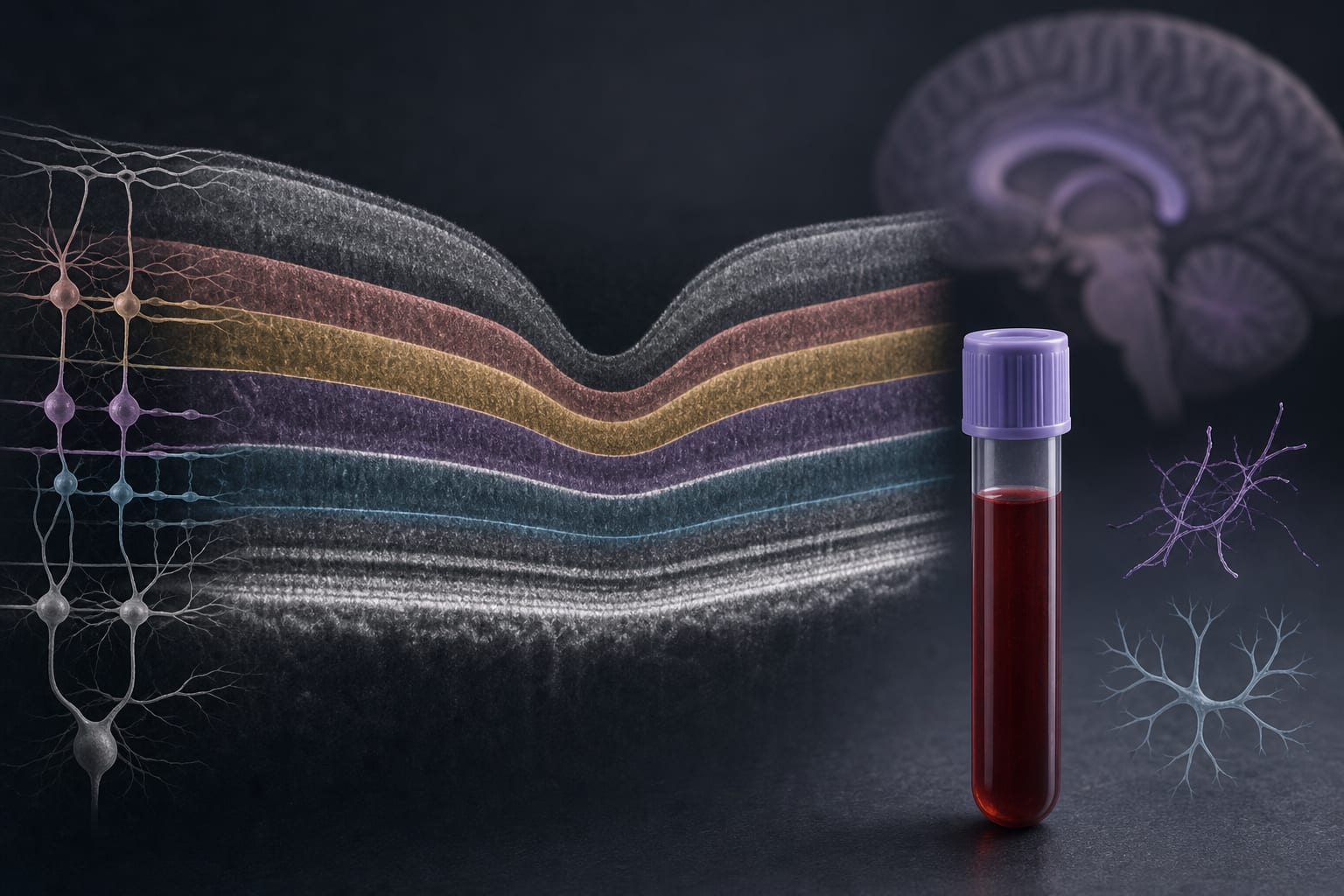
Clinical Report: Retinal Layer Thickness Correlates with Plasma Biomarkers
Overview
Revise to emphasize the implications of the findings in the context of existing research.
Background
Alzheimer's disease (AD) is a progressive neurodegenerative disorder that often remains asymptomatic for years, making early identification crucial for preventive strategies. Retinal imaging has emerged as a promising tool for detecting early changes associated with AD, potentially complementing existing plasma biomarkers. Understanding the relationship between retinal metrics and plasma biomarkers could enhance early risk assessment and monitoring of AD.
Data Highlights
No numerical data or trial data presented in the article.
Key Findings
Thinner INL and GCL are associated with higher levels of p-tau217 and GFAP.
Retinal imaging may provide insights into early neurodegenerative changes related to AD.
Current plasma biomarkers include Aβ42/40, p-tau217, p-tau181, NfL, and GFAP.
Longitudinal studies are needed to validate the preliminary findings of this pilot study.
Retinal OCT offers a noninvasive method for assessing retinal architecture in relation to AD biomarkers.
Clinical Implications
The findings suggest that retinal layer thickness measurements could serve as additional biomarkers for assessing Alzheimer's disease risk in cognitively normal individuals. Clinicians may consider incorporating retinal imaging alongside plasma biomarkers for a more comprehensive evaluation of AD risk.
Conclusion
This pilot study highlights the potential of retinal layer thickness as a correlate of plasma biomarkers in assessing Alzheimer's disease risk. Further research is necessary to confirm these findings and establish clinical applicability.
Routine dilated examinations identified peripheral retinal abnormalities across refractive groups, with higher pathology rates among patients with at least 3.00 D of myopia
In a UK Biobank cohort, thinner ganglion cell-inner plexiform layer and macular measurements were associated with incident depression over more than a decade of follow-up, while no independent association emerged for anxiety disorders.