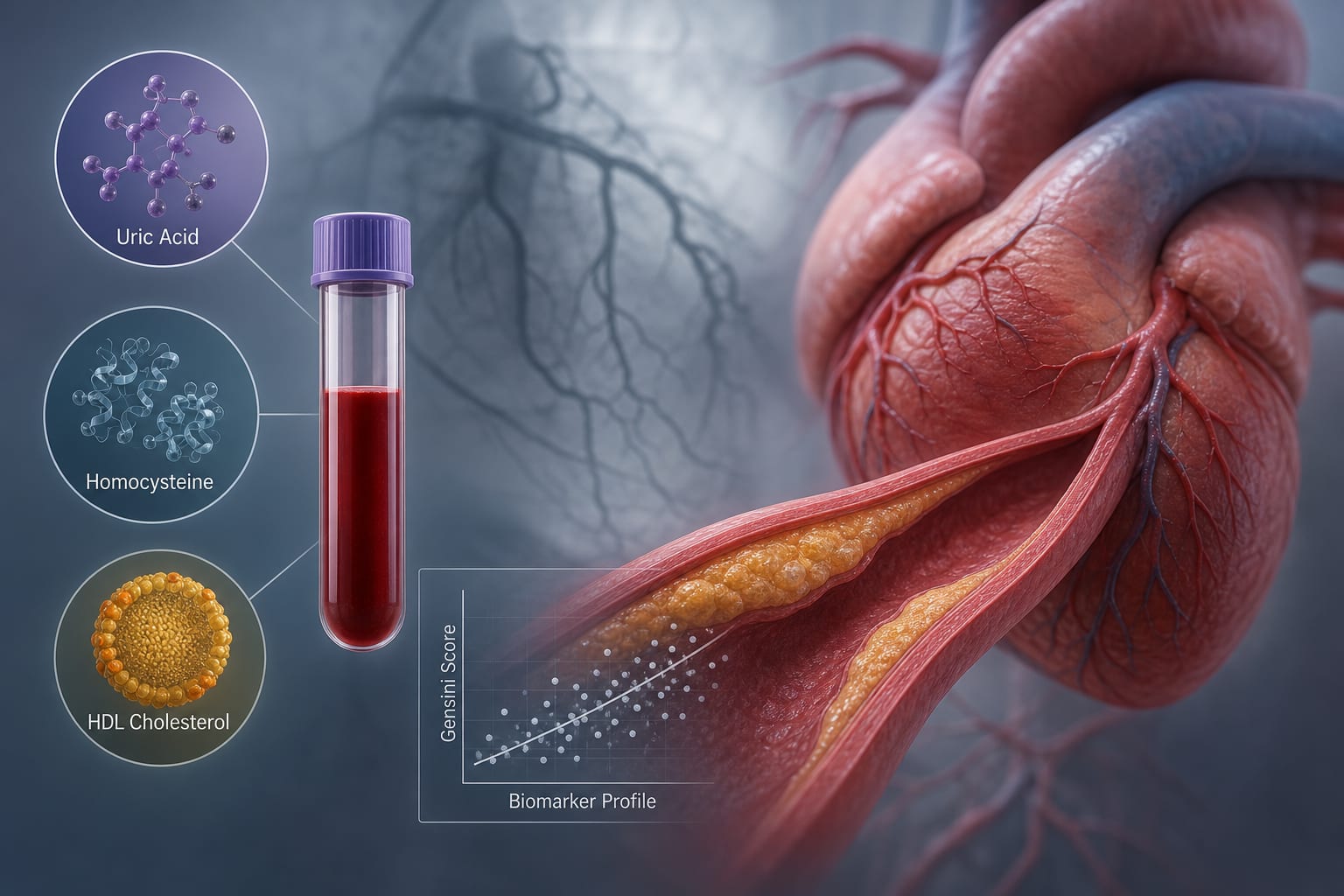
Links Between Uric Acid, HDL Cholesterol, Homocysteine Levels, and CAD
Overview
This study investigates the associations of homocysteine, HDL cholesterol, and uric acid with coronary heart disease (CHD) severity.
Background
Coronary heart disease (CHD) is a leading cause of morbidity and mortality worldwide, necessitating reliable biomarkers for early diagnosis and risk assessment. This study evaluates the predictive value of homocysteine, uric acid, and HDL cholesterol in assessing CHD severity.
Data Highlights
Biomarker
Correlation with Gensini Score
AUC
Homocysteine
r = 0.314
0.794
Uric Acid
r = 0.307
0.749
HDL Cholesterol
r = -0.324
0.767
Combined Model
-
0.803
Key Findings
Hcy, UA, and HDL-C levels were significantly altered in CHD patients compared to controls (p < 0.001).
Gensini scores positively correlated with Hcy and UA, and negatively with HDL-C (all p < 0.01).
Adding Hcy, UA, and HDL-C to clinical predictors increased explained variance of the Gensini score from 31% to 48% (p < 0.001).
The combined biomarker model achieved the highest discriminative performance (AUC = 0.803).
Reclassification metrics showed modest improvement with the combined model (NRI = 0.24, IDI = 0.065, ΔAUC = 0.084; all p < 0.01).
Clinical Implications
The findings suggest that measuring serum Hcy, UA, and HDL-C can enhance the assessment of CHD severity. These biomarkers may serve as additional tools for risk stratification in clinical practice.
Conclusion
Serum Hcy, UA, and HDL-C are significantly associated with CHD presence and severity.