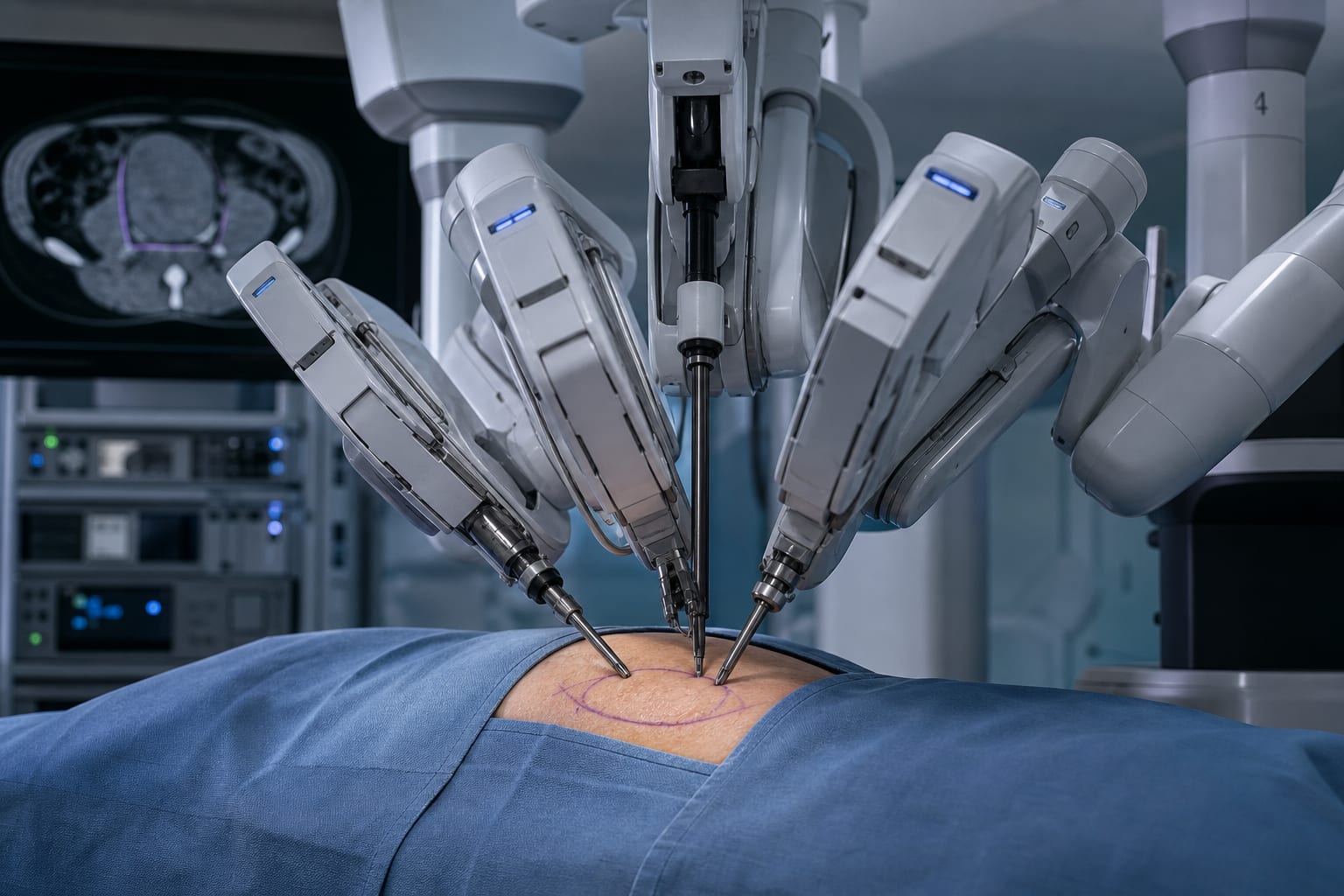
Clinical Report: Robotic-Assisted Minimally Invasive Resection of Tumors
Overview
This case series evaluates the feasibility and safety of robotic-assisted resection of abdominal wall tumors. All five patients achieved R0 resection with no complications, suggesting this approach is a viable minimally invasive option.
Background
Surgical management of abdominal wall tumors requires careful consideration of oncological resection and structural integrity. Traditional open surgery is associated with higher postoperative complications and longer recovery times. Robotic-assisted techniques may offer advantages in precision and recovery, warranting further investigation.
Data Highlights
Parameter
Value
Number of Patients
5
Mean Age
56.8 years
Mean BMI
21.8 kg/m²
Mean Operative Time
144 min
Mean Hospital Stay
3.4 days
R0 Resection Achieved
Yes
Complications
None
Key Findings
All patients achieved R0 resection with robotic-assisted techniques.
No intraoperative or postoperative complications were reported.
Four out of five patients underwent mesh-based reconstruction.
The mean operative time was 144 minutes.
The mean length of hospital stay was 3.4 days.
No hernia or tumor recurrence was observed during short-term follow-up.
Clinical Implications
Robotic-assisted resection of abdominal wall tumors is a safe and effective minimally invasive option. This technique may reduce recovery time and postoperative complications compared to traditional open surgery, making it a valuable addition to surgical practice.
Conclusion
Robotic-assisted resection of abdominal wall tumors confined to the musculofascial layer demonstrates promising short-term outcomes. Further studies with larger cohorts are needed to confirm these findings.
by Johannes Maria Alberto Toti, Ramon Pini, Sebastiano Spampatti, Lorenzo Bernardi, Barbara Kopf, Francesco Mongelli, Fabio Garofalo, Fabiano Iaquinandi, Davide La Regina