Covert macrovascular disease and early outcome after ischemic cerebrovascular events - Report - MDSpire

Covert macrovascular disease and early outcome after ischemic cerebrovascular events

  • By

  • Priyanka Boettger

  • Linda Vollmann

  • Jamschid Sedighi

  • Hassan Hassan

  • Heinz Frederik Noll

  • Pascal Bauer

  • Tobias Braun

  • Michael Buerke

  • Heidrun Kraemer-Best

  • Martin Juenemann

  • Omar Alhaj Omar

  • Samuel Sossalla

  • June 8, 2026

  • 0 min

Share

Clinical Report: Subclinical Macrovascular Pathology and Initial Outcomes Following Ischemic Stroke Events

Overview

This study investigates the prevalence and prognostic significance of covert macrovascular disease in patients with acute ischemic stroke. Findings suggest that subclinical macrovascular abnormalities are associated with increased stroke severity and poorer early functional outcomes.

Background

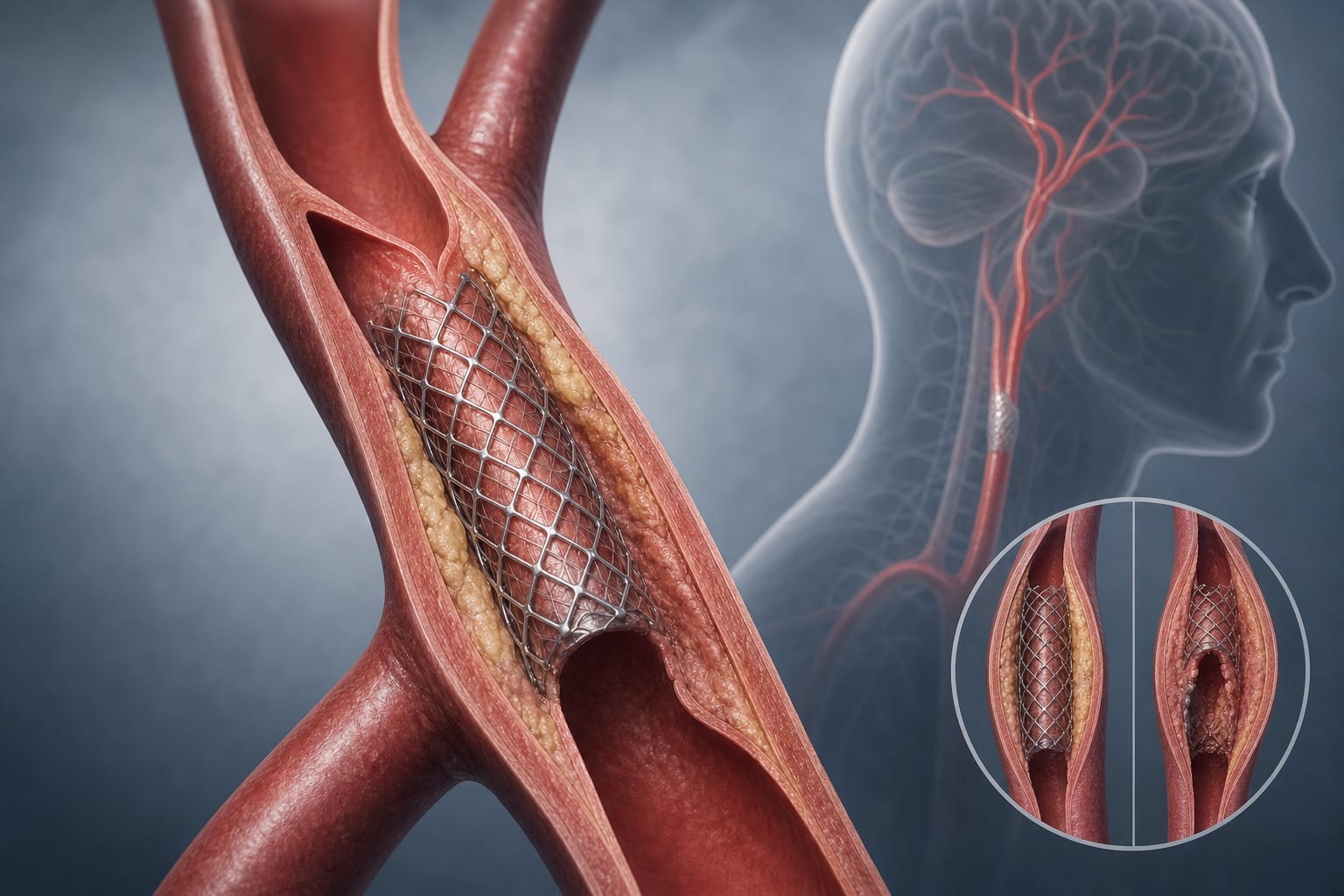
Understanding the role of macrovascular pathology in ischemic stroke is crucial as it extends beyond traditional microvascular disease. Covert macrovascular disease, including non-stenotic carotid plaques and aortic arch atheroma, may significantly influence cerebral perfusion and recovery. This study aims to refine prognostication and inform secondary prevention strategies by examining these subclinical conditions.

Data Highlights

No specific numerical data provided in the article.

Key Findings

  • Covert macrovascular disease may represent a marker of systemic vascular vulnerability.
  • Patients with covert macrovascular abnormalities exhibited increased stroke severity as measured by NIHSS.
  • Functional outcomes, assessed via the modified Rankin Scale, were poorer in patients with macrovascular pathology.
  • Subclinical macrovascular disease is frequently observed in embolic stroke of undetermined source (ESUS).
  • Metabolic factors like prediabetes and obesity may exacerbate the impact of macrovascular disease on stroke outcomes.

Clinical Implications

Clinicians should consider the presence of covert macrovascular disease in stroke patients as a potential indicator of worse outcomes. This understanding may guide more aggressive management of vascular risk factors and inform secondary prevention strategies.

Conclusion

The findings underscore the importance of recognizing covert macrovascular disease in ischemic stroke patients, as it may significantly affect clinical outcomes and management approaches.

Related Resources & Content

  1. Frontiers in Neurology, 2026 -- Impact of cerebral small vessel disease burden and systemic clinical phenotypes on short-term neurological outcomes after acute ischemic stroke
  2. Frontiers in Neurology, 2026 -- Risk factors for early neurological deterioration in patients with acute ischaemic stroke and assessment of short-term prognosis
  3. Frontiers in Neurology, 2026 -- Prognostic value of systemic inflammation response index in successfully recanalized acute large vessel occlusion stroke patients: a retrospective study
  4. Acta Neuropathologica, 2018 -- Inflammation Following Stroke: A Potential Therapeutic Target or a Beneficial Mechanism?
  5. 2024 Guideline for the Primary Prevention of Stroke - Professional Heart Daily | American Heart Association
  6. Medical Management and Revascularization for Asymptomatic Carotid Stenosis - PubMed
  7. Latest Articles | Stroke
  8. 2024 Guideline for the Primary Prevention of Stroke - Professional Heart Daily | American Heart Association
  9. Medical Management and Revascularization for Asymptomatic Carotid Stenosis - PubMed
  10. Latest Articles | Stroke

Original Source(s)

Related Content