A risk-scoring model for predicting late postoperative hemorrhage following pancreatoduodenectomy: development and external validation - Report - MDSpire
Advertisement
A risk-scoring model for predicting late postoperative hemorrhage following pancreatoduodenectomy: development and external validation
Clinical Report: Development and External Validation of a Risk Assessment Tool for Late Postoperative Hemorrhage After Pancreatoduodenectomy
Overview
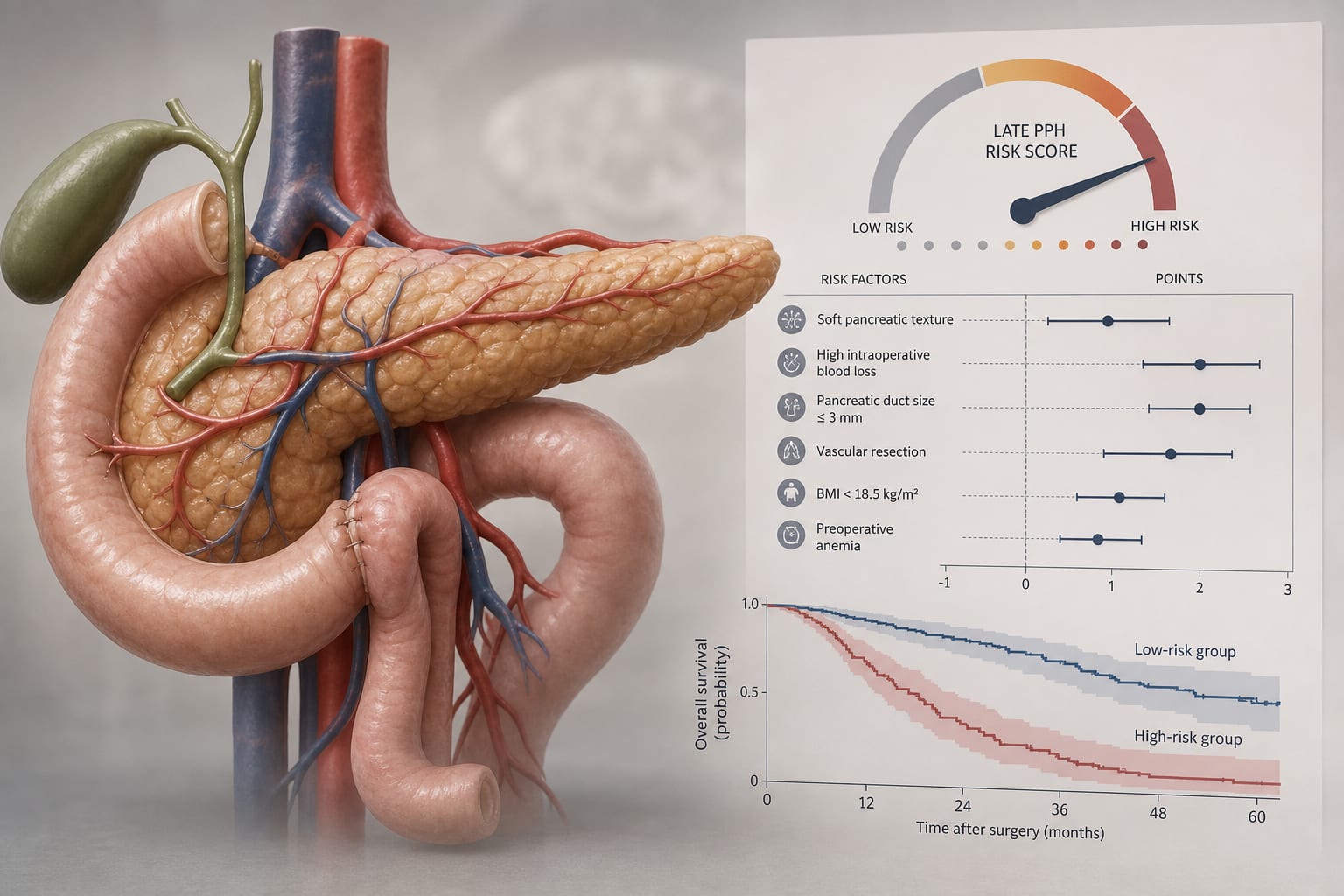
This study developed and validated a risk-scoring model to predict late post-pancreatectomy hemorrhage (PPH) after pancreatoduodenectomy (PD). The model incorporates four independent risk factors.
Background
Late PPH is a serious complication following PD, significantly impacting patient survival. Understanding and predicting the risk of late PPH is crucial for improving postoperative outcomes. Current models often lack external validation and clinical applicability.
Data Highlights
Cohort
Late PPH Rate
Median Survival (months)
Training
7.7%
20.7
Validation
7.6%
35.2
Key Findings
Late PPH occurred in 7.7% of the training cohort and 7.6% of the validation cohort.
Median survival for patients with late PPH was 20.7 months compared to 35.2 months for those without (P = 0.009).
The common hepatic artery was the most frequent site of hemorrhage, accounting for 22.6% of cases.
Independent risk factors for late PPH included BMI, preoperative total bilirubin, preoperative prothrombin time, and clinically relevant postoperative pancreatic fistula.
The predictive model achieved concordance indices of 0.863 in the training cohort and 0.825 in the validation cohort.
Clinical Implications
The developed risk-scoring model allows clinicians to stratify patients into low- and high-risk groups for late PPH, facilitating targeted monitoring and preventive strategies. Utilizing routine clinical variables enhances the model's applicability in everyday practice.
Conclusion
The study created and validated a risk-scoring model for late PPH after PD.