Clinical Report: Endoscopic Sub-Platysmal Release Technique for CMT
Overview
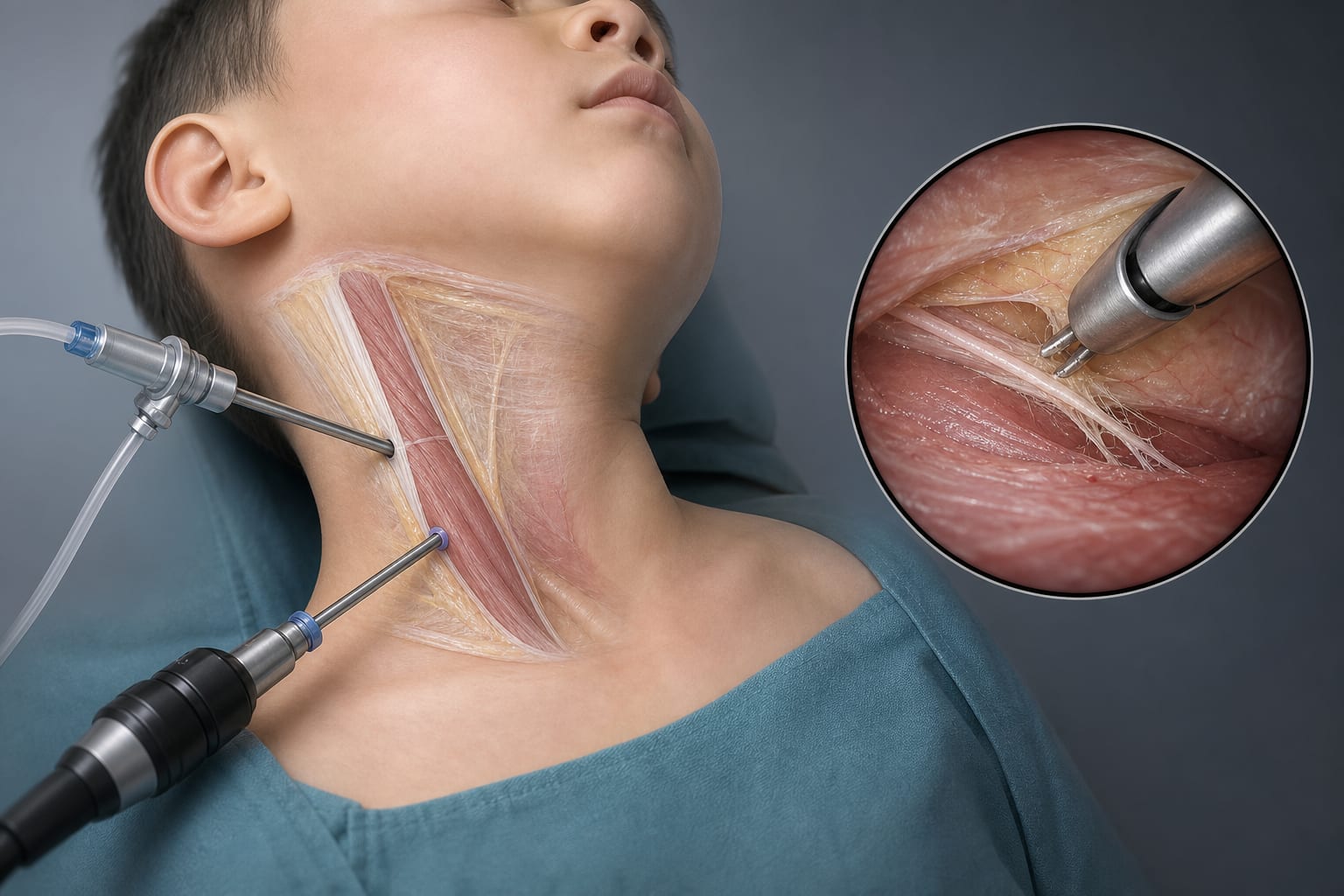
This study evaluates the endoscopic sub-platysmal release technique for congenital muscular torticollis (CMT) in pediatric patients, demonstrating significant improvements in neck rotation and lateral bending deficiencies. With a high success rate and minimal complications, this technique offers a promising alternative to traditional surgical methods.
Background
Congenital muscular torticollis (CMT) is a prevalent condition in infants that can lead to long-term functional and cosmetic issues if untreated. Traditional surgical interventions often result in visible scarring, which can be a source of dissatisfaction for families. The development of minimally invasive techniques, such as the endoscopic sub-platysmal release, addresses these concerns while aiming to improve clinical outcomes.
Data Highlights
Outcome Measure
Preoperative
Postoperative
P-value
Neck Rotation Deficiency (°)
26.5 (IQR, 23.1°−29.4°)
3.0 (IQR, 2.5°−4.1°)
< 0.001
Lateral Bending Deficiency (°)
18.2 (IQR, 15.8°−20.5°)
2.5 (IQR, 2.0°−3.3°)
< 0.001
Key Findings
A total of 44 pediatric patients underwent the endoscopic sub-platysmal release technique.
Mean operative time was 35.2 ± 6.4 minutes with minimal blood loss (4.5 ± 1.2 mL).
95.4% of patients achieved excellent or good outcomes according to the Cheng and Tang scoring system.
Significant improvements in neck rotation and lateral bending deficiencies were observed postoperatively (P < 0.001).
No intraoperative or postoperative complications were reported.
Clinical Implications
The endoscopic sub-platysmal release technique for CMT is a safe and effective option for pediatric patients, providing significant functional improvements with minimal invasiveness. This approach should be considered for children who do not respond to conservative treatments, particularly when cosmetic outcomes are a concern.
Conclusion
The endoscopic sub-platysmal release technique represents a valuable advancement in the surgical management of congenital muscular torticollis, combining efficacy with a favorable safety profile.