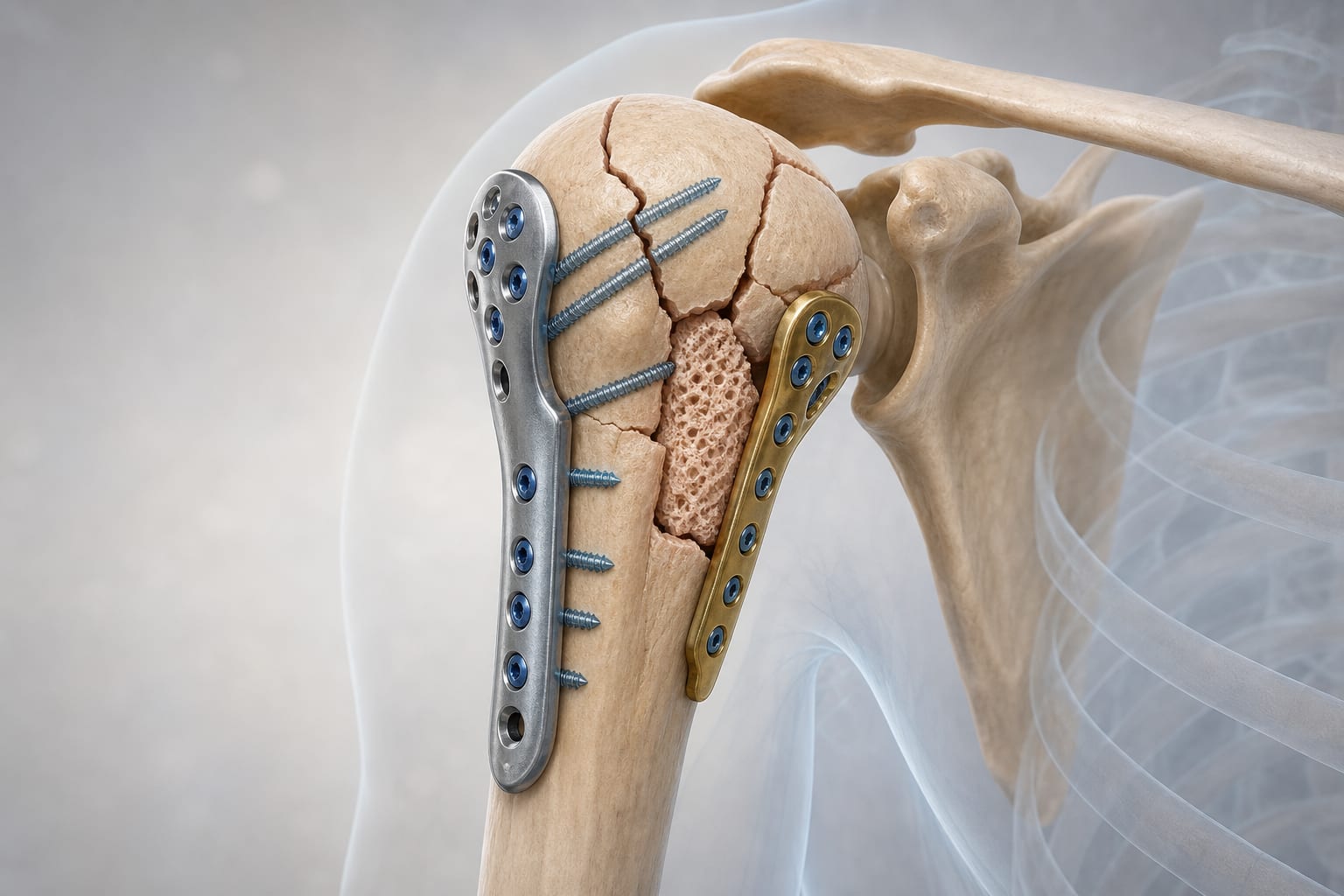
Comparison of Three Reconstruction Techniques for Medial Column Support Loss in Elderly Patients with Proximal Humeral Fractures
-
By
-
Jianchuan, Wang
-
April 7, 2026
-
0 min
Clinical Report: Evaluation of Three Surgical Approaches for Proximal Humeral Fractures
Overview
This study evaluates three surgical methods for medial column support deficiency in elderly patients with proximal humeral fractures. The findings indicate that all methods effectively restore stability, with the dual plating approach showing superior results in terms of specific outcomes such as complication rates and functional scores.
Background
Proximal humeral fractures are common in the elderly, often leading to significant functional impairment. The integrity of the medial column is crucial for successful surgical outcomes, as its deficiency can complicate fracture management. Understanding the effectiveness of various surgical techniques is essential for optimizing treatment strategies in this vulnerable population.
Data Highlights
| Group | Complications | Follow-up Duration (months) |
|---|---|---|
| Double Plate | 1 | 16.8 ± 2.6 |
| Bone Graft | 2 | 16.8 ± 2.6 |
| Steel Plate | 3 | 16.8 ± 2.6 |
Key Findings
- All three surgical approaches effectively restored medial column stability.
- No significant differences in pain scores (VAS), ASES, DASH, or Constant Murley scores among groups, with p-values indicating statistical significance.
- Complications were reported as 1, 2, and 3 in the double plate, bone graft, and steel plate groups, respectively, with no significant differences noted.
- Mean age of participants was 62.4 years, with a gender distribution of 16 males and 35 females.
- Follow-up duration ranged from 12 to 26 months, with a mean of 16.8 months.
Clinical Implications
Surgeons should consider the dual plating technique for geriatric patients with proximal humeral fractures and medial column support deficiency, as it may yield better outcomes. However, potential risks and patient-specific factors should also be assessed. Continuous assessment of shoulder function and complication rates is essential for optimizing patient care.
Conclusion
The study concludes that while all surgical methods are effective, the dual plating approach may offer superior stability restoration in elderly patients with proximal humeral fractures, emphasizing the need for individualized treatment plans.
Related Resources & Content
- Court-Brown, C. M., Caesar, B., Archives of Orthopaedic and Trauma Surgery, 2020 -- Outcomes of Open Reduction and Internal Fixation for Distal Humerus Fractures in Patients Aged 70 and Older
- Archives of Orthopaedic and Trauma Surgery, 2025 -- Intraoperative evaluation of rotational alignment in minimally invasive plate osteosynthesis for humeral shaft fractures using combined fluoroscopic and endoscopic assistance: surgical technique, clinical outcomes, and literature review
- Archives of Orthopaedic and Trauma Surgery, 2024 -- Long-term functional outcomes of proximal humerus fractures treated with intramedullary nailing are comparable to those of non-operative management.
- Impact of Cement Augmentation on Radiological Outcomes in Angular Stable Plating for Proximal Humerus Fractures: A Retrospective Study
- Overview | Fractures (non-complex): assessment and management | Guidance | NICE
- Surgery with locking plate or hemiarthroplasty versus nonoperative treatment of 3–4-part proximal humerus fractures in older patients (NITEP): An open-label randomized trial
- NICE Guidance on Fractures
- PLOS Medicine on Humerus Fractures
- Calcar Screw Position in Proximal Humerus Fracture Fixation: Don't Miss High | Orthopaedic Trauma Association (OTA)
This content is an AI-generated, fully rewritten summary based on a published scholarly article. It does not reproduce the original text and is not a substitute for the original publication. Readers are encouraged to consult the source for full context, data, and methodology.