Robotic-Assisted Extended Sistrunk Approach (RESA) for Salvage Surgery After Head and Neck Irradiation - Report - MDSpire

Robotic-Assisted Extended Sistrunk Technique for Salvage Surgery Following Head and Neck Radiation Therapy

  • By

  • Bartosz Wojtera

  • Avinash Beharry

  • Karma Lambercy

  • Pascaline Dübi

  • Jelena Todic

  • Christian Simon

  • June 5, 2026

Share

Clinical Report: Robotic-Assisted Extended Sistrunk Technique for Salvage Surgery

Overview

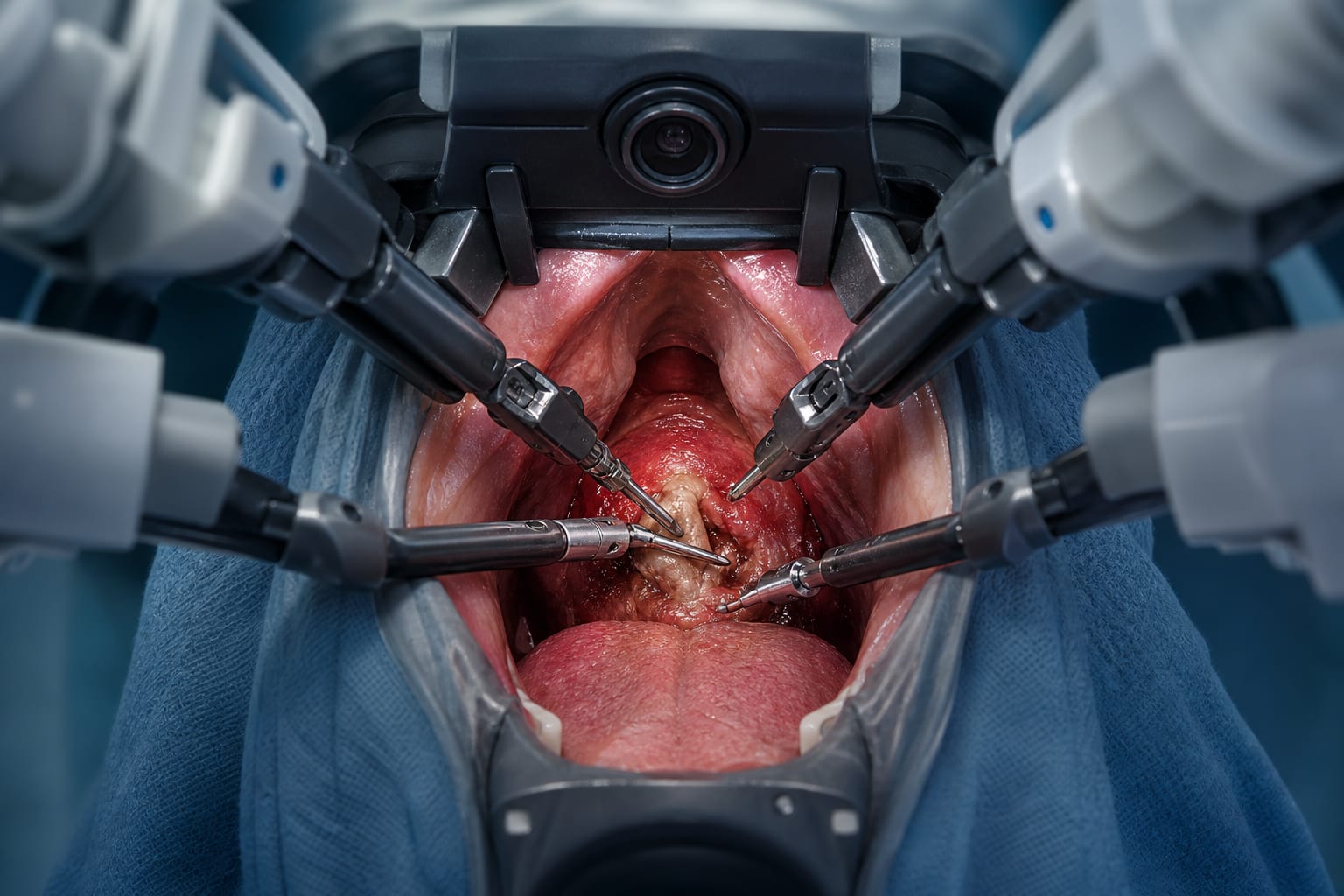
The robotic-assisted extended Sistrunk approach (RESA) provides a minimally invasive surgical option for patients with head and neck tumors previously treated with radiotherapy. This technique allows for enhanced visualization and precise dissection.

Background

Minimally invasive surgery has significantly improved the management of upper aerodigestive tract malignancies, particularly through transoral robotic surgery (TORS). However, access limitations often exclude patients with tumors located inferior to the tongue base and hyoid bone. The RESA technique provides direct access through a submental incision.

Data Highlights

No numerical data or trial results were provided in the source material.

Key Findings

  • RESA provides direct access to hypopharyngeal and laryngeal structures.
  • The technique allows for controlled en bloc resection.
  • All patients in the case series had previously undergone radiotherapy to the head and neck region.

Clinical Implications

RESA may offer an alternative for patients with head and neck tumors who have previously undergone radiotherapy.

Conclusion

The RESA technique represents an advancement in minimally invasive surgery for head and neck cancer.

Related Resources & Content

  1. Head and Neck — Submental Approach Robotic-Assisted Neck Dissection (SARAND) for Minimally Invasive Bilateral Neck Dissection: A Feasibility Cadaver Dissection Study
  2. Techniques in Coloproctology — Robotic-Assisted Resection of Rectal Cancer Utilizing a Comprehensive Intracorporeal Double-Stapling Approach
  3. Journal of Neuro-Oncology — Visual outcome after fractionated stereotactic radiation therapy of benign anterior skull base tumors
  4. Transoral Robotic Surgery in the Multidisciplinary Care of Patients With Oropharyngeal Squamous Cell Carcinoma: ASCO Guideline - PubMed
  5. Journal of Neuro-Oncology — Combining Intraoperative Radiotherapy with Spinal Stabilization Surgery: A New Approach for Treating Spinal Metastases Based on Initial Single-Center Findings
  6. NCCN Head and Neck Cancers guideline
  7. NICE NG36 Recommendations
  8. Transoral Robotic Surgery in the Multidisciplinary Care of Patients With Oropharyngeal Squamous Cell Carcinoma: ASCO Guideline - PubMed
  9. Long-Term Follow-Up of E3311, an ECOG-ACRIN Cancer Research Group Phase II Trial of Transoral Surgery and Risk-Based Adjuvant Treatment in Human Papillomavirus–Initiated Oropharynx Cancer | Journal of Clinical Oncology
  10. Radiation vs. trans-oral surgery for treatment de-escalation in HPV-related oropharyngeal cancers: Primary analysis of the ORATOR2 randomized trial - PubMed
  11. Long-Term Results of a Phase 2 Clinical Trial of Radiation Volume and Dose Deintensification Following Transoral Robotic Surgery and Neck Dissection for Human Papillomavirus–Associated Oropharyngeal Squamous Cell Carcinoma - ScienceDirect
  12. Transoral Robotic Surgery (TORS) Versus Open Surgery for Recurrent Oropharyngeal Squamous Cell Carcinoma: A Systematic Review and Meta‐Analysis - Laxague - 2026 - Head & Neck - Wiley Online Library
  13. Transoral robotic surgery in head and neck cancer: an umbrella review of meta-analyses - PubMed
  14. A Meta-analysis of Functional Outcomes and Recovery Metrics Comparing Transoral Robotic Surgery and (Chemo)Radiotherapy - PubMed
  15. Salvage Transoral Robotic Surgery With Submental Flap Reconstruction: Functional and Oncologic Outcomes - PubMed
  16. The robotic‐assisted extended “Sistrunk” approach for tumors of the upper aerodigestive tract with limited transoral access: First description of oncological and functional outcomes - PMC

Original Source(s)

Related Content