Melan-Dx: Enhanced AI Framework for Differential Diagnosis of Melanocytic Neoplasms
Overview
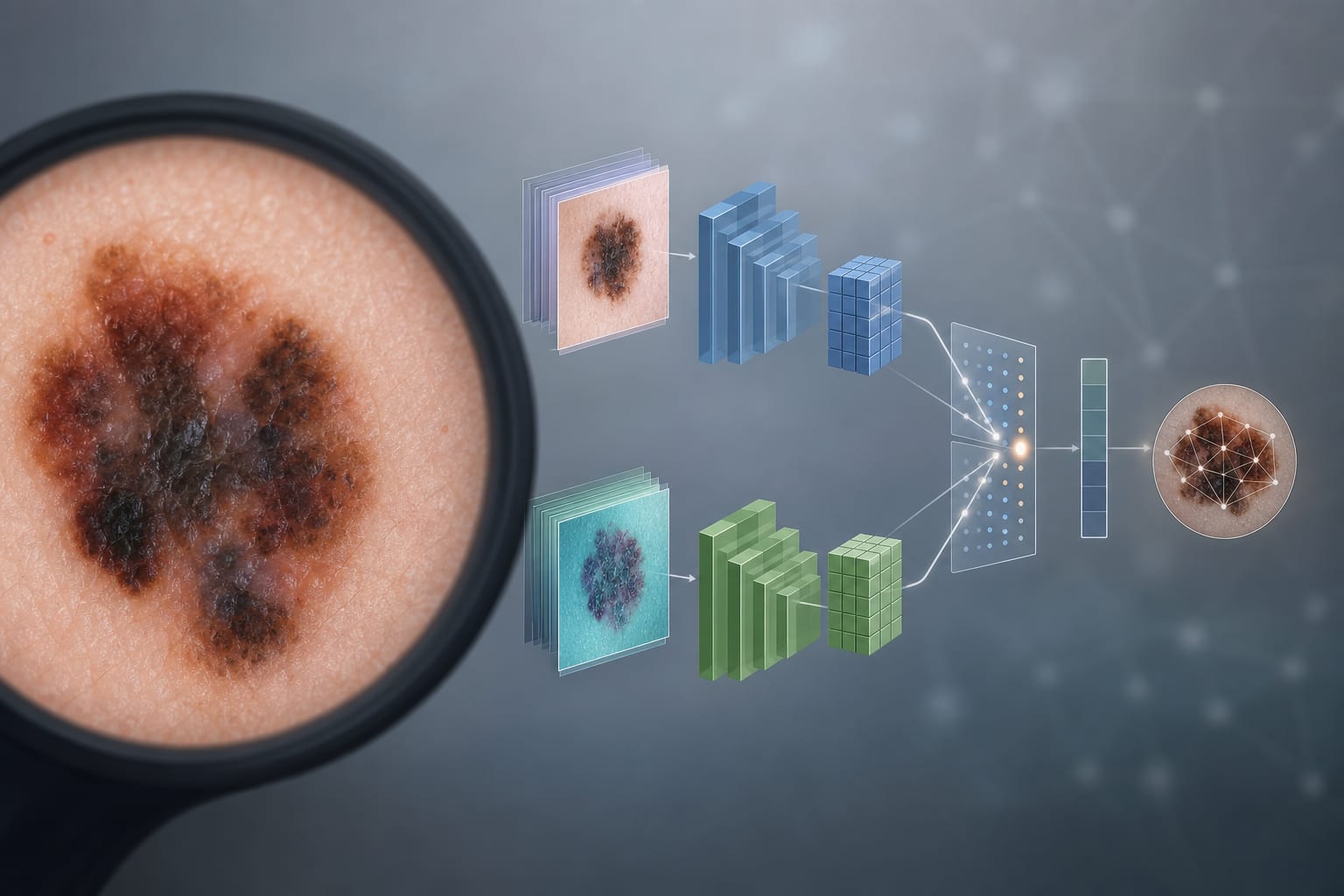
Melan-Dx is a novel knowledge-enhanced vision-language AI framework developed to improve the differential diagnosis of over forty melanocytic neoplasm subtypes. Utilizing a curated multi-modal dataset from expert dermatopathologists, Melan-Dx significantly outperforms existing models in accuracy and classification metrics at both patch and whole-slide levels.
Background
Melanoma ranks among the top five cancers and is the leading cause of death from skin cancers, often complicated by frequent misdiagnoses. Accurate differentiation among numerous melanocytic neoplasm histologic subtypes remains challenging for current pathology image models. Diagnostic errors contribute to poor prognosis and overdiagnosis concerns in melanoma management. Advances in AI offer potential to enhance diagnostic precision by integrating expert knowledge with image analysis.
Data Highlights
Metric
Performance
Binary Classification Accuracy
0.869
Top-1 Accuracy (40-class)
0.699
ROC AUC (Few-shot WSI)
0.915
AUPRC (Fully Supervised WSI)
0.925
Improvement over Linear/Finetuned Methods
Up to 13.8%
Improvement over Zero-shot Approaches
23–70.6%
Improvement in Whole Slide Image Classification
Up to 8.4%
Key Findings
Melan-Dx leverages a curated dataset of 2893 images and 1102 knowledge entries annotated by expert dermatopathologists.
The framework integrates vision and knowledge retrieval to enhance frozen pathology vision-language models without fine-tuning the vision backbone.
Achieves 0.869 accuracy in binary classification and 0.699 Top-1 accuracy across 40 melanocytic neoplasm classes.
Demonstrates superior performance in few-shot and fully supervised whole-slide image classification tasks with ROC AUC of 0.915 and AUPRC of 0.925 respectively.
Outperforms existing linear, fully finetuned, and zero-shot models by margins up to 13.8%, 8.4%, and 70.6% respectively.
The publicly available code and embeddings facilitate reproducibility and further research.
Clinical Implications
Melan-Dx offers a promising tool to reduce diagnostic errors and improve accuracy in differentiating melanocytic neoplasms, potentially leading to better patient outcomes. Its ability to enhance existing pathology models without extensive retraining may accelerate clinical adoption. Integration of expert knowledge with AI image analysis supports more reliable and interpretable diagnostic decision-making in dermatopathology.
Conclusion
Melan-Dx represents a significant advancement in AI-assisted dermatopathology by combining curated expert knowledge with vision-language modeling to improve differential diagnosis of melanocytic neoplasms. This approach may help address current challenges in melanoma diagnosis and reduce misclassification rates.
A foundation artificial intelligence model surpassed less experienced physicians but did not outperform expert dermatologists in multiclass skin lesion diagnosis.