Early postoperative voice-change phenotypes after thyroid surgery: a prospective cohort study - Report - MDSpire

Early postoperative voice-change phenotypes after thyroid surgery: a prospective cohort study

  • By

  • Heyang Jiao

  • Yingying Wang

  • Shijie Li

  • Peiyao Wang

  • Jiedong Kou

  • Yuqing Gao

  • Yishen Zhao

  • Hui Sun

  • June 15, 2026

  • 0 min

Share

Clinical Report: Characterization of Early Voice Change Patterns Following Thyroid Surgery

Overview

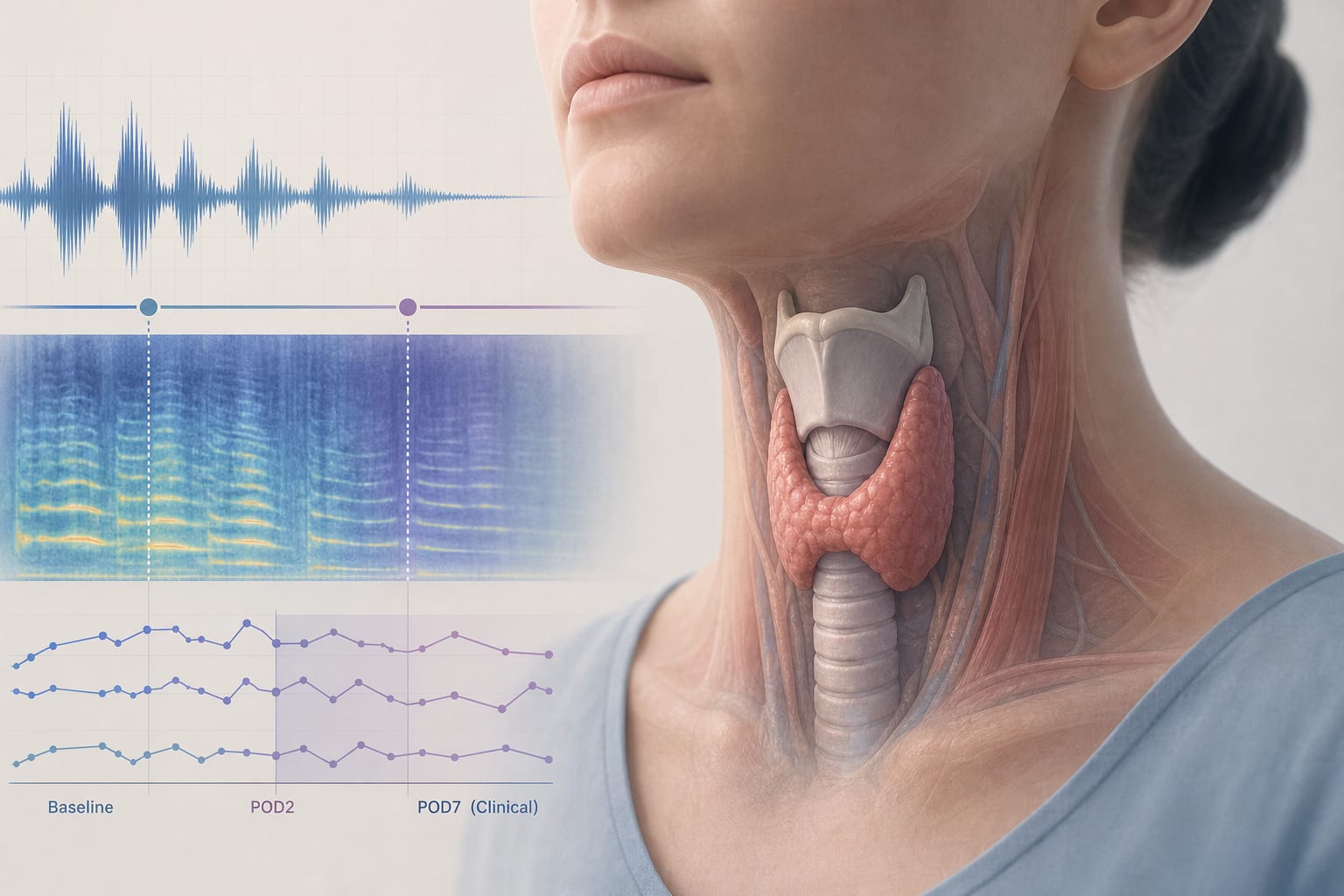
This study identifies early postoperative voice change patterns following thyroid surgery, highlighting significant differences in voice outcomes among distinct phenotypes. The findings suggest that these phenotypes are clinically relevant and can inform postoperative management.

Background

Post-thyroidectomy voice changes are common and can significantly impact patient quality of life. Understanding the early patterns of voice change is crucial for timely interventions and improving patient outcomes. This study provides insights into the short-term clinical relevance of these changes, which are often overlooked.

Data Highlights

PhenotypeVHI-30 Responder RateGrade Change
A1.7% (1/59)Low
B53.6% (30/56)High
C1.5% (2/130)Low

Key Findings

  • 245 patients were included in the final analysis from an initial cohort of 401.
  • Three distinct voice change phenotypes were identified: A (59 patients), B (56 patients), and C (130 patients).
  • All five spectral clustering features differed significantly across phenotypes (P < 0.001).
  • Phenotype B exhibited the highest short-term burden with a responder rate of 53.6%.
  • Significant differences in VHI-30 change and Grade change were observed among phenotypes (all P < 0.001).
  • Exploratory analyses indicated that phenotype B's clinical profile was not solely explained by surgical factors.

Clinical Implications

The identification of distinct voice change phenotypes can guide clinicians in monitoring and managing postoperative voice outcomes. Early recognition of patients at higher risk for voice changes may facilitate timely interventions, such as voice therapy or further evaluation.

Conclusion

This study underscores the importance of characterizing early postoperative voice changes as clinically interpretable patterns, which can enhance patient care and inform future research on voice outcomes after thyroid surgery.

Related Resources & Content

  1. Papadakis et al., 2020 -- Evaluation of Perceptual and Acoustic Voice Metrics as Initial Screening for Vocal Fold Paresis Following Thyroid or Parathyroid Procedures
  2. 2025 American Thyroid Association Management Guidelines for Adult Patients with Differentiated Thyroid Cancer
  3. Intraoperative Nerve Monitoring in Thyroid Surgery: A Comprehensive Review of Technical Principles, Anesthetic Considerations, and Clinical Applications
  4. Conformal Thyroidectomy as a Viable Approach for Papillary Thyroid Microcarcinoma: A Retrospective Cohort Analysis with a Decade of Follow-Up Data
  5. Impact of Surgical Techniques and Surgeons' Experience on Vocal Recovery After Reconstructive Surgery of the Recurrent Laryngeal Nerve
  6. Surgeon-administered transcutaneous laryngeal ultrasound for evaluating vocal cord function post-total thyroidectomy: a prospective investigation
  7. 2025 American Thyroid Association Management Guidelines
  8. Intraoperative Nerve Monitoring in Thyroid Surgery
  9. Analysis of Voice Quality After Thyroid Surgery - ScienceDirect

Original Source(s)

Related Content