Conexiant’s news site is now MDSpire News. Learn more
Advertisement
The Relationship Between Pulse Pressure and the Advancement of Cardiometabolic Diseases: Links to New Multimorbidity and Mortality in the UK Biobank Study
Clinical Report: The Relationship Between Pulse Pressure and Cardiometabolic Diseases
Overview
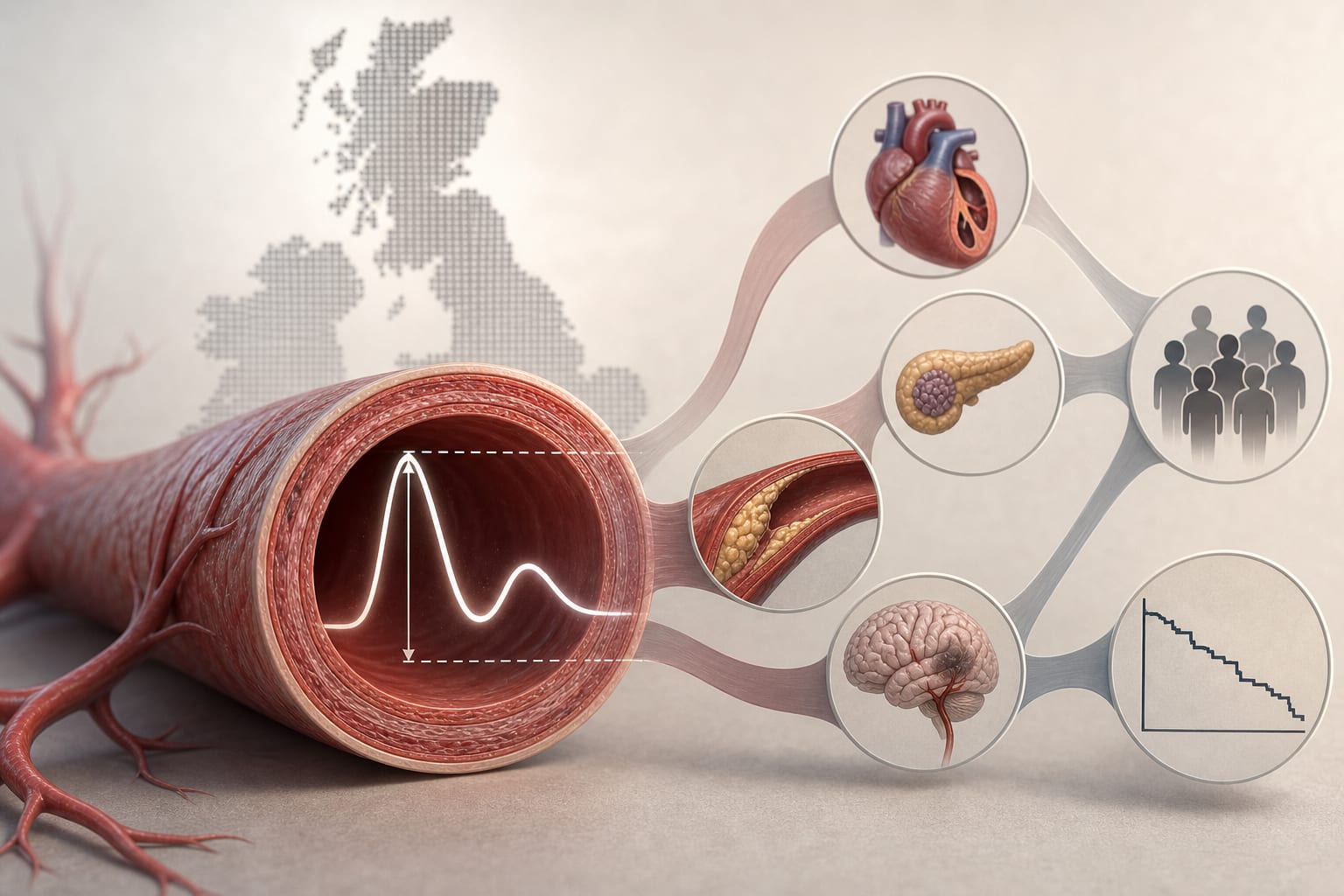
This study investigates the association between pulse pressure (PP) and the progression of cardiometabolic diseases (CMDs) and multimorbidity (CMM) using data from the UK Biobank.
Background
Cardiometabolic diseases (CMDs) are prevalent and contribute significantly to global health burdens. Understanding the risk factors for cardiometabolic multimorbidity (CMM) is crucial for improving patient outcomes and healthcare management. Pulse pressure (PP) serves as an important indicator of cardiovascular health.
Data Highlights
Outcome
Hazard Ratio (HR)
95% Confidence Interval (CI)
Transition from health to CMD
1.13
1.12–1.14
Transition to CMM
1.18
1.15–1.21
PP-CMM association in stroke patients
1.23
1.11–1.36
Key Findings
Per 1-SD increase in PP, there is a significant association with transitions from health to CMD (HR = 1.13).
Per 1-SD increase in PP, the risk of progressing to CMM is increased (HR = 1.18).
Individuals in the highest quartile of PP (Q4) have a 36% higher risk of CMD and CMM compared to those in the lowest quartile (Q1).
The PP-CMM association is strongest in patients with stroke (HR = 1.23).
Threshold effects for CMD, mortality, and CMM development were identified at 40 mmHg, 42 mmHg, and 52 mmHg, respectively.
Subgroup analyses indicate stronger associations in participants aged < 60 years, women, and those with a BMI of 18.5 ≤ 25 kg/m2.
Clinical Implications
Healthcare professionals should consider pulse pressure as a risk marker for the progression of cardiometabolic diseases and multimorbidity.
Conclusion
This study demonstrates an association between elevated pulse pressure and risks of cardiometabolic disease progression and all-cause mortality.