Implementing High-Sensitivity Cardiac Troponin Testing Pathways
-
By
-
James S. Ford
-
William B. Stubblefield
-
Jesse O. Wrenn
-
November 10, 2026
Clinical Report: Implementing High-Sensitivity Cardiac Troponin Testing Pathways
Overview
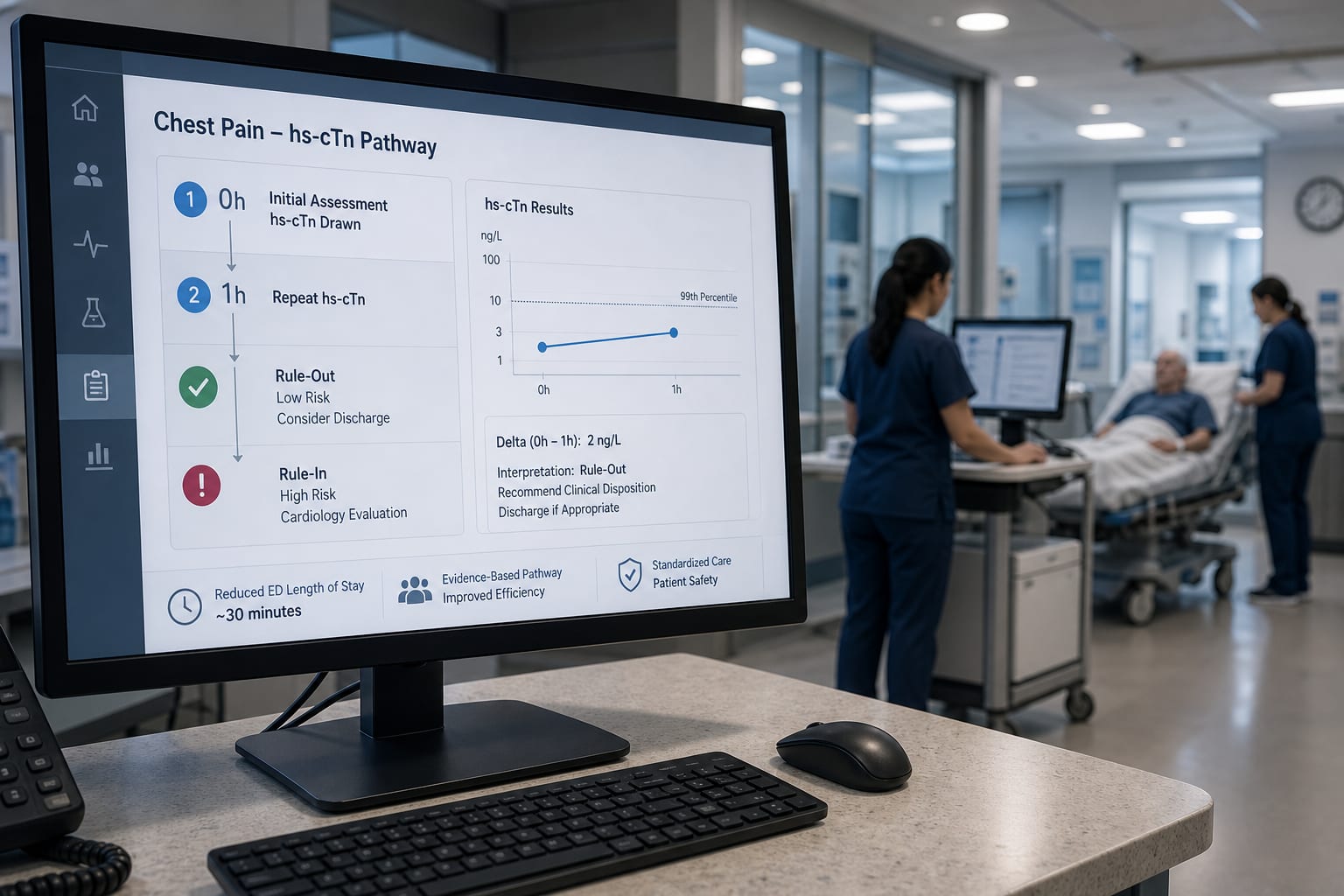
Implementation of an electronic health record–integrated high-sensitivity cardiac troponin (hs-cTn) pathway across four urban emergency departments was associated with an approximately 30-minute reduction in emergency department length of stay among patients with chest pain who underwent troponin testing, with the largest reductions among those requiring serial testing. The source emphasizes that workflow design may contribute to operational effects, while increased serial testing and 30-day acute myocardial infarction diagnoses require assessment alongside downstream interventions and patient-centered outcomes.
Background
Cardiac troponin testing is central to the assessment of acute coronary syndrome, and the first hs-cTn assay for clinical use in the United States was approved by the FDA in January 2017. The source reports that the Fifth Universal Definition of Myocardial Infarction, published in August 2026, recommends incorporating hs-cTn into accelerated diagnostic pathways. Prior studies cited in the article found emergency department length-of-stay changes after hs-cTn implementation ranging from a 60-minute decrease to a 10-minute increase. This variation highlights the importance of evaluating pathway implementation and workflow, as well as assay performance.
Data Highlights
| Measure | Finding reported in source |
|---|---|
| ED length of stay after EHR-integrated hs-cTn pathway implementation | Approximately 30-minute decrease across four urban EDs for chest-pain patients undergoing troponin testing; greatest reductions among patients requiring serial assays. |
| ED length-of-stay changes in earlier hs-cTn implementation studies | Reported range: 60-minute decrease to 10-minute increase. |
| Potential operational capacity | One study estimated that ED length-of-stay reductions associated with an hs-cTn pathway could permit 1,600 additional ED visits across a three-hospital system. |
| Chronic myocardial injury recognition | Earlier work reported an increase of more than 40% after hs-cTn implementation. |
| Missed AMI in a US claims-based analysis, 2009–2017 | 1.3% of AMI hospitalizations followed a probable missed AMI during a treat-and-release ED visit for chest pain or dyspnea. |
| Downstream findings in Jia et al | More 30-day AMI diagnoses in the hs-cTn group; no corresponding increase in 30-day PCI or ED cardiology consultation. |
Key Findings
- Jia et al reported that an EHR-integrated hs-cTn pathway was associated with an approximately 30-minute reduction in ED length of stay across four urban EDs, with the greatest reductions among patients requiring serial troponin assays.
- The pathway conditionally released serial orders, displayed pathway status and timing on shared track boards, and incorporated the final evaluation interpretation.
- Earlier studies reported ED length-of-stay changes ranging from a 60-minute decrease to a 10-minute increase after hs-cTn implementation.
- Jia et al reported more frequent serial troponin measurement and significantly more 30-day AMI diagnoses during the hs-cTn period than during the conventional cTn period, without a corresponding increase in 30-day PCI or ED cardiology consultation.
- Earlier work cited in the article found that hs-cTn implementation increased recognition of chronic myocardial injury by more than 40%; the article states that the clinical value of additional diagnoses remains to be established.
- The related point-of-care assay report describes independent analytical verification of the QuidelOrtho TriageTrue hs-TnI assay, with acceptable precision, minimal analytical interference, and strong concordance with laboratory-based assays across clinically relevant thresholds.
Clinical Implications
The article describes EHR pathway features—including conditional serial orders, shared displays of pathway status and timing, and a final evaluation interpretation—as components of the implementation associated with shorter ED stays. It also states that changes in ED efficiency should be evaluated alongside diagnostic testing, interventions, and patient-centered outcomes, and identifies broader ED crowding measures such as leaving without being seen and time to initial clinician evaluation as areas for future research.
Conclusion
The reported ED length-of-stay reduction occurred in the context of an EHR-integrated hs-cTn pathway, while other studies have reported variable operational effects. Increased serial testing and AMI diagnoses, without a corresponding rise in PCI or ED cardiology consultation in Jia et al, leave the clinical significance of additional diagnoses an important question identified by the source.
Related Resources & Content
- 2025 ACC/AHA/ACEP/NAEMSP/SCAI, American Heart Association, 2025 — Guideline for the Management of Patients With Acute Coronary Syndromes
- MDSpire News, n.d. — Putting a POC Troponin to the Test
- MDSpire News, n.d. — Troponin Testing and Early MI Discharge
- JAMA Cardiology, n.d. — Early Rule Out of Myocardial Infarction With a Novel High-Sensitivity Cardiac Troponin T Assay
- The Lancet, 2026 — Safety and efficacy of the 0/1 h pathway for myocardial infarction in the emergency department: an international, pragmatic, stepped-wedge, cluster-randomised, controlled trial
- Authors not specified in supplied material, n.d. — Performance of 0/1 h versus 0/3 h pathways in patients with suspected myocardial infarction: a systematic review and individual participant data meta-analysis of randomised controlled trials
- the pathologist — Troponin at the Heart of it
- 2025 ACC/AHA/ACEP/NAEMSP/SCAI Guideline for the Management of Patients With Acute Coronary Syndromes
- Safety and efficacy of the 0/1 h pathway for myocardial infarction in the emergency department: an international, pragmatic, stepped-wedge, cluster-randomised, controlled trial
- Performance of 0/1 h versus 0/3 h pathways in patients with suspected myocardial infarction: a systematic review and individual participant data meta-analysis of randomised controlled trials
- Putting a POC Troponin to the Test
- Troponin Testing and Early MI Discharge
Based on findings from:
Operationalizing High-Sensitivity Cardiac Troponin Pathways
James S. Ford, William B. Stubblefield, Jesse O. Wrenn. Jama Network Open, 2026.
https://jamanetwork.com/journals/jamanetworkopen/fullarticle/2856374
This content is an AI-generated, fully rewritten summary based on a published scholarly article. It does not reproduce the original text and is not a substitute for the original publication. Readers are encouraged to consult the source for full context, data, and methodology.