Clinical Report: Assessing Anxiety Through Contrastive Personal Memory Recall
Overview
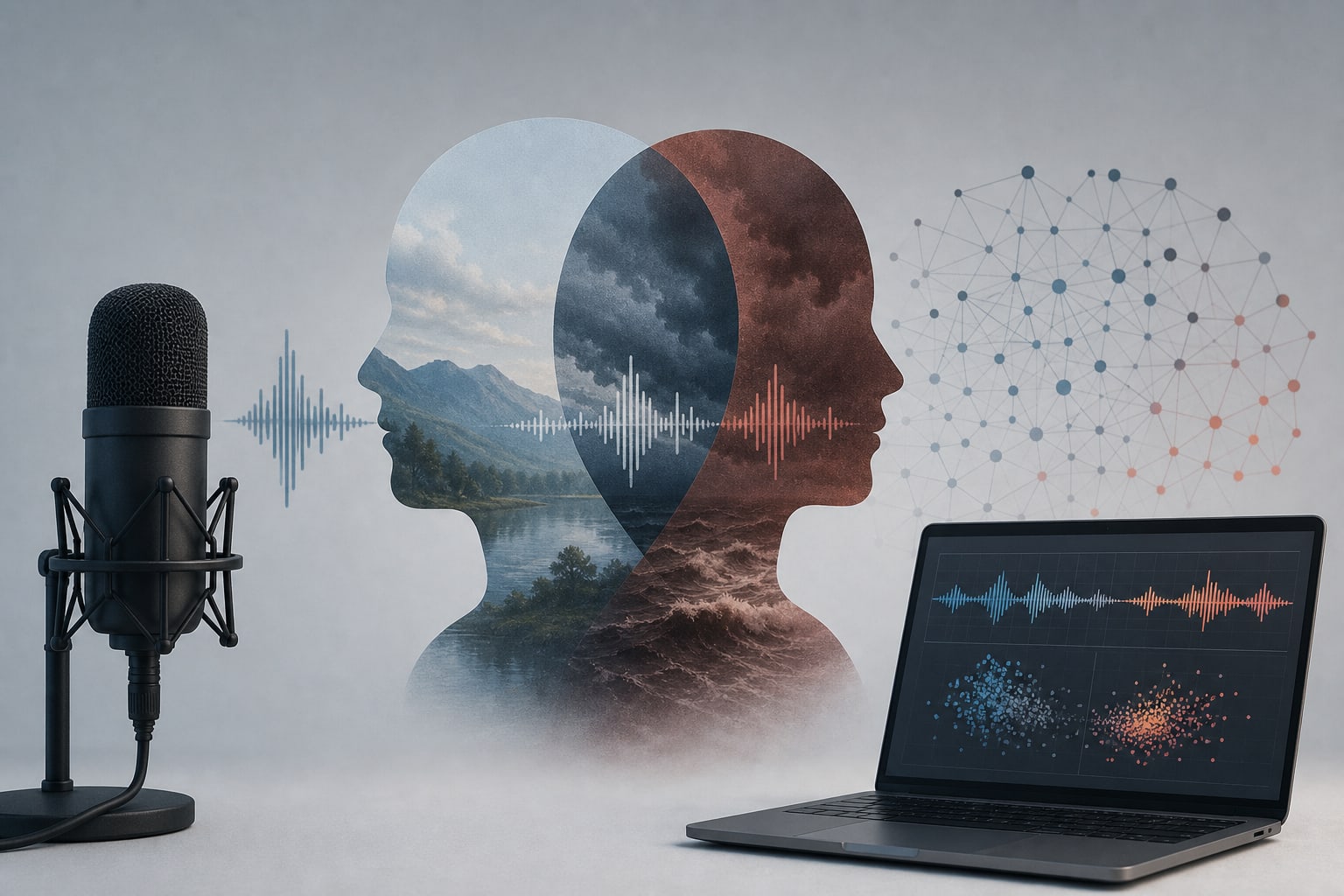
This study introduces a novel framework for anxiety screening using autobiographical memory recall, achieving 70% accuracy in distinguishing anxious from non-anxious individuals. The method leverages linguistic patterns in spontaneous speech to identify anxiety-related signals, suggesting potential for digital screening applications.
Background
Anxiety disorders are prevalent and significantly impact quality of life, making timely identification crucial for effective treatment. Traditional screening methods are often time-consuming and may not be feasible in routine clinical settings. This study explores the use of spontaneous speech as a low-burden alternative for anxiety screening, particularly in telehealth contexts.
Data Highlights
The study involved 156 participants, with 101 classified as non-anxious and 55 as anxious based on HAM-A scores. The proposed method achieved 70% accuracy and a macro-F1 score of 0.67, with bootstrap confidence intervals of 0.62–0.77 for accuracy.
Key Findings
The contrastive autobiographical recall framework effectively captures within-person affective shifts in language.
Performance was better for non-anxious participants compared to anxious participants.
Ablation analysis indicated that the full composite representation yielded the best performance for anxious-class detection.
The method outperformed both BERT-based and lexicon-based baseline models.
HAM-A labels should be interpreted as screening rather than diagnostic tools.
Clinical Implications
The findings suggest that integrating spontaneous speech analysis into anxiety screening could enhance detection capabilities in digital health settings. However, further validation in larger and more diverse cohorts is necessary to confirm these results.
Conclusion
This study presents a promising approach to anxiety screening through language analysis, highlighting the potential for scalable digital solutions in mental health care.