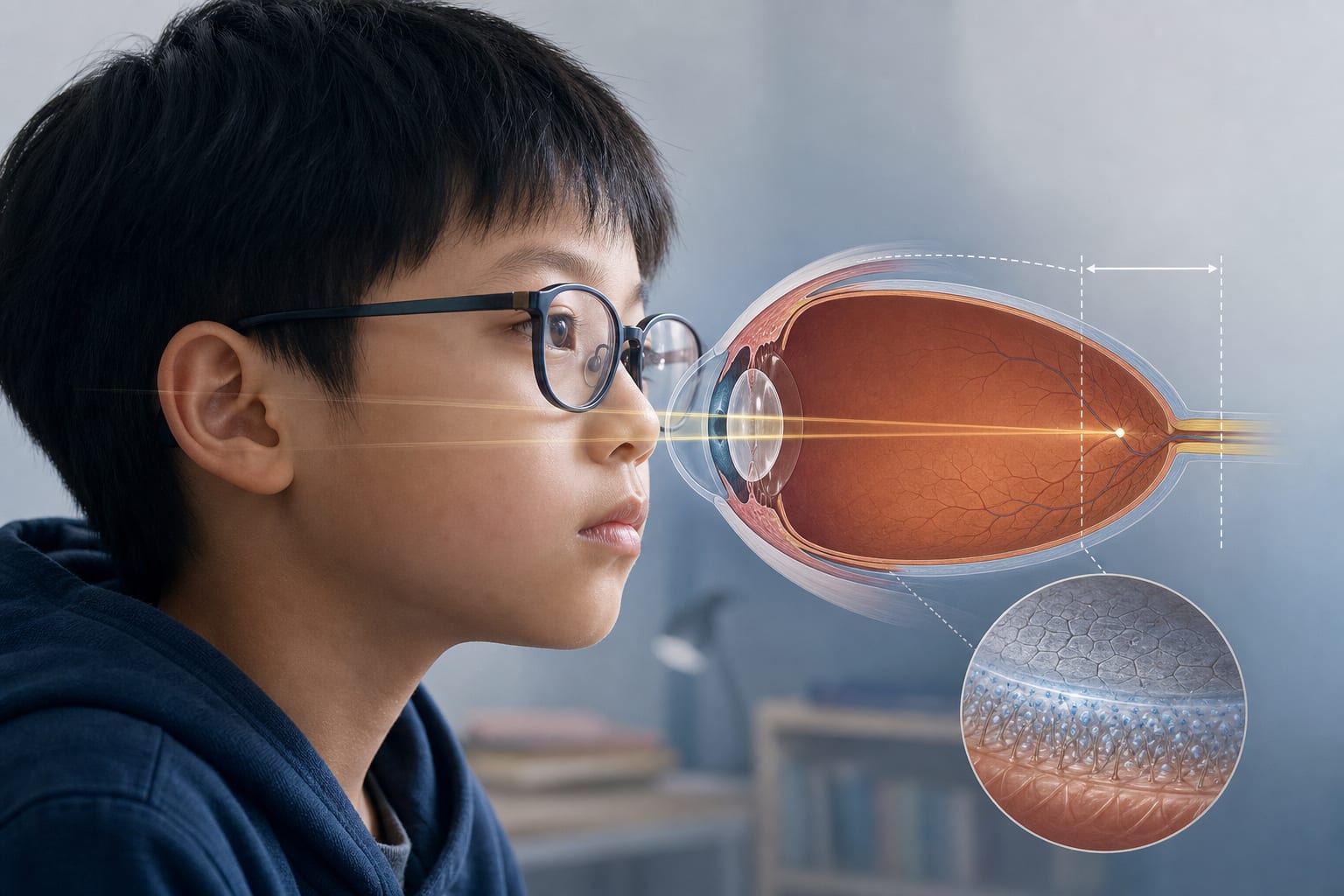
Linking Dry Eye Disease and Myopia in Children: An Overview of Existing Evidence and Potential Mechanisms
-
By
-
Hongsu Wang
-
Han Yu Zhang
-
May 29, 2026
Clinical Report: Linking Dry Eye Disease and Myopia in Children
Overview
This report summarizes the association between dry eye disease (DED) and myopia in schoolchildren, highlighting significant prevalence rates and potential underlying mechanisms. The findings indicate that myopic children are at a higher risk for developing DED, necessitating further investigation and management strategies.
Background
The rising prevalence of myopia and dry eye disease among schoolchildren, particularly in East Asia, poses significant public health challenges. Myopia affects approximately one-third of schoolchildren globally, while DED impacts learning and quality of life. Understanding the relationship between these conditions is crucial for developing effective interventions.
Data Highlights
| Study | Findings |
|---|---|
| Study 1 | Myopic children have a higher prevalence of DED compared to non-myopic peers. |
| Study 2 | High myopia correlates with a 1.5-2 times higher incidence of DED. |
| Study 3 | Significant reduction in tear break-up time in myopic adolescents. |
Key Findings
- Myopic individuals show a higher prevalence of DED compared to non-myopic individuals.
- In schoolchildren, myopia is a significant risk factor for DED.
- Prolonged screen time and contact lens use are contributing factors to DED in children.
- High myopia correlates with anatomical changes that may exacerbate DED.
- Effective management of DED can improve overall well-being in affected children.
Clinical Implications
Healthcare professionals should be vigilant in screening for DED in myopic children, particularly those with prolonged screen exposure. Early diagnosis and management of DED can enhance the quality of life and learning outcomes for affected schoolchildren.
Conclusion
The association between dry eye disease and myopia in children underscores the need for integrated management strategies. Addressing both conditions simultaneously may improve health outcomes in this vulnerable population.
Related Resources & Content
- Gifford K., Contact Lens Spectrum, 2021 -- MASTERING MYOPIA
- Frontiers in Medicine, 2026 -- Diuretic inhibition of experimental myopia implicates retinal ion-driven efflux in the regulation of ocular growth
- Conexiant, 2026 -- Myopia Severity Tied to Pediatric Retinal Pathology
- Contact Lens Spectrum, 2026 -- Myopia Beyond 2025
- TFOS DEWS III: Diagnostic Methodology, ScienceDirect, 2025
- IMI Interventions for Controlling Myopia Onset and Progression 2025 - Myopia Institute
- Frontiers, 2025 -- Relationship between myopia and diagnosis rates of dry eye disease and related indicators: a systematic review and meta-analysis
- TFOS DEWS III: Diagnostic Methodology - ScienceDirect
- IMI Interventions for Controlling Myopia Onset and Progression 2025 - Myopia Institute
- Frontiers | Relationship between myopia and diagnosis rates of dry eye disease and related indicators: a systematic review and meta-analysis
Based on findings from:
Association between dry eye and myopia in schoolchildren: current evidence and possible mechanisms
Hongsu Wang, Han Yu Zhang. Frontiers In Medicine, 2026.
https://www.frontiersin.org/journals/medicine/articles/10.3389/fmed.2026.1803506/full
This content is an AI-generated, fully rewritten summary based on a published scholarly article. It does not reproduce the original text and is not a substitute for the original publication. Readers are encouraged to consult the source for full context, data, and methodology.