Clinical Report: PruDensNet: An Efficient Depthwise Separable CNN for Classifying Brain Tumors Using MRI Data
Overview
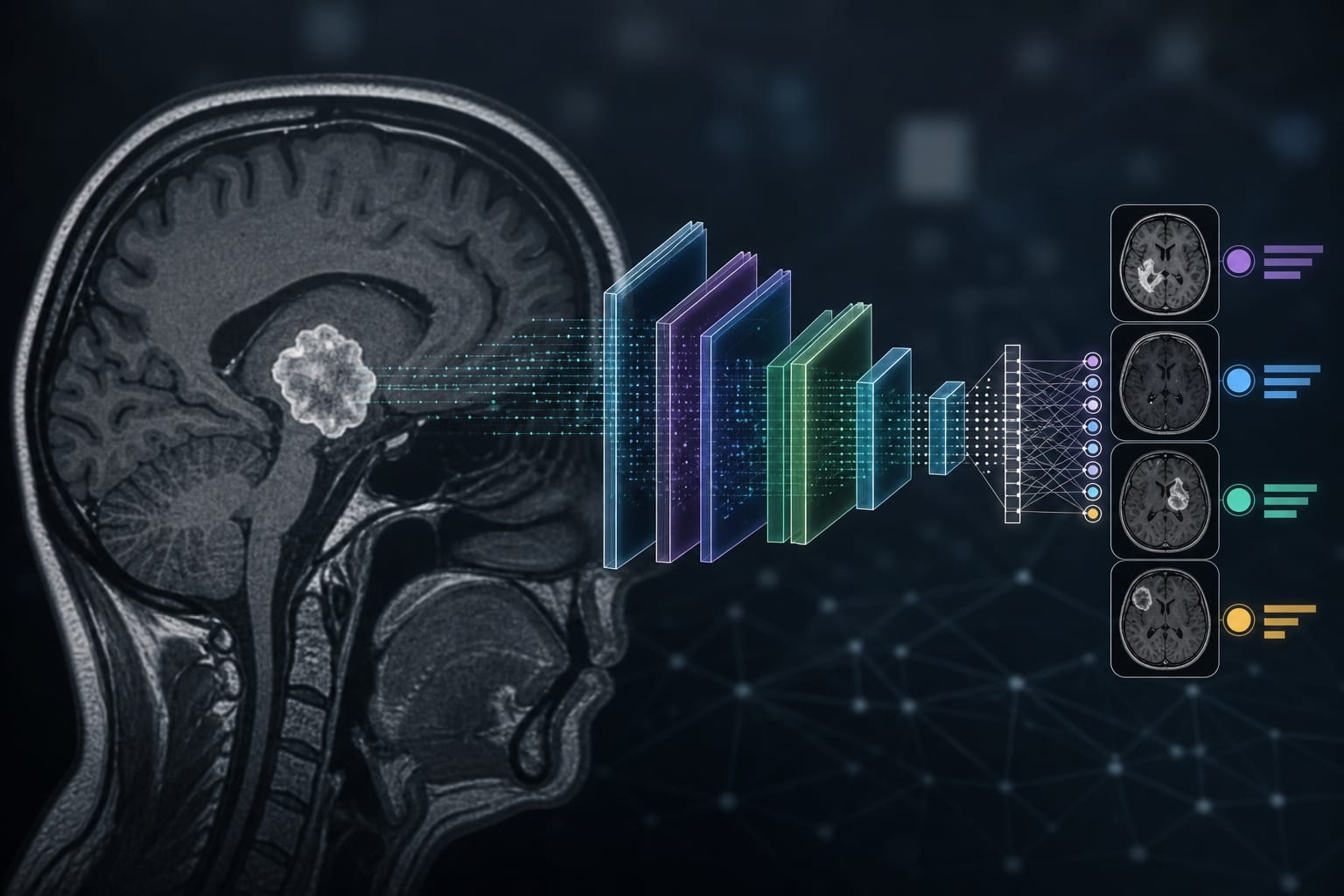
PruDensNet is a novel depthwise-separable convolutional network designed for efficient brain tumor classification using MRI data, achieving a test accuracy of 96.05%. The architecture emphasizes parameter efficiency and integrates advanced training techniques, making it suitable for cost-sensitive clinical environments.
Background
Automated brain tumor classification using MRI is crucial for effective diagnosis and treatment planning. However, existing methods often struggle with computational costs and variability in imaging protocols. PruDensNet addresses these challenges by providing a lightweight and efficient solution that can be deployed in resource-constrained settings, enhancing clinical workflows.
Data Highlights
Metric
Value
Test Accuracy
96.05%
Validation Accuracy
97.27%
Parameters
1.46 M
Key Findings
PruDensNet achieves a test accuracy of 96.05% on a four-class brain tumor MRI benchmark.
The model utilizes approximately 1.46 million parameters, making it parameter-efficient.
It incorporates lightweight channel and spatial attention mechanisms to enhance classification performance.
Training methodologies include MixUp, CutMix, and label smoothing, improving robustness without increasing inference costs.
The architecture is designed for deployment in latency-sensitive clinical environments, such as CPU-only workstations.
Clinical Implications
The development of PruDensNet offers a promising tool for clinicians in need of efficient and accurate brain tumor classification from MRI scans. Its lightweight design allows for integration into existing clinical workflows without significant resource demands, potentially improving patient outcomes through timely diagnosis.
Conclusion
PruDensNet represents a significant advancement in the field of MRI-based brain tumor classification, balancing accuracy and efficiency. Further validation in diverse clinical settings will be essential to confirm its utility in practice.