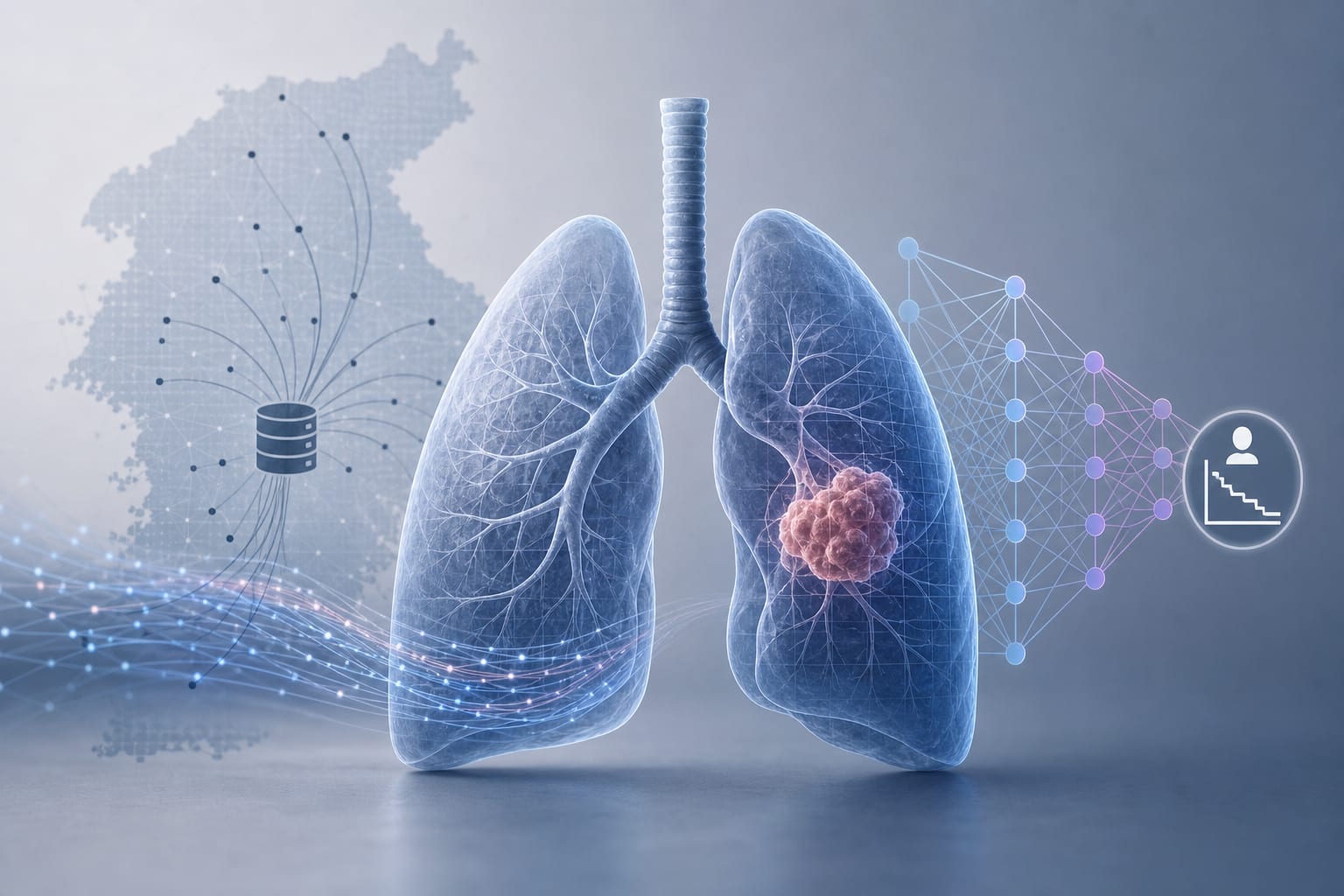
Developing and Validating a Model to Forecast 5-Year Survival in Non–Small-Cell Lung Cancer Utilizing Data from the Korean Central Cancer Registry
-
By
-
Jong Hyuk Lee
-
Ho Cheol Kim
-
Kyu-Won Jung
-
Chang Min Choi
-
June 8, 2026
Clinical Report: Developing and Validating a Model to Forecast 5-Year Survival in NSCLC
Overview
This study developed and validated a deep learning model to predict 5-year survival in non-small-cell lung cancer (NSCLC) using data from the Korean Central Cancer Registry. The model integrates various clinical features and aims to enhance prognostic accuracy for individual patients.
Background
Non-small-cell lung cancer (NSCLC) is a leading cause of cancer mortality globally, with prognosis heavily influenced by factors such as disease stage and molecular biomarkers. Accurate survival prediction is essential for optimizing treatment strategies and improving patient outcomes. The use of machine learning, particularly deep learning, offers a promising avenue for enhancing prognostic models in oncology.
Data Highlights
The study utilized data from the Korean Central Cancer Registry, which includes comprehensive clinical information from over 50 medical centers across South Korea. The dataset comprised patients diagnosed with NSCLC between 2014 and 2017.
Key Findings
- A deep learning model was developed to predict 5-year mortality in NSCLC patients.
- The model incorporated a grouped-input architecture to enhance interpretability and clinical relevance.
- Permutation-based importance was used to assess feature contributions transparently.
- The study addressed challenges related to data preprocessing and hyperparameter tuning to ensure reproducibility.
- Results indicated that the model could effectively utilize routine clinical variables for survival prediction.
Clinical Implications
The developed model provides a clinically applicable tool for predicting 5-year survival in NSCLC patients, which can aid in personalized treatment planning. By utilizing routinely collected clinical data, the model enhances the feasibility of integrating advanced predictive analytics into everyday clinical practice.
Conclusion
This study demonstrates the potential of deep learning models in improving survival predictions for NSCLC, emphasizing the importance of utilizing large, well-curated datasets for robust clinical applications.
Related Resources & Content
- Frontiers in Oncology, 2026 -- Construction and verification of 5-year survival prediction model for post-op ESCC patients
- European Radiology, 2023 -- A predictive model for assessing progression-free survival in advanced non-small cell lung cancer patients following image-guided microwave ablation combined with chemotherapy
- The ASCO Post, 2025 -- External Validation Confirms Ability of AI Model to Stratify Recurrence Risk in Early-Stage Lung Cancer
- The ASCO Post — External Validation Confirms Ability of AI Model to Stratify Recurrence Risk in Early-Stage Lung Cancer
- IASLC Staging Project: Lung Cancer, Thymic Tumors, and Mesothelioma | IASLC
- Ninth Edition of the Tumor, Node, and Metastasis Classification of Lung Cancer - PubMed
- CAP Publishes Guideline for PD-L1 Testing of Patients with Lung Cancer
- Early and locally advanced non-small-cell lung cancer: ESMO Clinical Practice Guideline for diagnosis, treatment and follow-up - PubMed
- Overall Survival with Neoadjuvant Nivolumab plus Chemotherapy in Lung Cancer | New England Journal of Medicine
- KEYTRUDA® (pembrolizumab) Demonstrates Long-Term Survival Benefit in Certain Patients With Earlier or Advanced Stages of Non-Small Cell Lung Cancer (NSCLC) - Merck.com
- Overall Survival with Osimertinib in Resected EGFR-Mutated NSCLC | New England Journal of Medicine
- Survival with Osimertinib plus Chemotherapy in EGFR-Mutated Advanced NSCLC | New England Journal of Medicine
- Amivantamab Plus Lazertinib vs Osimertinib in EGFR-Mutated Advanced NSCLC - The ASCO Post
- Therapy for Stage IV Non–Small Cell Lung Cancer With Driver Alterations: ASCO Living Guideline, Version 2025.1 | Journal of Clinical Oncology
- Lung Cancer Survival Rates | 5-Year Survival Rates for Lung Cancer | American Cancer Society
Based on findings from:
Predicting 5-Year Mortality in Non–Small-Cell Lung Cancer Using the Korean Central Cancer Registry: Model Development and Validation Study
Jong Hyuk Lee, Ho Cheol Kim, Kyu-Won Jung, Chang Min Choi. Jmir Medical Informatics, 2026.
https://medinform.jmir.org/2026/1/e80574
This content is an AI-generated, fully rewritten summary based on a published scholarly article. It does not reproduce the original text and is not a substitute for the original publication. Readers are encouraged to consult the source for full context, data, and methodology.