Morphometric anatomy of the middle cranial fossa via the anterior petrosal (Kawase) approach: a bilateral cadaveric study - Report - MDSpire

Morphometric anatomy of the middle cranial fossa via the anterior petrosal (Kawase) approach: a bilateral cadaveric study

  • By

  • Huong Dinh Nguyen

  • Tuyen Quang Le

  • Hung Manh Ngo

  • Hung Dinh Kieu

  • June 23, 2026

  • 0 min

Share

Clinical Report: Bilateral Cadaveric Analysis of Middle Cranial Fossa Morphometry

Overview

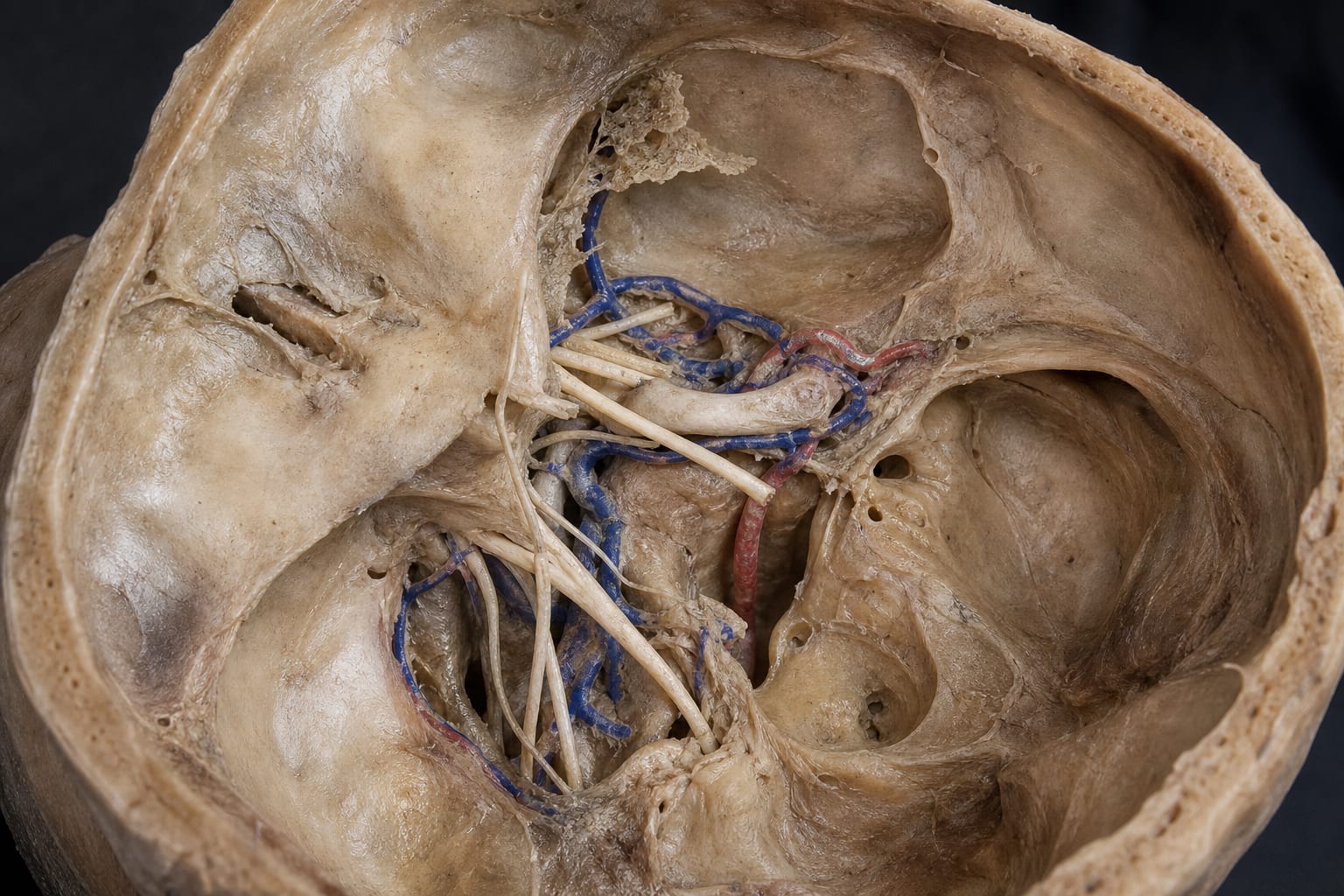
This study provides a detailed morphometric analysis of the middle cranial fossa through the anterior petrosal approach, based on dissections of 21 Vietnamese cadaveric heads. Key anatomical landmarks were identified, revealing predominantly bilateral symmetry and specific measurements.

Background

Understanding the anatomy of the middle cranial fossa is crucial for safe surgical interventions in the petroclival region. The anterior petrosal (Kawase) approach is a widely used technique, yet comprehensive morphometric data, particularly for Southeast Asian populations, has been limited. This study provides detailed measurements and relationships of critical neurovascular structures.

Data Highlights

MeasurementMean (± SD)
GSPN Length10.66 ± 2.44 mm
Distance from Foramen Spinosum to Zygomatic Root29.68 ± 1.97 mm
Distance between Foramen Ovale and Foramen Rotundum11.70 ± 2.44 mm
Distance to Geniculate Ganglion3.39 ± 0.98 mm
Distance to Internal Carotid Artery Genu4.56 ± 1.29 mm
Angle between GSPN and Arcuate Eminence121.82 ± 15.38°
Angle between GSPN and Superior Semicircular Canal104.07 ± 13.25°
Angle between IAC and Superior Semicircular Canal45.42 ± 12.09°

Key Findings

  • The greater superficial petrosal nerve (GSPN) was consistently identified in all specimens.
  • Mean GSPN length was measured at 10.66 ± 2.44 mm.
  • Significant distances between key foramina were documented, including 29.68 ± 1.97 mm from foramen spinosum to zygomatic root.
  • Angular measurements revealed a mean angle of 121.82 ± 15.38° between the GSPN and arcuate eminence.
  • Overall bilateral symmetry was observed, with a notable exception in the IAC–SSC angle.

Clinical Implications

The detailed morphometric data provided in this study can enhance surgical planning and neuronavigation for procedures involving the middle cranial fossa. Understanding the spatial relationships of critical structures may reduce the risk of complications during surgery.

Conclusion

This analysis of the middle cranial fossa anatomy through the anterior petrosal approach offers insights for surgical practice within the Vietnamese population.

Related Resources & Content

  1. Establishing the Posterior Boundaries of the Endoscopic Endonasal Technique for Accessing the Craniovertebral Junction: An Anatomical Study with Radiographic Correlations
  2. Exploring the Anterolateral Triangle: Insights into the Foramen Lacerum via the Transorbital Approach - An Anatomical and Technical Analysis
  3. Techniques for Simpson Grade I Resection of Medial and Inner Ridge Meningiomas in the Sphenoid Wing
  4. Meningioma: International Consortium on Meningiomas consensus review on scientific advances and treatment paradigms for clinicians, researchers, and patients
  5. Approach-related complications of extradural anterior petrosal approach: systematic review and meta-analysis
  6. Evaluating the Viability of the Transmastoid Infralabyrinthine Technique Without Jugular Bulb Decompression for Accessing the Extradural Region of the Petrous Apex and Petroclival Junction Before Surgical Intervention
  7. NCCN Clinical Practice Guidelines in Oncology (NCCN Guidelines®)
  8. Joint EANM/EANO/RANO/SNMMI practice guideline/procedure standards for diagnostics and therapy of meningiomas
  9. Meningioma: International Consortium on Meningiomas consensus review on scientific advances and treatment paradigms for clinicians, researchers, and patients - PubMed
  10. Approach-related complications of extradural anterior petrosal approach: systematic review and meta-analysis - PubMed
  11. Combined petrosal approach: a systematic review and meta-analysis of surgical complications - PMC
  12. Anterior transpetrosal approach and the tumor removal rate, postoperative neurological changes, and complications: experience in 274 cases over 33 years - PubMed
  13. Anterior Petrosectomy vs. Retrosigmoid Approach—Surgical Anatomy and Navigation-Augmented Morphometric Analysis: A Comparative Study in Cadaveric Laboratory Setting | MDPI
  14. A Modified Anterior Petrosectomy Approach for Resection of Petroclival Meningioma; with Management of Complications - ScienceDirect

Original Source(s)

Related Content