Case Report: Stepwise quantitative assessment of intraoperative intracranial pressure after perforation, craniotomy, dural incision, and hematoma removal in acute subdural hematoma - Report - MDSpire

Case Report: Stepwise quantitative assessment of intraoperative intracranial pressure after perforation, craniotomy, dural incision, and hematoma removal in acute subdural hematoma

  • By

  • Sota Wakahara

  • Ryota Tamura

  • Takahiro Iinuma

  • Konosuke Ishikawa

  • Kosuke Karatsu

  • Ryo Yamamoto

  • Yukio Sato

  • Junichi Sasaki

  • Masahiro Toda

  • June 23, 2026

  • 0 min

Share

Clinical Report: Gradual Evaluation of Intraoperative ICP Changes in ASDH

Background

Acute subdural hematoma is a critical condition often requiring urgent surgical intervention to alleviate elevated intracranial pressure. The timing and effectiveness of surgical procedures can significantly influence patient outcomes, yet there is limited quantitative data on how each surgical phase affects ICP.

Data Highlights

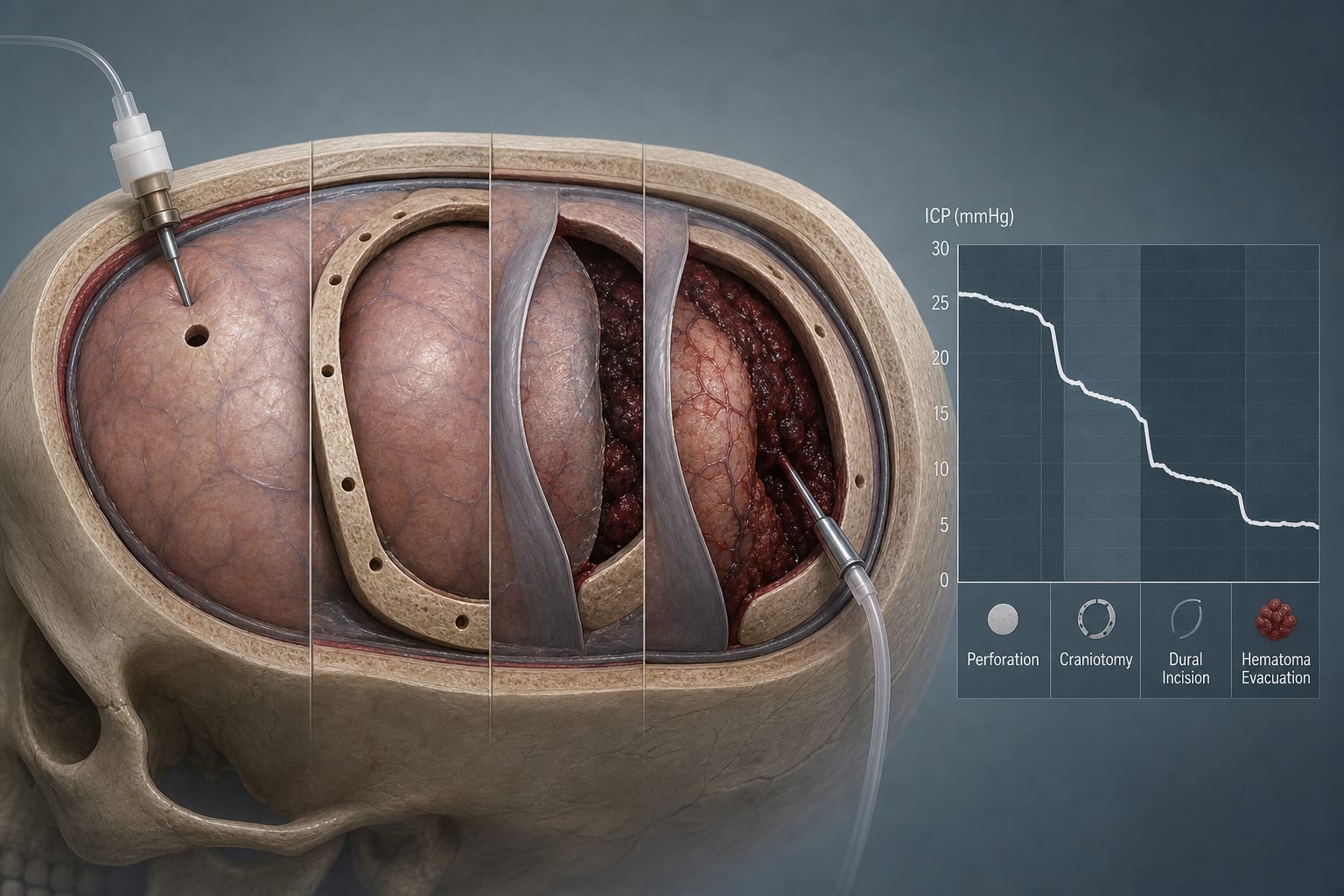
Surgical PhaseICP (mmHg)
Burr Hole Placement42
Partial Craniotomy39
Complete Craniotomy20
Dural Incision14
Hematoma Evacuation9

Key Findings

  • Initial ICP was recorded at 45 mmHg before surgical intervention.
  • Each surgical phase resulted in a quantifiable reduction in ICP.
  • ICP decreased from 42 mmHg after burr hole placement to 9 mmHg following hematoma evacuation.

Clinical Implications

Monitoring ICP during surgical procedures for ASDH is important. Understanding the impact of each surgical phase on ICP can inform clinical decision-making.

Conclusion

This case illustrates the sequential reduction of ICP during surgical intervention for acute subdural hematoma.

Related Resources & Content

  1. Brain Trauma Foundation, Guidelines for the Surgical Management of TBI, 2023 -- Surgical Management of TBI
  2. New England Journal of Medicine, Decompressive Craniectomy versus Craniotomy for Acute Subdural Hematoma, 2023 -- Comparative Study on ASDH
  3. Changes in Intracranial Pressure During Initial Postoperative Mobilization in Patients with Chronic Subdural Hematoma
  4. Frontiers in Surgery — Evaluation of intraoperative color Doppler ultrasonography in the surgical evacuation of acute intracranial hematoma: a single-center study from Botswana
  5. BMC Neurology — Revision rate and postoperative volume development of chronic subdural hematomas after burr hole craniotomy in combination with tranexamic acid vs. surgery alone – a single-center propensity score-matched analysis
  6. Impact of Early Cerebrospinal Fluid Drainage on the Severity of Initial Brain Injury Following Aneurysmal Subarachnoid Hemorrhage
  7. Changes in Intracranial Pressure During Initial Postoperative Mobilization in Patients with Chronic Subdural Hematoma
  8. Evaluation of intraoperative color Doppler ultrasonography in the surgical evacuation of acute intracranial hematoma
  9. Revision rate and postoperative volume development of chronic subdural hematomas after burr hole craniotomy
  10. Guidelines for the Surgical Management of TBI — Brain Trauma Foundation
  11. Decompressive Craniectomy versus Craniotomy for Acute Subdural Hematoma | New England Journal of Medicine
  12. Dura Opening in Cases with Acute Traumatic Subdural Hemorrhage

Original Source(s)

Related Content