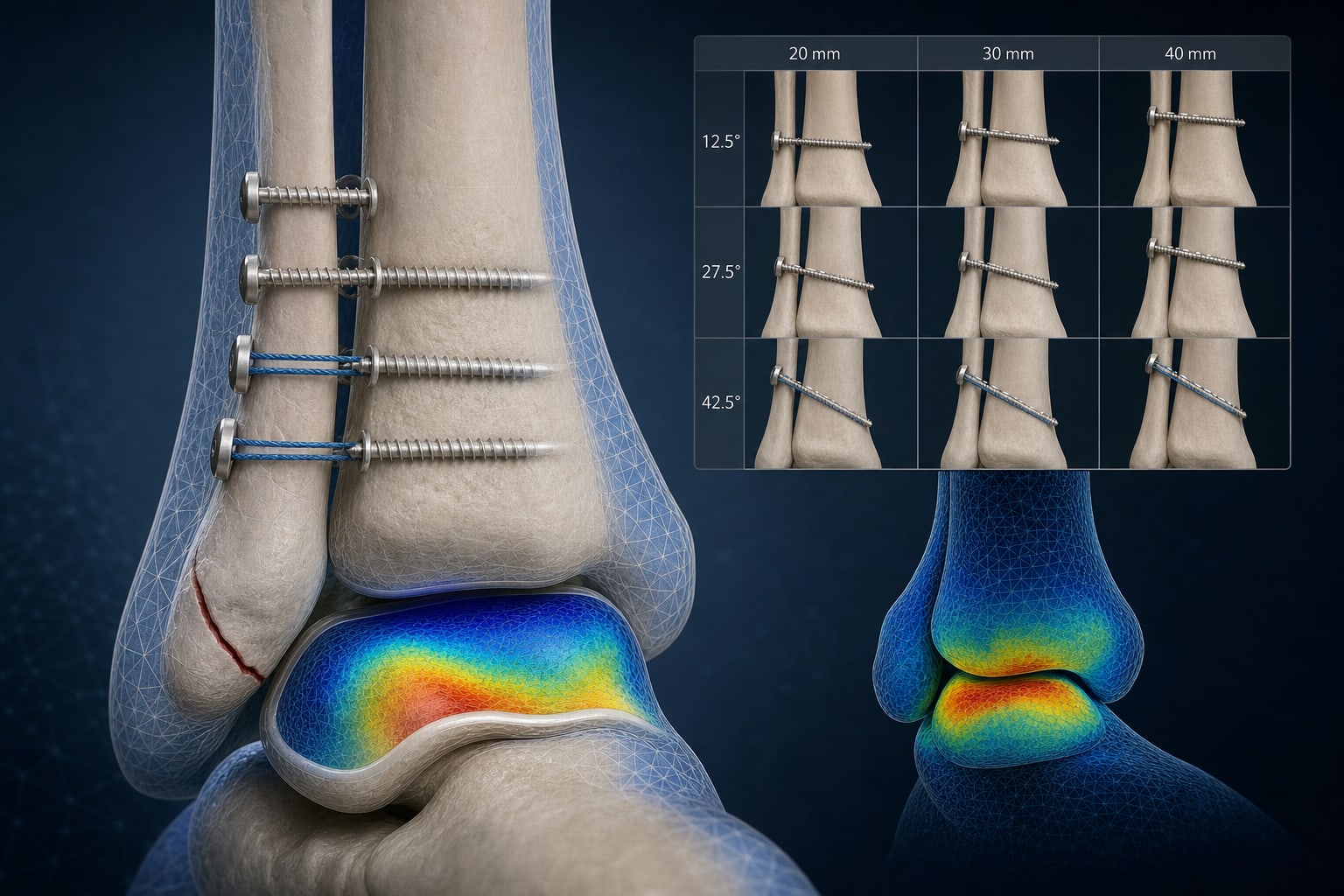
The Impact of Fixation Height Versus Anterior Tilt Angle on Biomechanics in Syndesmotic Fixation for Weber B Ankle Fractures: A Finite Element Analysis
-
By
-
Dong Jiang
-
Zhiwei Wu
-
Jianwen Cheng
-
July 14, 2026
Clinical Report: The Impact of Fixation Height Versus Anterior Tilt Angle on Biomechanics
Overview
This study evaluates the biomechanical effects of fixation height and anterior tilt angle in syndesmotic fixation for Weber B ankle fractures using finite element analysis. Key findings indicate that fixation height significantly influences tibiotalar contact stress and fibular translation.
Background
Weber B ankle fractures are prevalent and often involve syndesmotic instability, which is critical for maintaining ankle joint integrity. Proper fixation techniques are essential to restore stability and prevent long-term complications.
Data Highlights
| Fixation Height (mm) | Peak Tibiotalar Contact Stress Increase (%) | Fibular Translation |
|---|---|---|
| 20-30 | Near-physiologic mechanics | Lower |
| 40 | Biomechanical deterioration | Higher |
Key Findings
- Residual instability increased peak tibiotalar contact stress by 36.8%.
- Fixation at 20-30 mm restored near-physiologic mechanics.
- 40 mm fixation resulted in biomechanical deterioration.
- Tricortical screws better restrained fibular translation compared to suture-buttons.
- Suture-buttons preserved more micromotion but had higher implant stress concentrations.
Clinical Implications
Fixation height should be prioritized in surgical planning for syndesmotic injuries, with a recommendation for placement 20-30 mm above the tibial plafond. The choice between tricortical screws and suture-buttons should consider the balance between rigidity and the need for physiologic motion.
Conclusion
The study highlights the significant impact of fixation height on the biomechanics of syndesmotic fixation in Weber B ankle fractures.
Related Resources & Content
- Anwar et al., PubMed, 2025 -- Effectiveness of suture button fixation versus screw fixation for the management of acute distal tibiofibular syndesmotic injuries: a systematic review and meta-analysis
- British Orthopaedic Association, BOA, 2024 -- BOAST - The Management of Ankle Fractures
- Conexiant, Unstable Weber B Fractures: Cast vs Surgery, 2025 -- Unstable Weber B Fractures: Cast vs Surgery
- Does the positioning of the syndesmosis fixation device influence the immediate alignment of the distal tibiofibular joint?
- To Repair or Not to Repair? The Impact of Fixing a Small Posterior Malleolar Fragment on Rotational Stability in Trimalleolar Fractures
- Impact of Coronal Splits on the Structural Integrity of Bi-condylar Tibial Plateau Fractures: A Biomechanical Study
- Does the positioning of the syndesmosis fixation device influence the immediate alignment of the distal tibiofibular joint?
- To Repair or Not to Repair? The Impact of Fixing a Small Posterior Malleolar Fragment on Rotational Stability in Trimalleolar Fractures
- Impact of Coronal Splits on the Structural Integrity of Bi-condylar Tibial Plateau Fractures: A Biomechanical Study
- BOASt - The Management of Ankle Fractures
- Effectiveness of suture button fixation versus screw fixation for the management of acute distal tibiofibular syndesmotic injuries: a systematic review and meta-analysis - PubMed
- Frontiers | Ankle fracture with syndesmotic injury treated by screw fixation: a prospective study on clinical and radiographic outcomes
Based on findings from:
Fixation height has a greater biomechanical effect than anterior tilt angle in syndesmotic fixation for weber B ankle fractures: a specific finite element study
Dong Jiang, Zhiwei Wu, Jianwen Cheng. Frontiers In Surgery, 2026.
https://www.frontiersin.org/journals/surgery/articles/10.3389/fsurg.2026.1890743/full
This content is an AI-generated, fully rewritten summary based on a published scholarly article. It does not reproduce the original text and is not a substitute for the original publication. Readers are encouraged to consult the source for full context, data, and methodology.