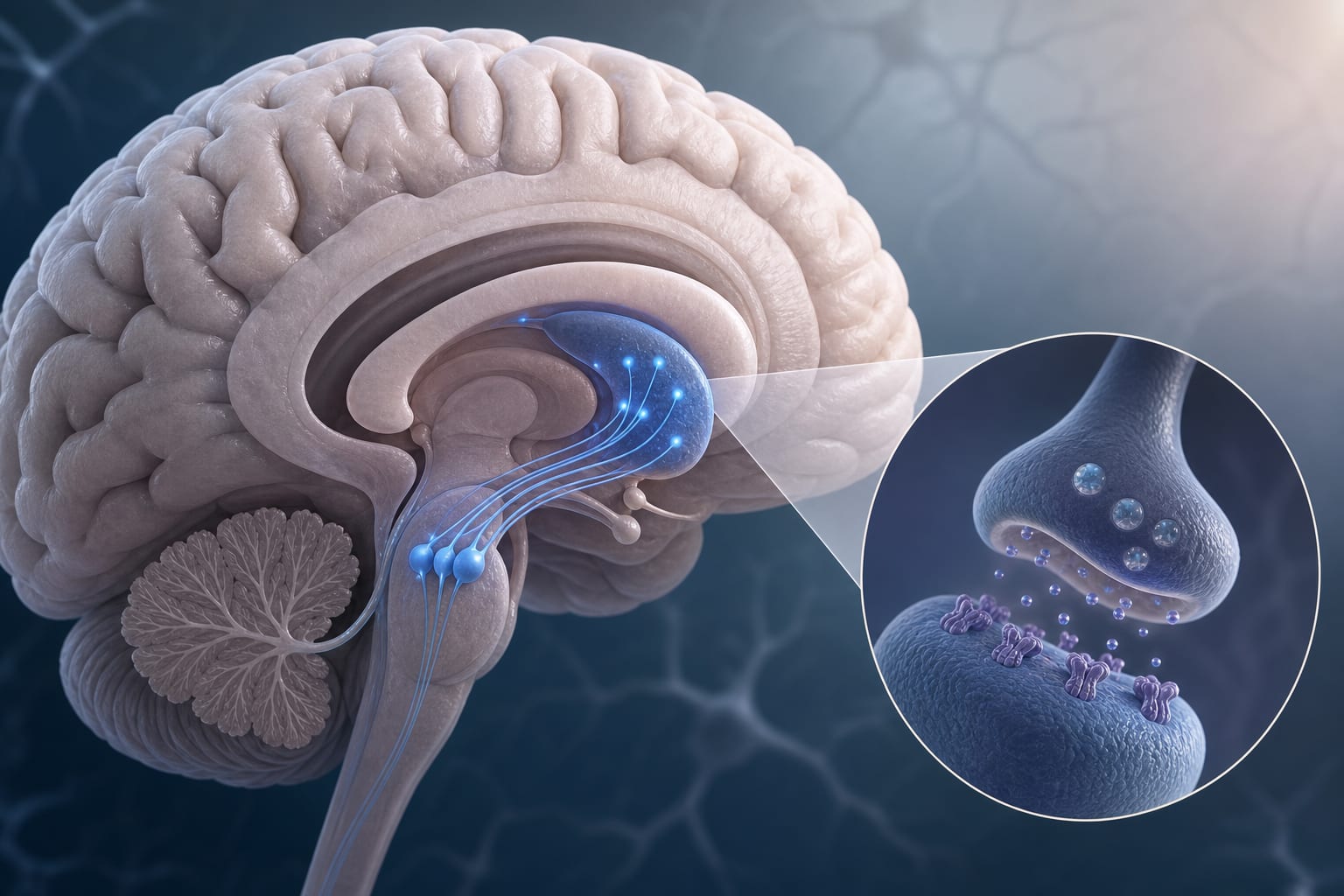
Clinical Report: Tavapadon as a Complementary Therapy for Parkinson's Disease
Overview
The TEMPO-3 trial demonstrated that tavapadon, a selective D1/D5 agonist, significantly increased good-on time and reduced OFF time in patients with Parkinson's Disease (PD) on stable levodopa therapy. The treatment was well-tolerated, with a safety profile that did not indicate increased risk of impulse control disorders compared to placebo.
Background
Expand on the limitations of current treatments and the role of dopamine agonists.
Data Highlights
Outcome
Tavapadon
Placebo
Difference
Good-on time increase (hours)
+1.10
0
1.10
OFF time reduction (hours)
-0.94
0
-0.94
Key Findings
Tavapadon increased good-on time by 1.10 hours compared to placebo over 27 weeks.
OFF time was reduced by 0.94 hours with tavapadon versus placebo.
The trial included 148 clinical sites across 14 countries, emphasizing its global relevance.
Adverse events were primarily mild to moderate, with nausea (14.3%) and dyskinesia (10.0%) being the most common.
No increased risk of impulse control disorders or somnolence was observed with tavapadon compared to placebo.
Clinical Implications
Tavapadon may serve as a valuable adjunctive therapy for patients with PD experiencing motor fluctuations despite stable levodopa treatment. Its favorable safety profile, particularly regarding impulse control disorders, makes it a promising option for enhancing patient quality of life.
Conclusion
The findings from the TEMPO-3 trial support the use of tavapadon as an effective adjunctive treatment for managing motor fluctuations in Parkinson's Disease, providing a new therapeutic avenue that aligns with current clinical guidelines.
by Hubert H. Fernandez, Stuart H. Isaacson, Robert A. Hauser, Pinky Agarwal, William Ondo, Ariane Park, Daniel Kremens, Matthew Leoni, Sridhar Duvvuri, Cari Combs, Erica Koenig, Ih Chang, Gina Pastino, Stacey Tringali, Nicole Golonski, Raymond Sanchez, Linda Harmer, Joey Boiser, Cindy Zadikoff, Zoltan Mari
Aviva Abosch, M.D., Ph.D., a neurosurgeon at Baptist Health Miami Neuroscience Institute, part of Baptist Health Brain and Spine Care, was installed as the Esernia Endowed Chair in Surgical Treatment of Adult Epilepsy and Movement Disorders.