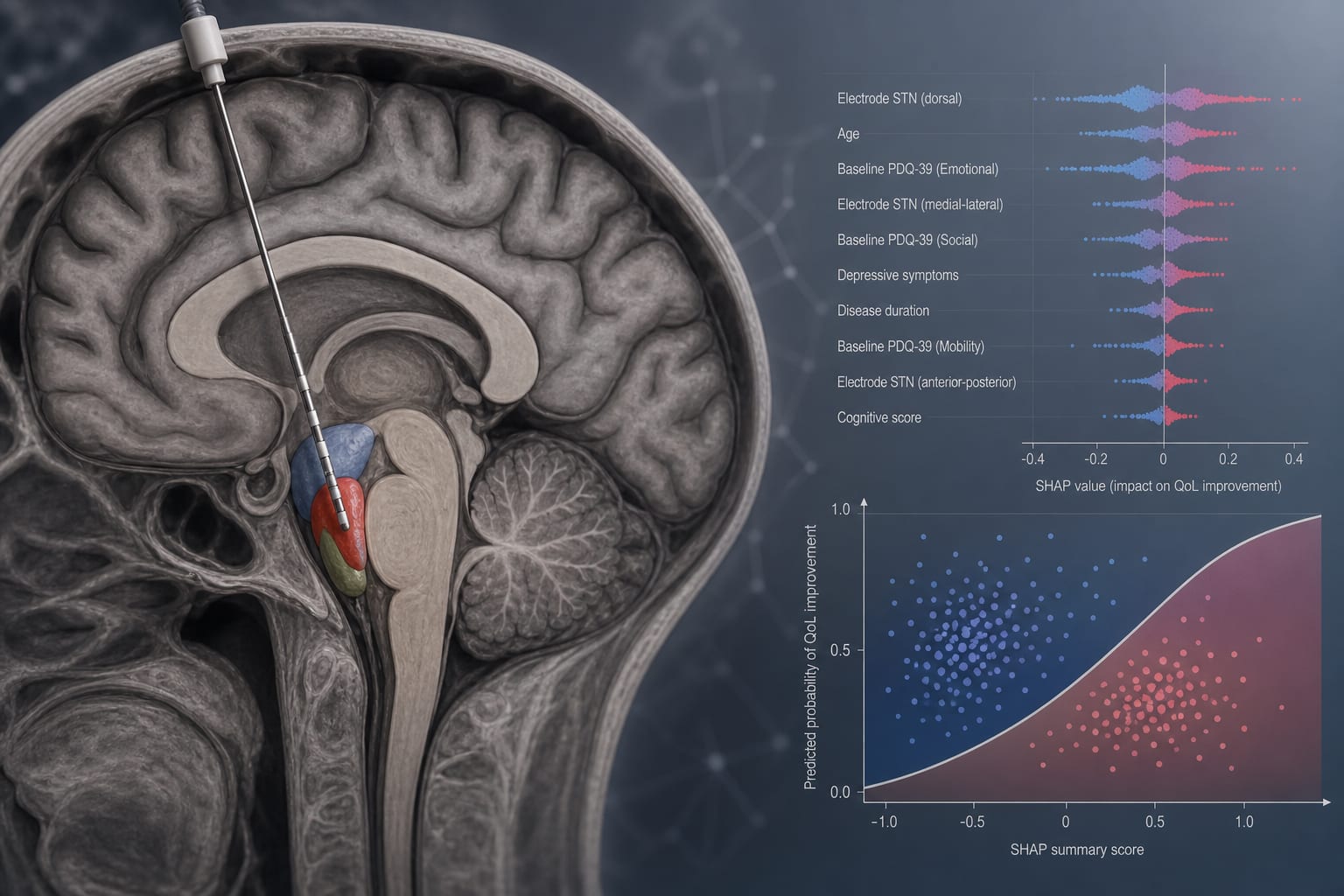
Influence of Age, Emotional Factors, and Electrode Placement on QoL in PD
Overview
This study analyzed 130 Parkinson's disease patients undergoing deep brain stimulation (DBS) to identify predictors of quality of life (QoL) improvement. Key findings indicate that younger age, greater preoperative emotional burden, and optimal electrode placement are associated with better postoperative QoL outcomes.
Background
Quality of life (QoL) is a critical aspect of managing Parkinson's disease (PD), often significantly impaired by the condition. Deep brain stimulation (DBS) has shown effectiveness in alleviating motor symptoms, yet its impact on QoL can vary widely among patients. Understanding the factors that predict QoL changes post-DBS is essential for optimizing treatment and patient counseling.
Data Highlights
The study utilized an explainable random-forest classifier with SHAP analysis to predict QoL changes exceeding minimal clinically important difference thresholds, achieving an area under the curve of 0.70.
Key Findings
Younger age is a predictor of improved QoL post-DBS.
Greater preoperative emotional burden correlates with better postoperative QoL outcomes.
Electrode placement at the motor-associative transition in the right subthalamic nucleus is beneficial for QoL improvement.
The model achieved balanced sensitivity and specificity in predicting QoL changes.
Incorporating multimodal predictors helps mitigate analytic dependency in QoL outcome modeling.
Clinical Implications
The findings support the importance of considering age, emotional factors, and precise electrode placement when planning DBS for Parkinson's disease patients. This individualized approach may enhance postoperative QoL outcomes and inform preoperative counseling.
Conclusion
Identifying key predictors of QoL improvement in Parkinson's disease patients undergoing DBS can guide personalized treatment strategies and improve patient outcomes.