Survival benefits of neoadjuvant chemotherapy in advanced pancreatic cancer with vascular resection: who benefits the most? A study on key predictive factors - Report - MDSpire

Survival benefits of neoadjuvant chemotherapy in advanced pancreatic cancer with vascular resection: who benefits the most? A study on key predictive factors

  • By

  • Ting-Kai Liao

  • Wei-Hsun Lu

  • Ping-Jui Su

  • Chih-Jung Wang

  • Ying Jui Chao

  • Yan-Shen Shan

  • May 28, 2026

  • 0 min

Share

Clinical Report: Evaluating the Survival Advantages of Neoadjuvant Chemotherapy in Advanced Pancreatic Cancer

Overview

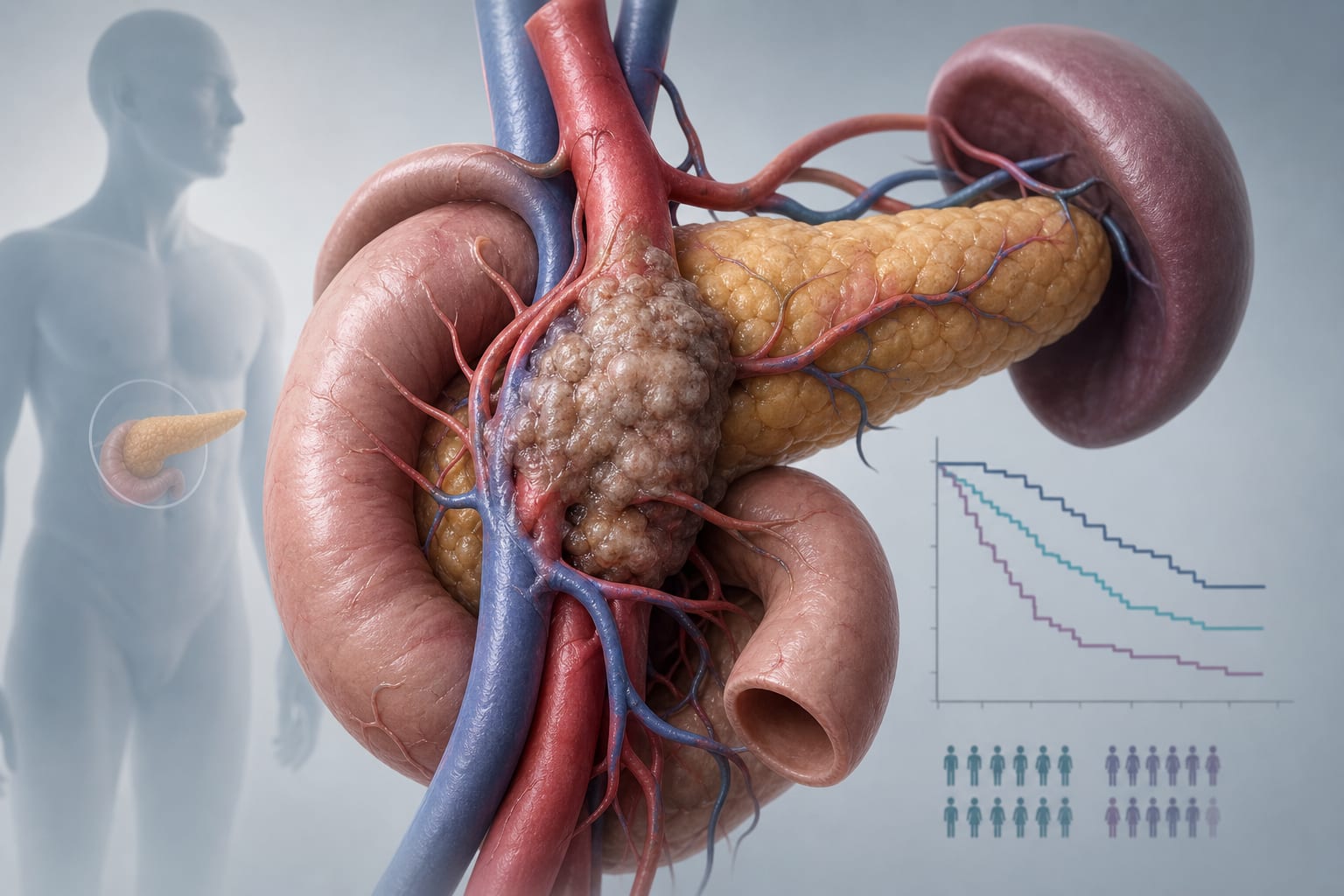
This study evaluates the survival outcomes of neoadjuvant chemotherapy (NAC) in patients with borderline resectable (BRPC) and locally advanced pancreatic cancer (LAPC) undergoing radical surgery with vascular resection. Key predictive factors for overall survival (OS) and progression-free survival (PFS) were identified, highlighting the potential benefits of NAC in this challenging patient population.

Background

Pancreatic ductal adenocarcinoma (PDAC) is a highly lethal cancer, with a significant proportion of patients presenting with BRPC or LAPC, which complicates surgical options and is associated with poor survival rates. Neoadjuvant chemotherapy has emerged as a strategy to improve resectability and survival outcomes in these patients. Understanding the optimal administration of NAC and its impact on survival is crucial for enhancing treatment strategies.

Data Highlights

No specific numerical data provided in the source material.

Key Findings

  • NAC may improve resectability rates in patients with BRPC and LAPC.
  • Optimal strategies for NAC administration remain under debate, particularly regarding regimen choice and duration.
  • Current clinical tools for assessing treatment response have limitations.
  • Identifying predictive factors for OS and PFS can help select patients who may benefit most from NAC.
  • Vascular resection during surgery is feasible and does not necessarily compromise survival outcomes.

Clinical Implications

Clinicians should consider NAC as a viable option for patients with BRPC and LAPC to potentially enhance surgical outcomes. Ongoing assessment of treatment response and careful patient selection based on predictive factors are essential for optimizing therapeutic strategies.

Conclusion

The study underscores the potential survival benefits of NAC in advanced pancreatic cancer with vascular involvement, emphasizing the need for further research to refine treatment protocols and improve patient outcomes.
Related Resources & Content

  1. Frontiers in Medicine, 2026 -- Limited benefits of neoadjuvant therapy on R0 resection rate and overall survival in patients with resectable or locally advanced PDAC in randomized controlled trials
  2. The ASCO Post, 2018 -- Using Neoadjuvant Therapy to Reduce Early Recurrences, Increase Survival in Patients With Pancreatic Cancer
  3. The ASCO Post, 2026 -- VTE During Perioperative Therapy in Resectable and Borderline Resectable Pancreatic Cancer
  4. the asco post — VTE During Perioperative Therapy in Resectable and Borderline Resectable Pancreatic Cancer
  5. The ASCO Post — VTE During Perioperative Therapy in Resectable and Borderline Resectable Pancreatic Cancer
  6. NCCN Clinical Practice Guidelines in Oncology (NCCN Guidelines®)
  7. Pancreatic cancer - Symptoms, diagnosis and treatment | BMJ Best Practice US
  8. Venous Resection During Pancreatoduodenectomy for Pancreatic Cancer: A Systematic Review and Meta-Analysis - PubMed
  9. Neoadjuvant FOLFIRINOX versus neoadjuvant gemcitabine-based chemoradiotherapy in resectable and borderline resectable pancreatic cancer (PREOPANC-2): a multicentre, open-label, phase 3 randomised trial - PubMed
  10. Preoperative mFOLFIRINOX versus PAXG for stage I–III resectable and borderline resectable pancreatic ductal adenocarcinoma (PACT-21 CASSANDRA): results of the first randomisation analysis of a randomised, open-label, 2 × 2 factorial phase 3 trial - ScienceDirect
  11. Neoadjuvant therapy versus upfront surgery approach in resectable pancreatic cancer: a systematic review and meta-analysis - PubMed
  12. Favorable Response Defined by CA19-9 Reduction After Neoadjuvant Treatment for Pancreatic Cancer - PubMed
  13. Prognostic impact of post-neoadjuvant CA19-9 values in pancreatic cancer: more pronounced following neoadjuvant chemotherapy compared to neoadjuvant chemoradiotherapy - ScienceDirect
  14. Frontiers | Predicting resectability after neoadjuvant chemotherapy for patients with borderline resectable pancreatic cancer: a single center, retrospective trial
  15. CA19-9 as a Dynamic Biomarker for Continuous Monitoring of Therapeutic Efficacy in Pancreatic Adenocarcinoma - PMC
  16. The Role of Circulating Tumor DNA in Surgical Management of Pancreatic Cancer: Systematic Review and Meta-analysis - PubMed
  17. Futility of resection after neoadjuvant therapy in pancreatic ductal adenocarcinoma - ScienceDirect

Original Source(s)

Related Content