Comorbidities, Weight-Based Initial Fluid Resuscitation, and Mortality in Patients With Sepsis - Report - MDSpire

Comorbidities, Weight-Based Initial Fluid Resuscitation, and Mortality in Patients With Sepsis

  • By

  • Elizabeth S. Munroe

  • Emily Walzl

  • Sarah Seelye

  • Megan Cahill

  • Tawny Czilok

  • Jessica Jones

  • Michael T. Kenes

  • Patricia J. Posa

  • Stephanie Parks Taylor

  • Hallie C. Prescott

  • June 12, 2026

  • 0 min

Share

Impact of Comorbid Conditions, Initial Fluid Resuscitation Based on Weight, and Mortality Rates in Sepsis Patients

Overview

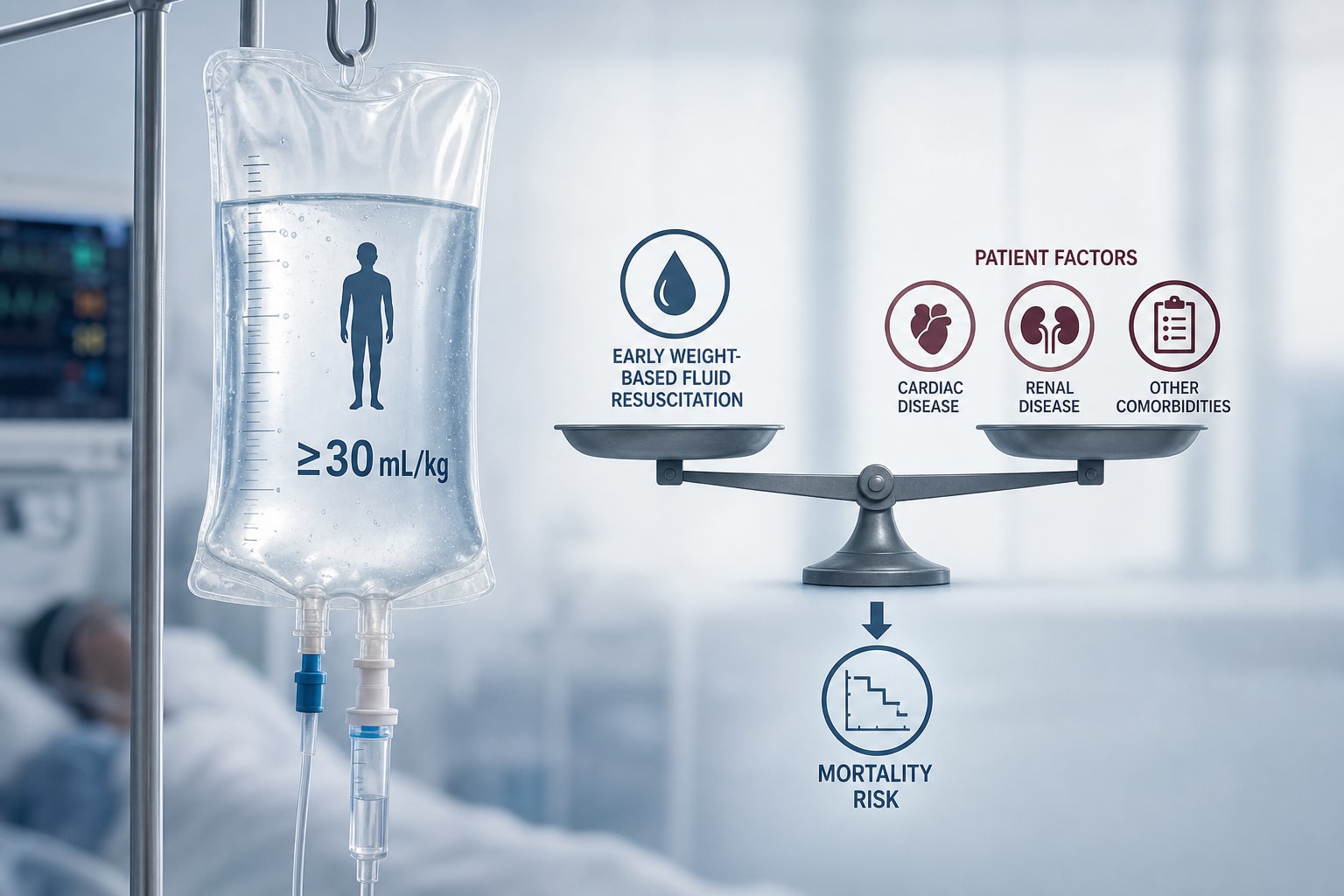
This cohort study evaluates the association between fluid resuscitation of 30 mL/kg or more within 6 hours of hospital arrival and 30-day mortality in patients with community-onset sepsis.

Background

Intravenous fluid resuscitation is critical in managing sepsis, particularly in restoring tissue perfusion. The Surviving Sepsis Campaign guidelines recommend a minimum of 30 mL/kg of crystalloid fluids for patients with sepsis-induced hypoperfusion.

Data Highlights

No numerical data provided in the source material.

Key Findings

  • Fluid resuscitation is recommended within 3 hours for patients with sepsis-induced hypoperfusion.
  • Concerns exist regarding fluid overload in patients with severe comorbidities.
  • Patients with intermediate lactate elevation may be excluded from sepsis initiatives.
  • The study evaluates three approaches to weight-based fluid dosing: tailored, SEP-1, and pragmatic.
  • Severe comorbidities were combined for analysis due to limited patient numbers.

Clinical Implications

The study's findings may inform future guidelines on fluid resuscitation strategies in sepsis management.

Conclusion

Further research is warranted to optimize fluid management in these populations.

Related Resources & Content

  1. Intensive Care Medicine, 2026 -- Vascular permeability and loss of glycocalix in sepsis: the role of fluid resuscitation
  2. JAMA Network Open, 2026 -- Closing the Gaps in Early Sepsis Fluid Resuscitation
  3. Intensive Care Medicine, 2012 -- Review of Key Developments in Intensive Care Medicine for 2011: Focus on Cardiovascular Issues, Infections, Pneumonia, Sepsis, Critical Care Organization and Outcomes, Education, Ultrasonography, Metabolism, and Coagulation
  4. Infection, 2024 -- The Relationship Between Serum Osmolality and 28-Day Mortality Rates in Sepsis Patients: Findings from a Retrospective Cohort Analysis
  5. Surviving Sepsis Campaign Guidelines 2021 | SCCM
  6. Restrictive Versus Liberal Fluid Strategy for Initial Resuscitation in Sepsis and Septic Shock: A Systematic Review and Meta Analysis
  7. Early Recognition and Initial Management of Sepsis in Adult Patients - NCBI Bookshelf
  8. Surviving Sepsis Campaign Guidelines 2021 | SCCM
  9. Restrictive Versus Liberal Fluid Strategy for Initial Resuscitation in Sepsis and Septic Shock: A Systematic Review and Meta Analysis
  10. Early Recognition and Initial Management of Sepsis in Adult Patients - NCBI Bookshelf

Original Source(s)

Related Content