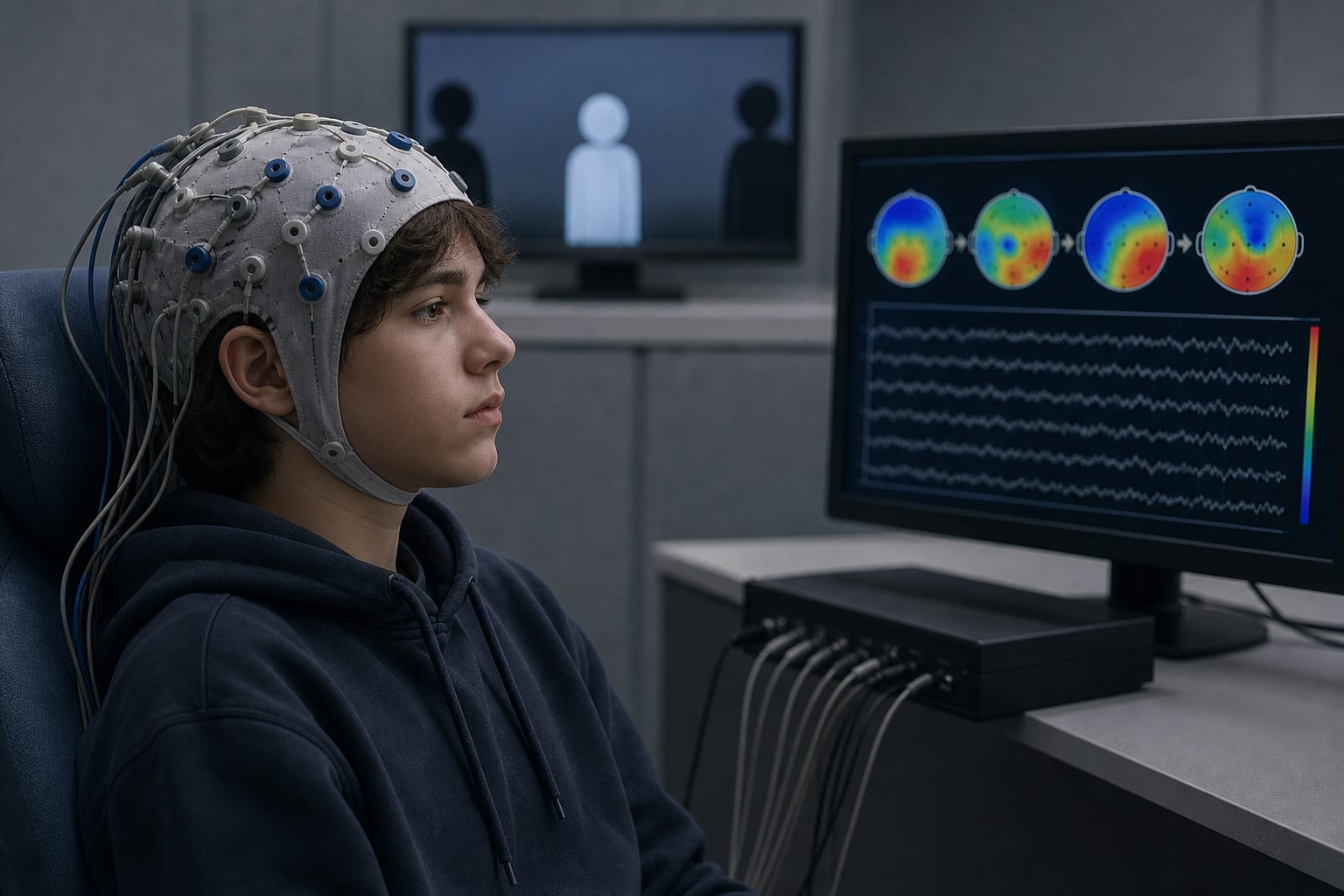
Altered EEG microstate dynamics in adolescents with non-suicidal self-injury at rest and following acute social exclusion - Report - MDSpire

Altered EEG microstate dynamics in adolescents with non-suicidal self-injury at rest and following acute social exclusion

  • By

  • Congcong Liu

  • Yajing Si

  • Yining Kou

  • Huili Xing

  • Xin Wu

  • Bin Shi

  • Liju Qian

  • Kun Li

  • Meng Zhang

  • July 16, 2026

Share

EEG Microstate Dynamics Alterations in Adolescents Engaging in NSSI

Overview

This study investigates resting-state EEG microstate dynamics in adolescents with non-suicidal self-injury (NSSI) and how these dynamics change following acute social exclusion. Key findings include reduced microstate A duration in the NSSI group compared to healthy controls and alterations in microstate dynamics after social exclusion.

Background

Non-suicidal self-injury (NSSI) is prevalent among adolescents and is associated with various adverse outcomes, including depression and anxiety. Understanding the neural mechanisms underlying NSSI is crucial for developing effective interventions. EEG microstate analysis offers insights into the fast dynamics of brain networks, which may be altered in adolescents with NSSI.

Data Highlights

No numerical data available in the source material.

Key Findings

  • Reduced microstate A duration in the NSSI group compared to healthy controls.
  • Shorter durations of microstates B and F in the NSSI group in exploratory analyses.
  • Higher occurrence of microstate D in the NSSI group.
  • Increased F→D transition probability in the NSSI group.
  • Within the NSSI group, reduced microstate A and increased microstate D expression after social exclusion.
  • Several interaction effects survived correction, indicating significant changes in microstate dynamics post-exclusion.

Clinical Implications

These findings suggest that adolescents with NSSI exhibit distinct EEG microstate dynamics that may be influenced by social experiences. Understanding these dynamics could inform targeted interventions for emotion regulation in this population.

Conclusion

The study highlights significant alterations in EEG microstate dynamics in adolescents with NSSI, particularly in response to social exclusion. Further research is needed to confirm these findings and explore their clinical relevance.

Related Resources & Content

  1. BMC Psychiatry (Springer), 2025 -- Altered cortical structure and networks associated with psychosocial adversity and pain hyposensitivity in adolescents with non-suicidal self-injury
  2. Frontiers in Psychiatry, 2026 -- Longitudinal changes in MMN and P3 during emotional processing in adolescents who engage in NSSI: a 12-week follow-up study
  3. BMC Psychiatry (Springer), 2025 -- Sleep characteristics and non-suicidal self-injury: unveiling the association in depressed adolescents
  4. Frontiers in Psychiatry, 2026 -- Cognitive-affective network structure in adolescents with non-suicidal self-injury: implications for clinical intervention
  5. Neural responses to social decision-making and their associated factors among nonsuicidal self-injured adolescents: An event-related potentials study - ScienceDirect
  6. Psychological interventions for suicidal behavior in adolescents: a comprehensive systematic review | Translational Psychiatry
  7. The Functional Aspects of Resting EEG Microstates: A Systematic Review - PubMed
  8. Neural responses to social decision-making and their associated factors among nonsuicidal self-injured adolescents: An event-related potentials study - ScienceDirect
  9. Psychological interventions for suicidal behavior in adolescents: a comprehensive systematic review | Translational Psychiatry
  10. The Functional Aspects of Resting EEG Microstates: A Systematic Review - PubMed

Original Source(s)

Related Content