Clinical Report: Retinal Age as Disease Biomarker
Overview
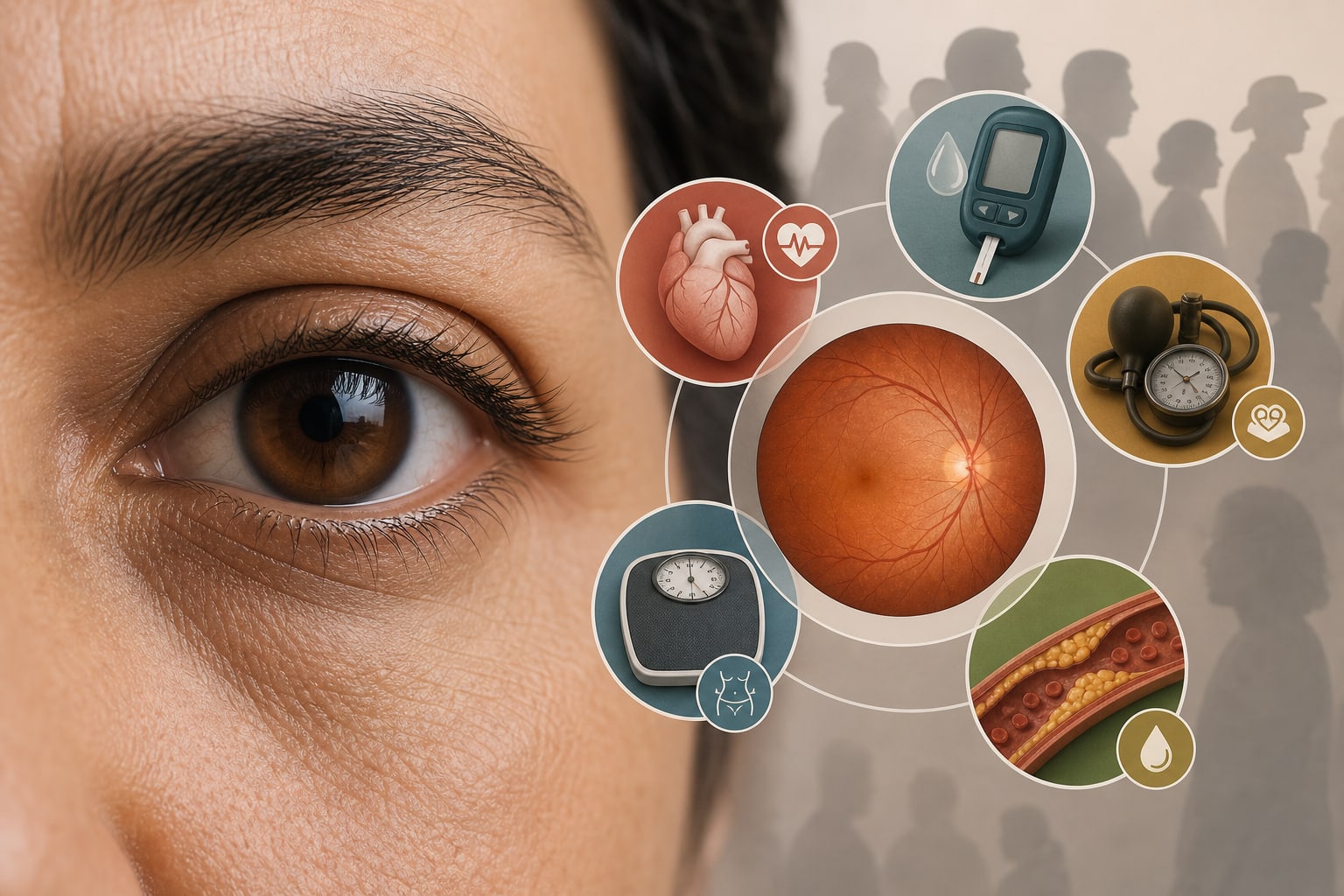
A study by Ninomiya et al. demonstrates that a single fundus photograph can accurately estimate biological aging, termed 'retinal age,' with implications for systemic disease screening. The developed AI model shows promise in linking retinal age gaps to conditions such as diabetes and cardiac disease.
Background
The concept of retinal age is emerging within oculomics, aiming to quantify biological aging and disease risk through retinal imaging. Accurate assessment of retinal age could enhance disease screening and preventive care, particularly for systemic conditions. However, challenges in generalizability and clinical utility remain critical considerations.
Data Highlights
| Validation Type | Mean Absolute Error (Years) |
|---|---|
| Internal | 2.78 |
| External (Hospital Cohort) | 3.39 |
| External (Larger Cohort) | Performance Declined |
Key Findings
- The AI model was trained on over 50,000 fundus images from more than 27,000 healthy individuals.
- Retinal age gaps were significantly higher in patients with diabetes, cardiac disease, or a history of stroke.
- The model achieved a mean absolute error of 2.78 years in internal validation.
- External validation showed a mean absolute error of 3.39 years in a hospital cohort.
- Attention was focused on the optic disc, macula, and major vascular arcades in predictions.
Clinical Implications
Integrating AI-based retinal age assessments into routine clinical workflows could enhance the identification of patients at risk for systemic diseases. This approach may facilitate early interventions without the need for additional tests.
Conclusion
The study supports the potential of retinal imaging as a non-invasive biomarker for systemic aging, suggesting a shift in its role from an ophthalmic tool to a broader preventive medicine platform.
Related Resources & Content
- Ninomiya et al., Communications Medicine, 2026 -- High-accuracy retinal age prediction via fundus-based multitask learning reveals the effect of systemic disease
- Conexiant, Retinal Age Model Tied to Disease Risk, 2026 -- Retinal Age Model Tied to Disease Risk
- Retinal Physician, Retinal Biomarkers for Alzheimer Disease, 2024 -- Retinal Biomarkers for Alzheimer Disease
- Ophthalmology Management, Retinal Imaging Captures Alzheimer’s and Dementia Risk, 2025 -- Retinal Imaging Captures Alzheimer’s and Dementia Risk
- Acta Neuropathologica — Retinal Signs of Alzheimer’s Disease: Investigating Ocular Manifestations
- High-accuracy retinal age prediction via fundus-based multitask learning reveals the effect of systemic disease | Communications Medicine
- A cross population study of retinal aging biomarkers with longitudinal pre-training and label distribution learning | npj Digital Medicine
- The retinal age gap: an affordable and highly accessible biomarker for population-wide disease screening across the globe - PubMed
- Retinal photograph-based deep learning predicts biological age, and stratifies morbidity and mortality risk - PMC
- Estimating biological age from retinal imaging: a scoping review | BMJ Open Ophthalmology
- framework of biomarkers for visual system aging: a consensus statement by the Aging Biomarker Consortium | Life Medicine | Oxford Academic
- WHO outlines considerations for regulation of artificial intelligence for health
Based on findings from:
Retinal Age as Disease Biomarker
The Ophthalmologist, 2026.
https://theophthalmologist.com/issues/2026/articles/may/retinal-age-as-disease-biomarker/
This content is an AI-generated, fully rewritten summary based on a published scholarly article. It does not reproduce the original text and is not a substitute for the original publication. Readers are encouraged to consult the source for full context, data, and methodology.