Pilot feasibility study of intraprocedural transcranial Doppler monitoring to assess Heal coating thrombogenicity in flow diversion - Report - MDSpire

Pilot feasibility study of intraprocedural transcranial Doppler monitoring to assess Heal coating thrombogenicity in flow diversion

  • By

  • Anil Arat

  • Ezgi Yilmaz

  • Sinan Balci

  • Ferdi Cay

  • Charles Matouk

  • Mehmet Akif Topcuoğlu

  • June 24, 2026

  • 0 min

Share

Clinical Report: Assessment of Thromboembolic Potential of Heal Coating

Overview

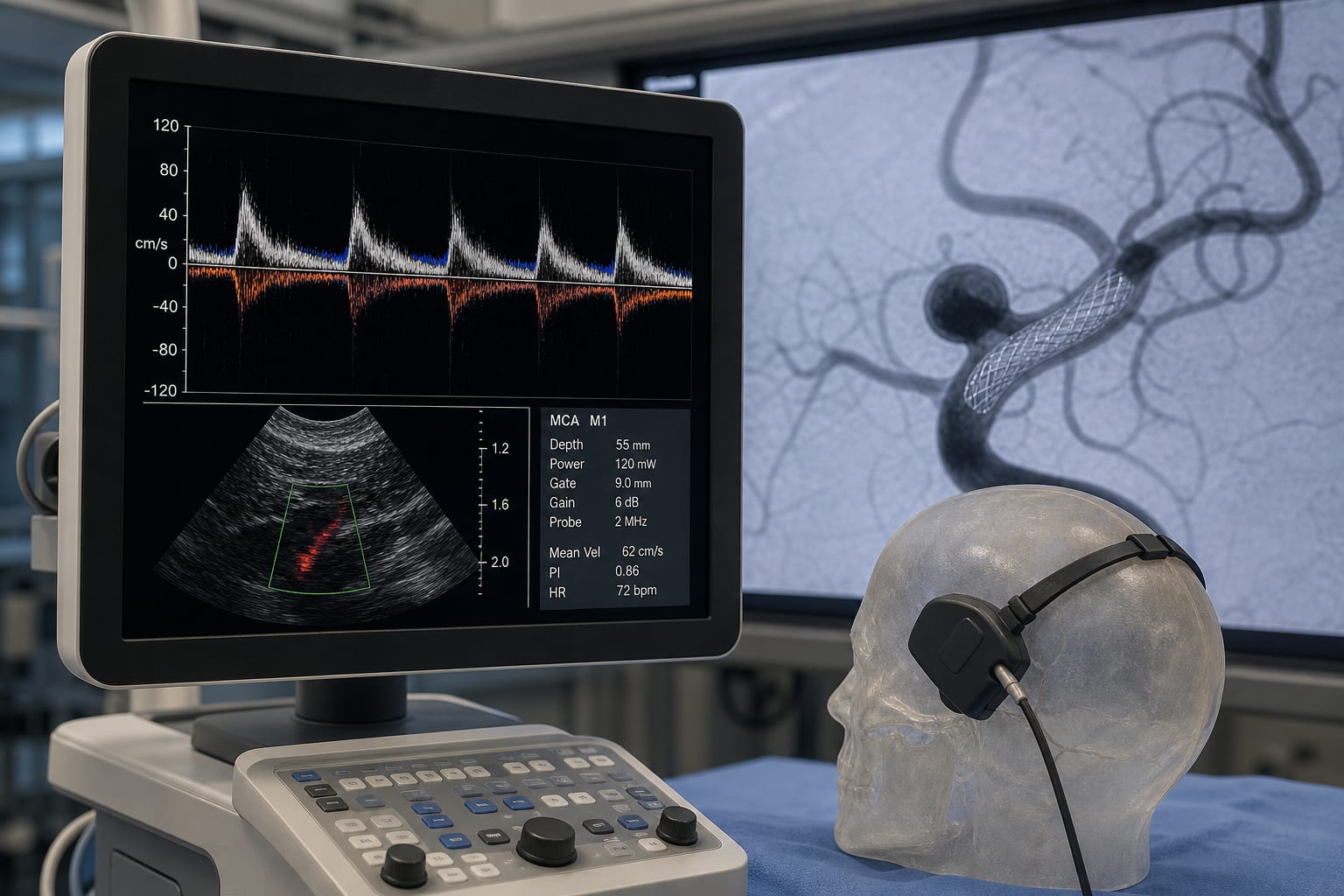
This pilot feasibility study utilized transcranial Doppler monitoring to assess the thromboembolic potential of the Derivo2 flow diverter and its coated version, Derivo 2heal. The study found that the bare Derivo2 FD had a higher incidence of solid emboli compared to the coated version within 30 minutes post-deployment.

Background

Flow diverters are used in the treatment of cerebral aneurysms, and their surface modifications aim to reduce thromboembolic risks. This study provides direct monitoring of embolic events during the procedure, which is a novel approach compared to previous studies relying on indirect measures.

Data Highlights

GroupEmboli DetectedStatistical Significance
DFD (DAPT)More solid embolip = 0.035
D2H (SAPT)Lower embolic loadp = 0.051

Key Findings

  • The bare Derivo2 FD group had more solid emboli compared to the coated Derivo 2heal FD group.
  • Statistical significance was observed with p = 0.035 for the DFD group.
  • When excluding one patient on aspirin only from the D2H group, the significance was marginal (p = 0.051).
  • Both groups did not differ in patient characteristics or DWI outcomes.
  • This study demonstrates the feasibility of using TCD for monitoring thromboembolic events during flow diversion procedures.

Clinical Implications

The findings suggest that the coated Derivo 2heal FD may be associated with a lower thromboembolic risk compared to the bare Derivo2 FD. Further randomized studies are warranted to evaluate the efficacy of the D2H coating in clinical practice.

Conclusion

This study highlights the potential of TCD monitoring in assessing thromboembolic risks associated with flow diverters. The results support the need for further investigation into the benefits of surface modifications in reducing thromboembolic events.

Related Resources & Content

  1. Frontiers in Neurology, 2026 -- Pilot Feasibility Study of Intraprocedural Transcranial Doppler Monitoring to Assess Heal Coating Thrombogenicity in Flow Diversion
  2. Frontiers in Neurology — In-vitro flow assessment study of intra-saccular endovascular devices for brain aneurysm treatment: SEAL™ vs. WEB™
  3. Acta Neurochirurgica — Half-dose ticagrelor versus clopidogrel dual antiplatelet therapy in flow diverter-treated intracranial aneurysms: analysis of platelet reactivity and perioperative safety outcomes
  4. Frontiers in Neurology — Diagnostic value of thromboelastography combined with conventional coagulation tests for lower extremity deep vein thrombosis after cerebrovascular surgery: a retrospective cohort study
  5. Comparative Analysis of Flow Diverter and Conventional Stent-Assisted Coiling for Managing Unruptured Intracranial Vertebral Artery Dissection Aneurysms: Insights from a Single-Center Study
  6. Evaluation of flow diverters for cerebral aneurysm therapy: recommendations for imaging analyses in clinical studies
  7. 1-month safety results in a randomized controlled trial (COATING) evaluating a surface-modification flow diverter (p64-MW-HPC) under single antiplatelet treatment
  8. Frontiers | Pilot Feasibility Study of Intraprocedural Transcranial Doppler Monitoring to Assess Heal Coating Thrombogenicity in Flow Diversion

Original Source(s)

Related Content