Prognostic significance of interstitial fibrosis and tubular atrophy in biopsy-proven diabetic kidney disease: a single-center retrospective cohort study - Report - MDSpire

Prognostic significance of interstitial fibrosis and tubular atrophy in biopsy-proven diabetic kidney disease: a single-center retrospective cohort study

  • By

  • Rui Zhang

  • Mingyan Wu

  • Hui Yang

  • Xingyan Zhou

  • Ziwei Guo

  • Haiyan Yu

  • Wenyu Song

  • Yi Bao

  • Yuxing Yang

  • Rui Yan

  • July 8, 2026

  • 0 min

Share

Prognostic Role of Interstitial Fibrosis and Tubular Atrophy in Biopsy-Confirmed Diabetic Kidney Disease

Overview

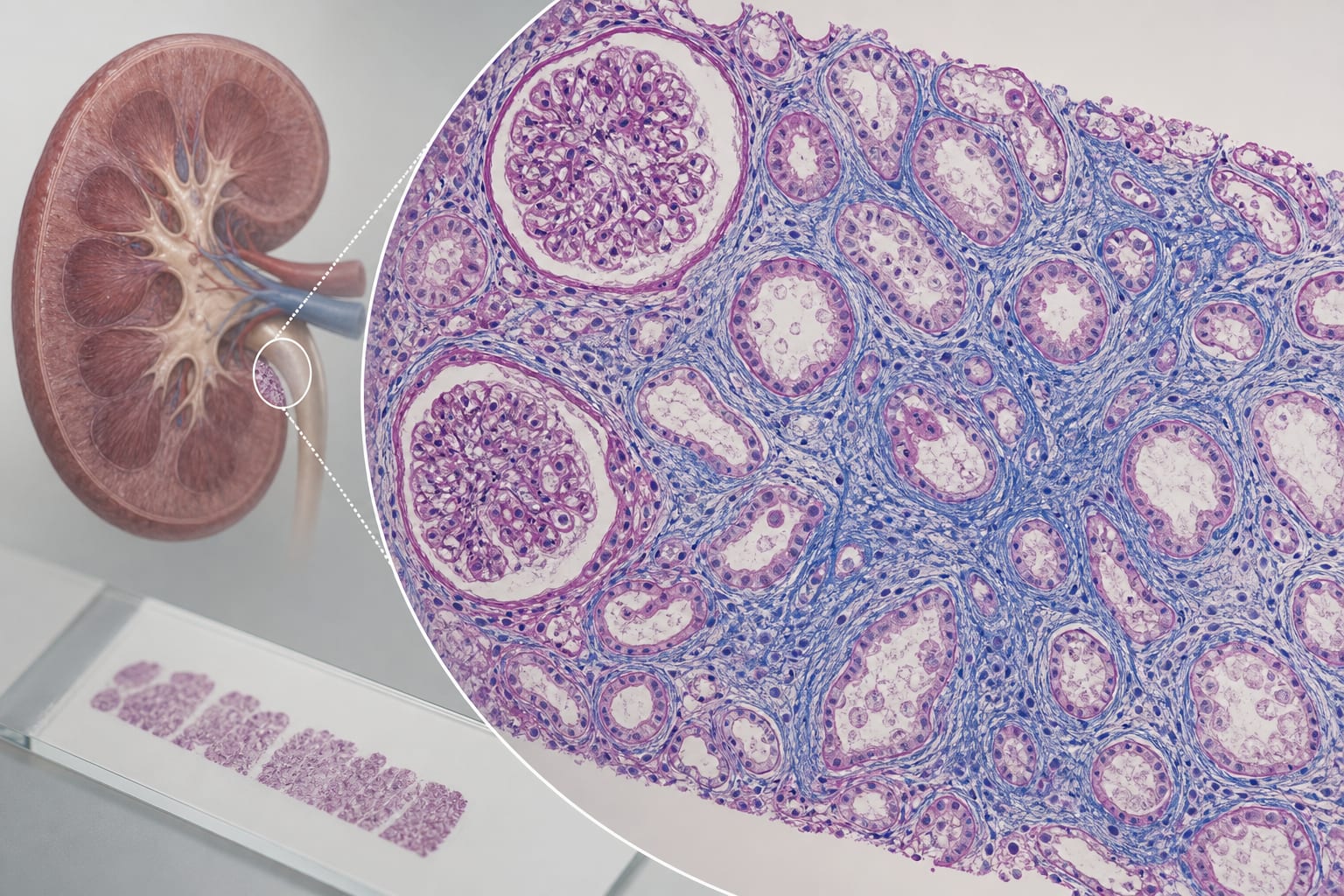
This study investigates the prognostic significance of interstitial fibrosis and tubular atrophy (IFTA) in patients with biopsy-confirmed diabetic kidney disease (DKD).

Background

Diabetic kidney disease is a prevalent complication of diabetes and a leading cause of kidney failure. Understanding the prognostic factors associated with DKD is crucial for improving patient management and outcomes. IFTA has emerged as a significant pathological feature.

Data Highlights

VariableHazard Ratio (HR)95% Confidence Interval (CI)P-value
IFTA score 2/3 vs. 13.961.71–9.160.001
24-hour proteinuria (per 1 g/day increase)1.521.19–1.94<0.001
Serum calcium (per 1 mmol/L increase)0.1400.041–0.4810.002

Key Findings

  • Higher IFTA scores (2/3) are associated with a significantly increased risk of kidney-related outcomes (HR 3.96).
  • Increased 24-hour proteinuria correlates with poorer kidney outcomes (HR 1.52).
  • Lower serum calcium levels are linked to adverse kidney outcomes (HR 0.140).
  • Patients with IFTA scores of 2/3 exhibited significantly lower kidney survival compared to those with IFTA score 1 (log-rank P = 0.0056).
  • Serum calcium, baseline eGFR, and IFTA were identified as important prognostic variables in random survival forest analysis.

Clinical Implications

Clinicians should consider IFTA scores, proteinuria levels, and serum calcium when assessing the prognosis of patients with biopsy-proven DKD. These factors may help in stratifying risk and guiding management strategies.

Conclusion

The study highlights the importance of IFTA in predicting kidney outcomes in diabetic kidney disease. Further research is warranted to validate these findings and explore their clinical implications.

Related Resources & Content

  1. Frontiers in Endocrinology, 2026 -- Development and validation of an explainable machine learning model for predicting interstitial fibrosis and tubular atrophy in biopsy-confirmed diabetic nephropathy
  2. Frontiers in Endocrinology, 2026 -- Diagnostic value of tubular and glomerular biomarkers across different stages of kidney injury in patients with type 2 diabetic nephropathy
  3. The Journal of Clinical Endocrinology & Metabolism, 2025 -- Proteomic Analysis of Plasma in Diabetic Kidney Disease Among Asians With Early-Onset Type 2 Diabetes
  4. ECRI Guidelines Trust®, 2025 -- Chronic kidney disease and risk management: standards of care in diabetes-2025.
  5. Frontiers | Prognostic Significance of Interstitial Fibrosis and Tubular Atrophy in Biopsy-Proven Diabetic Kidney Disease, 2026
  6. European Radiology — Evaluating the Diagnostic Precision of Ultrasound-Driven Multimodal Radiomics for Identifying Fibrosis in Chronic Kidney Disease
  7. ECRI Guidelines Trust® - Chronic kidney disease and risk management: standards of care in diabetes-2025.
  8. Frontiers | Prognostic Significance of Interstitial Fibrosis and Tubular Atrophy in Biopsy-Proven Diabetic Kidney Disease: A single-center retrospective cohort study
  9. A Clinicopathological Study of 267 Patients with Diabetic Kidney Disease Based on the Renal Pathology Society – 2010 Classification System - PMC

Original Source(s)

Related Content