Efficacy differences and predictors of personalized mixed acoustic therapy in chronic tinnitus patients with and without hearing loss - Report - MDSpire

Efficacy differences and predictors of personalized mixed acoustic therapy in chronic tinnitus patients with and without hearing loss

  • By

  • Yuan Chen

  • Yue Ba

  • Meiling Sun

  • Jun Hu

  • Qin Jiang

  • Bin Liu

  • July 1, 2026

  • 0 min

Share

Clinical Report: Comparative Efficacy and Predictive Factors of Customized Mixed Acoustic Therapy

Overview

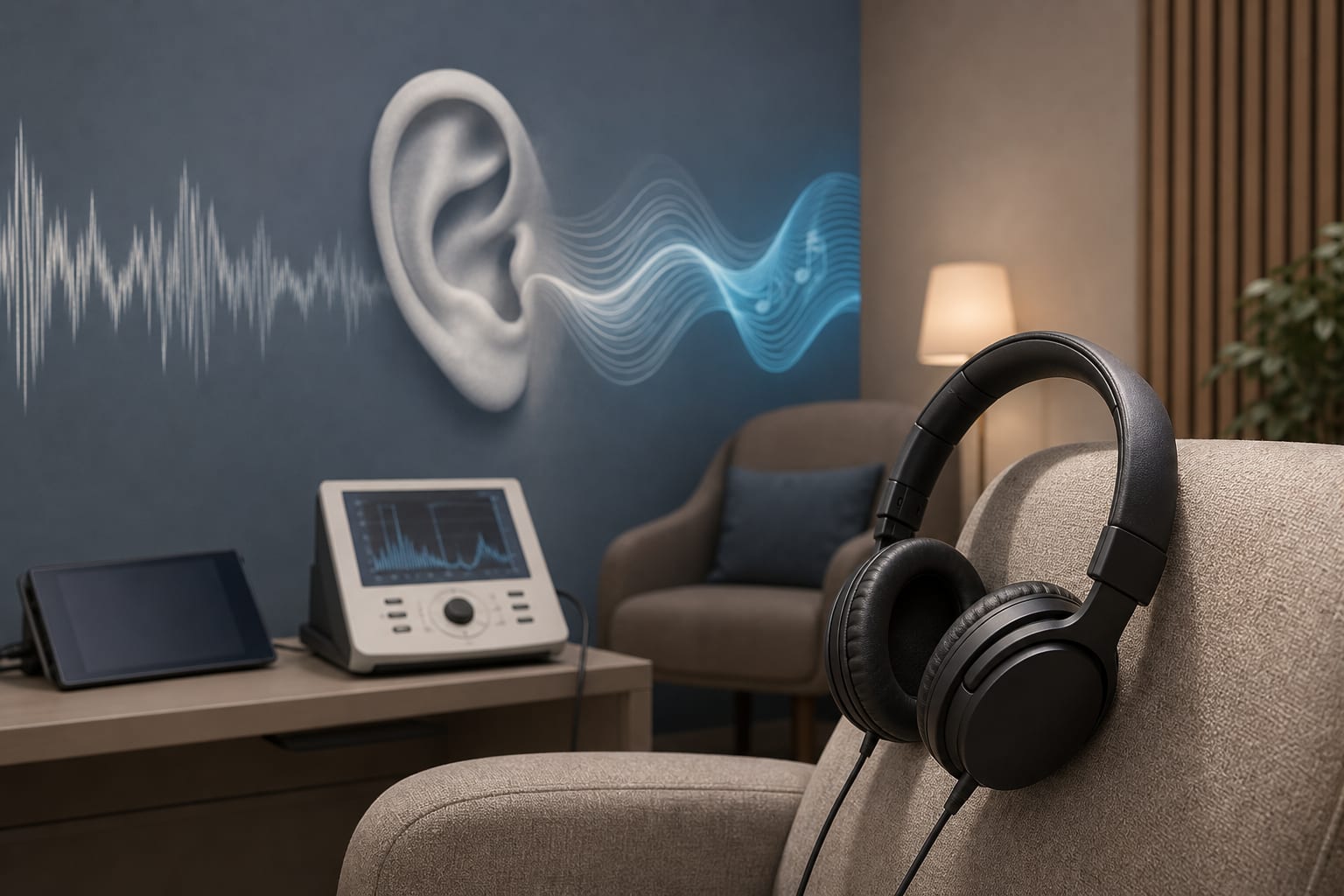
This study evaluates the efficacy of personalized mixed acoustic therapy for chronic tinnitus in patients with and without hearing loss. Findings indicate comparable improvements in tinnitus perception and sleep quality across both groups.

Background

Chronic tinnitus affects a significant portion of the adult population, impacting quality of life and emotional well-being. The relationship between tinnitus and hearing impairment is complex.

Data Highlights

GroupnHAMA ReductionTHI ReductionPSQI Improvement
HL51Statistically significantStatistically significantComparable
NHL60Greater reductionsGreater reductionsComparable

Key Findings

  • Both HL and NHL groups showed improvements in tinnitus frequency and loudness after 3 months.
  • NHL group had significantly greater reductions in HAMA and THI scores compared to HL group.
  • Independent predictors of favorable outcomes included NHL status, female sex, and lower baseline PSQI and HAMA scores.
  • Personalized mixed acoustic therapy can accommodate patients with central 'head noise' who cannot lateralize their tinnitus.

Clinical Implications

The findings indicate that personalized mixed acoustic therapy may be beneficial for both HL and NHL patients.

Conclusion

Personalized mixed acoustic therapy demonstrates efficacy in improving tinnitus perception and sleep quality.

Related Resources & Content

  1. BMC Neurology, 2026 -- The longer, the better? Investigating the effect of prolonged acoustic stimulation on brief acoustic tinnitus suppression
  2. Journal of Neuro-Oncology, 2024 -- Tinnitus Following Vestibular Schwannoma Treatment: A Systematic Review and Comparative Study of Microsurgical and Stereotactic Radiosurgical Approaches
  3. Frontiers in Psychiatry, 2026 -- Beyond the Auditory: Anxiety Bridges Sleep Disturbances and Depressive Symptoms to Tinnitus Handicap
  4. VA DoD Clinical Practice Guideline (CPG) for Tinnitus, 2024
  5. conexiant — Tinnitus Severity Linked to Depression, Anxiety
  6. Efficacy and safety of a modified sound therapy for patients with subjective tinnitus (MOST)
  7. VA DoD Clinical Practice Guideline (CPG) for Tinnitus
  8. The efficacy of notched music therapy vs conventional music therapy for chronic subjective tinnitus patients: a systematic review and meta-analysis - PubMed
  9. An innovative predictive model for assessing tinnitus sound therapy outcomes: integrating audiological and psychometric variables
  10. The results of short-course acoustic test could act as an effective predictor of the efficacy of customized music therapy for chronic tinnitus
  11. Digital Frequency Customized Relieving Sound for Chronic Subjective Tinnitus Management: Prospective Controlled Study - PMC
  12. Duration-dependent associations of sound therapy on tinnitus in hearing loss: A cross-sectional analysis of treatment duration cohorts - ScienceDirect

Original Source(s)

Related Content