Translational AI in whole-slide image cancer histopathology: state of the art and regulatory-approved solutions - Report - MDSpire

Translational AI in whole-slide image cancer histopathology: state of the art and regulatory-approved solutions

  • By

  • Richard Oliver Matzko

  • Burak Kucukgoz

  • Pawel Gertner

  • Christopher Carey

  • Chris M. Bacon

  • Tong Xin

  • July 9, 2026

  • 0 min

Share

Clinical Report: Advancements in Translational AI for Whole-Slide Imaging in Cancer Histopathology

Background

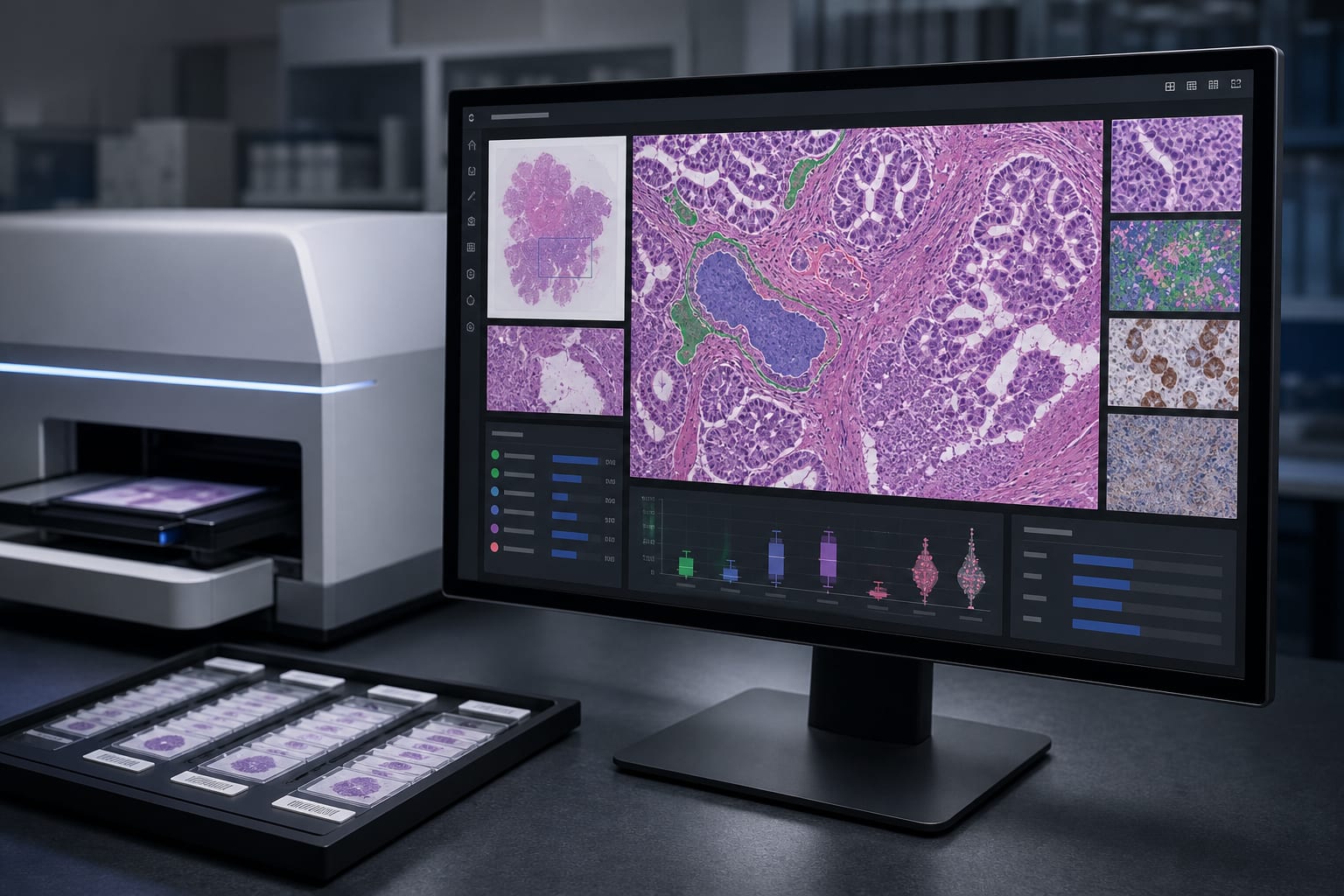
The integration of AI in cancer histopathology is crucial as it enhances diagnostic accuracy and efficiency, particularly in the evaluation of whole-slide images. Regulatory frameworks, such as those from the FDA and CAP, guide the development and validation of these AI tools, ensuring patient safety and effective clinical application.

Data Highlights

No specific numerical data or trial results were provided in the source material.

Key Findings

  • Only four FDA-approved whole-slide imaging solutions exist for cancer applications.
  • AI in digital histopathology is still in an emerging state, with ongoing challenges for clinical adoption.
  • Best practices for AI development and validation were identified through market-approved solutions.
  • Regulatory guidelines emphasize patient safety and effective integration into clinical workflows.
  • Future AI developments may include enhanced algorithms and multimodal approaches for broader applications.

Clinical Implications

Healthcare professionals should be aware of the limited number of FDA-approved AI tools for histopathology.

Conclusion

The review highlights the current landscape of AI in cancer histopathology.
Related Resources & Content

  1. Nature Medicine, 2024 -- An agentic framework for autonomous scientific discovery in cancer pathology
  2. the pathologist, 2026 -- Beyond Image Analysis: How AI is Reshaping the Pathology Workflow
  3. the pathologist, 2026 -- Slide Analysis, Rebuilt for Data Age
  4. Technical Performance Assessment of Digital Pathology Whole Slide Imaging Devices | FDA
  5. Validating Whole Slide Imaging Systems for Diagnostic Purposes in Pathology: 2021 Guideline Update
  6. Advancements in Histopathology: Embracing Digital and 3D Technologies Over Traditional Slides
  7. Digital Pathology Codes - CAP
  8. How Many Practices Are Using Digital Pathology? - CAP
  9. Technical Performance Assessment of Digital Pathology Whole Slide Imaging Devices | FDA
  10. Validating Whole Slide Imaging Systems for Diagnostic Purposes in Pathology: 2021 Guideline Update
  11. Digital transformation of pathology - the European Society of Pathology expert opinion paper | Virchows Archiv | Springer Nature Link
  12. 510(k) Premarket Notification
  13. FDA 510(k) clearance letter for AISight Dx
  14. EVALUATION OF AUTOMATIC CLASS III DESIGNATION FOR Paige Prostate
  15. 510(k) Substantial Equivalence Determination Decision Summary
  16. Device Classification Under Section 513(f)(2)(De Novo)
  17. Artificial intelligence in histopathology and cytopathology: an umbrella review of systematic reviews and meta-analyses | Surgical and Experimental Pathology | Springer Nature Link
  18. Artificial Intelligence (AI)-based tools in the diagnosis and management of prostate cancer: a systematic review and meta-analysis | Prostate Cancer and Prostatic Diseases
  19. Validation, implementation, and impact of an AI model in routine practice for pathologic diagnosis of prostate cancer in an academic medical center - PMC
  20. Influence of Artificial Intelligence Assistance on Gleason Grading and Prostate Cancer Detection by Uropathologists in Daily Practice: A Prospective Multicenter Study | JCO Clinical Cancer Informatics

Original Source(s)

Related Content