Case Report: From misdiagnosis to successful treatment using mepolizumab in ANCA-negative severe EGPA—clinical lessons in eosinophil-targeted therapy - Report - MDSpire

Case Report: From misdiagnosis to successful treatment using mepolizumab in ANCA-negative severe EGPA—clinical lessons in eosinophil-targeted therapy

  • By

  • Ju-Zhang Li

  • Si-Yao Guan

  • Qiao-Zhen Wu

  • Jiang-Nan Zheng

  • July 8, 2026

  • 0 min

Share

Clinical Report: Transitioning from Misdiagnosis to Effective Management of ANCA-Negative Severe EGPA with Mepolizumab

Background

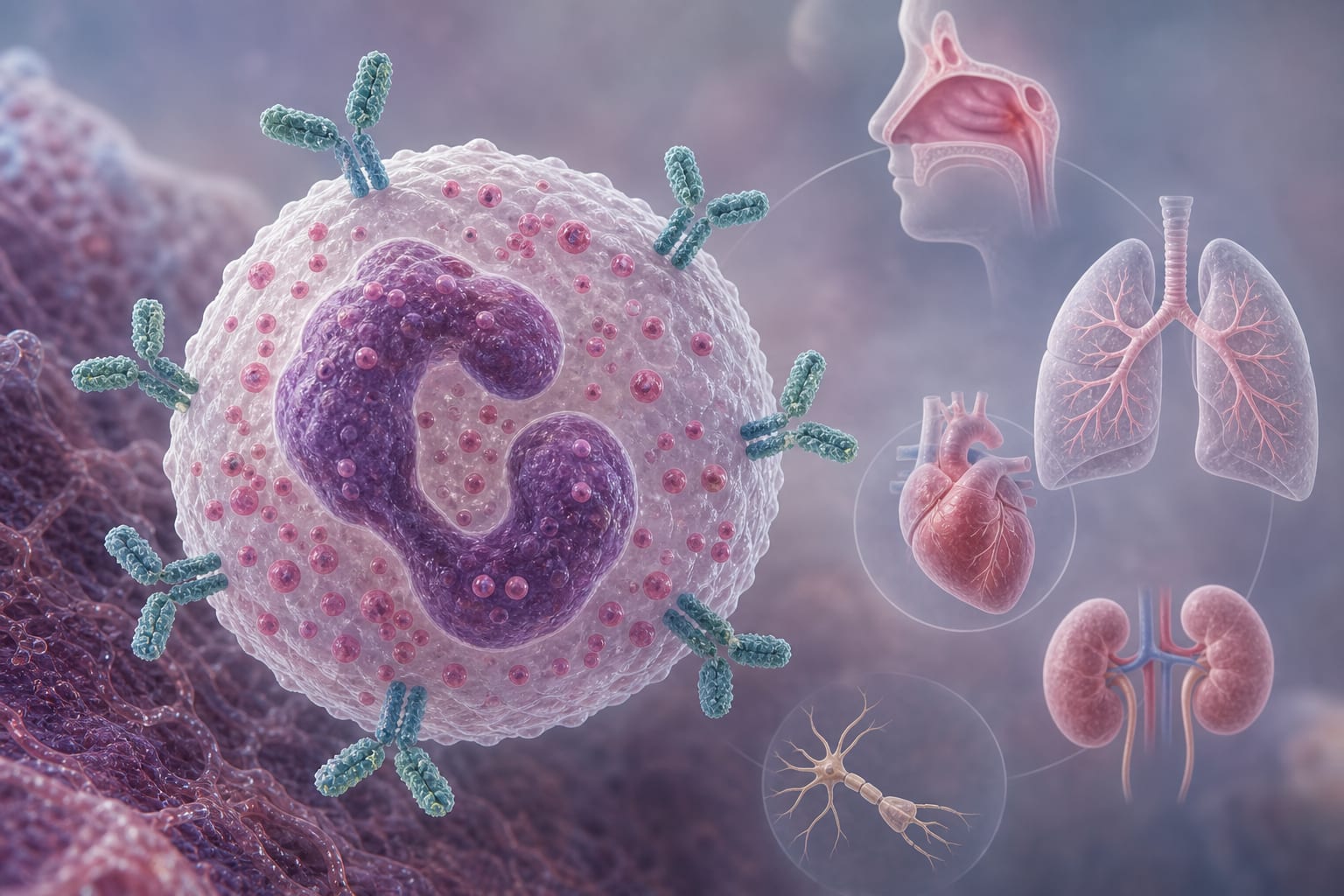
Eosinophilic granulomatosis with polyangiitis (EGPA) is a rare systemic vasculitis that can be misdiagnosed as refractory asthma, particularly in ANCA-negative patients. Understanding the effective management of EGPA is crucial for improving patient outcomes.

Data Highlights

No numerical data or trial data presented in the article.

Key Findings

  • The patient initially presented with asthma and chronic rhinosinusitis, later diagnosed with severe EGPA.
  • After switching from omalizumab to mepolizumab, the patient's symptoms resolved, allowing for glucocorticoid tapering.
  • Mepolizumab was administered at a dosing interval extended to 8 weeks while maintaining remission.
  • ANCA-negative EGPA patients may have a higher risk of severe organ involvement.
  • Clinicians should evaluate for EGPA before initiating biologic therapy in asthma patients.

Clinical Implications

This case highlights the importance of accurate diagnosis in patients with asthma and eosinophilia.

Conclusion

The successful management of this case with mepolizumab highlights the need for careful diagnostic evaluation in eosinophilic conditions.

Related Resources & Content

  1. EULAR recommendations for the management of ANCA-associated vasculitis: 2022 update - ScienceDirect
  2. 2022 American College of Rheumatology/European Alliance of Associations for Rheumatology Classification Criteria for Eosinophilic Granulomatosis With Polyangiitis
  3. the new gastroenterologist — Eosinophilic esophagitis: A year in review
  4. Frontiers in Immunology — Comparative real-world effectiveness and safety of benralizumab and two mepolizumab dosing regimens in eosinophilic granulomatosis with polyangiitis: a 24-month prospective single-center cohort study
  5. The New Gastroenterologist — Updated Clinical Guidelines on Eosinophilic Esophagitis Incorporate Recent Advances from the Past Decade
  6. The New Gastroenterologist — Extended Treatment for Eosinophilic Esophagitis Reduces Relapse Risk Without Increased Complications
  7. Comparative real-world effectiveness and safety of benralizumab and two mepolizumab dosing regimens in eosinophilic granulomatosis with polyangiitis: a 24-month prospective single-center cohort study
  8. Eosinophilic esophagitis: A year in review
  9. 2022 American College of Rheumatology/European Alliance of Associations for Rheumatology Classification Criteria for Eosinophilic Granulomatosis With Polyangiitis
  10. EULAR recommendations for the management of ANCA-associated vasculitis: 2022 update - ScienceDirect
  11. Genome-wide association study of eosinophilic granulomatosis with polyangiitis reveals genomic loci stratified by ANCA status | Nature Communications
  12. Red flags for clinical suspicion of eosinophilic granulomatosis with polyangiitis (EGPA) - ScienceDirect
  13. https://www.vasculitisfoundation.org/wp-content/uploads/2024/01/2021-ACR-VF-Guideline-for-Management-of-ANCA-Associated-Vasculitis.pdf
  14. [Multidisciplinary expert consensus on diagnosis and treatment of eosinophilic granulomatosis with polyangiitis (2025 Edition)] - PubMed
  15. Mepolizumab or Placebo for Eosinophilic Granulomatosis with Polyangiitis | New England Journal of Medicine
  16. Benralizumab versus Mepolizumab for Eosinophilic Granulomatosis with Polyangiitis | New England Journal of Medicine
  17. FASENRA (benralizumab) injection, for subcutaneous use
  18. Benralizumab for treating relapsing or refractory eosinophilic granulomatosis with polyangiitis - NCBI Bookshelf

Original Source(s)

Related Content