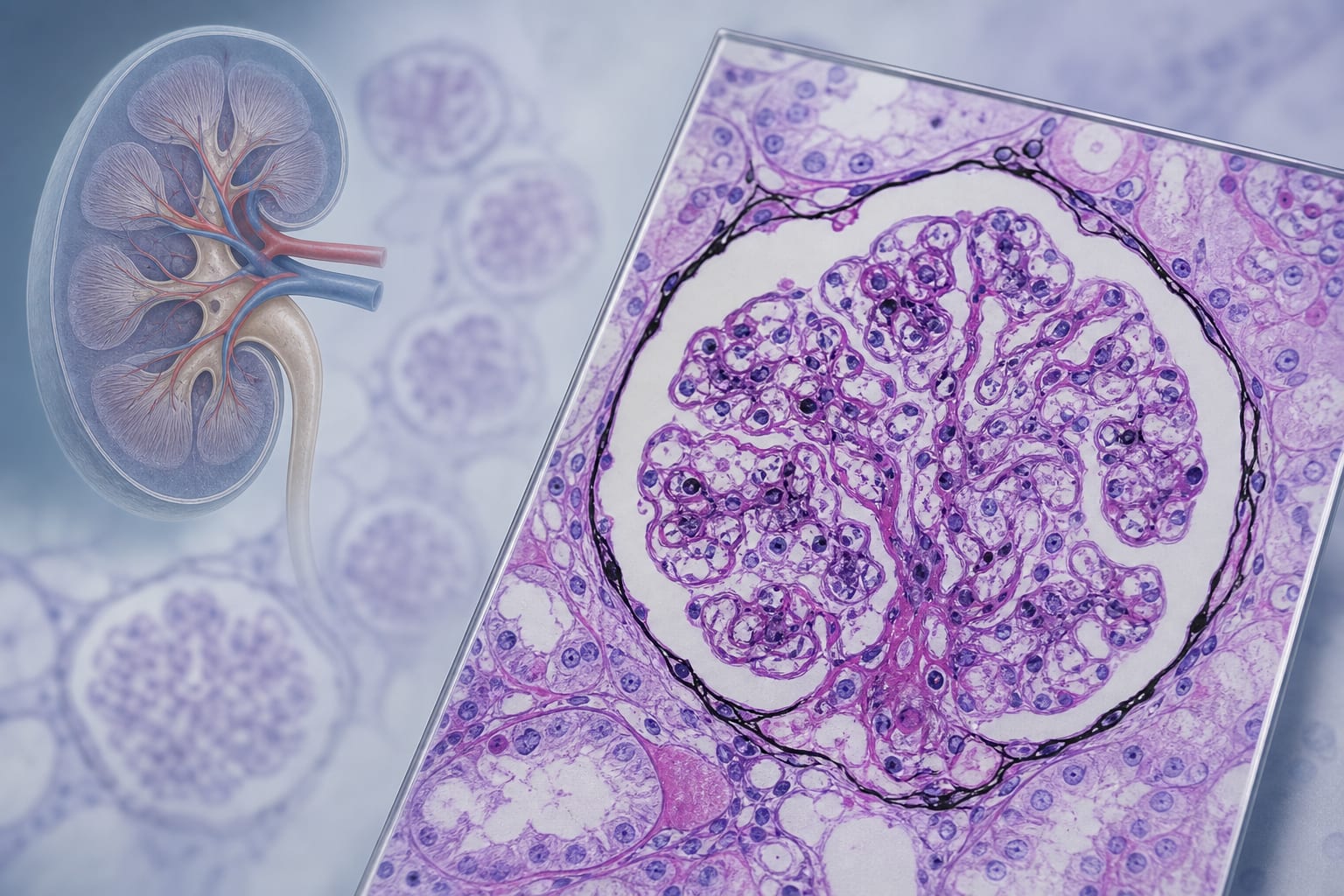
Clinical Report: Utilizing Oxford Classification Activity Scores to Direct Immunotherapy in IgA Nephropathy
Overview
This study investigates the role of Oxford classification activity scores in guiding immunotherapy for IgA nephropathy. It finds that immunotherapy is associated with a 22% increase in proteinuria remission at 12 months (HR 1.22; 95% CI 1.07-1.40; p=0.004), particularly in patients with high SumMEC scores.
Background
IgA nephropathy is the most common primary glomerulonephritis, accounting for a significant proportion of glomerulonephritis cases. The Oxford classification system has been proposed as a prognostic tool, but its utility in directing immunotherapy remains debated. Understanding the relationship between histological features and treatment response is crucial for optimizing patient management.
Data Highlights
A total of 2,389 patients were analyzed, with 1,211 receiving immunosuppressive therapy. Immunotherapy was associated with a 22% increase in proteinuria remission at 12 months (HR 1.22; 95% CI 1.07-1.40; p=0.004).
Key Findings
Immunotherapy improved proteinuria remission in IgA nephropathy patients.
High SumMEC scores were associated with better responses to immunotherapy.
Multivariate analysis indicated a 22% increase in remission rates at 12 months with immunotherapy.
Subgroup analyses showed comparable effects on 6-month and 12-month remission rates.
Clinical Implications
Clinicians should consider the findings regarding SumMEC scores when making treatment decisions for IgA nephropathy.
Conclusion
Immunosuppressive therapy may enhance proteinuria remission in patients with IgA nephropathy, particularly those with high SumMEC scores.
Ahead of ISC2026 in Prague, Jennifer Van Eyk explains how scalable LC-MS workflows and single-cell proteomics are helping reveal the biological differences that could make precision medicine a clinical reality