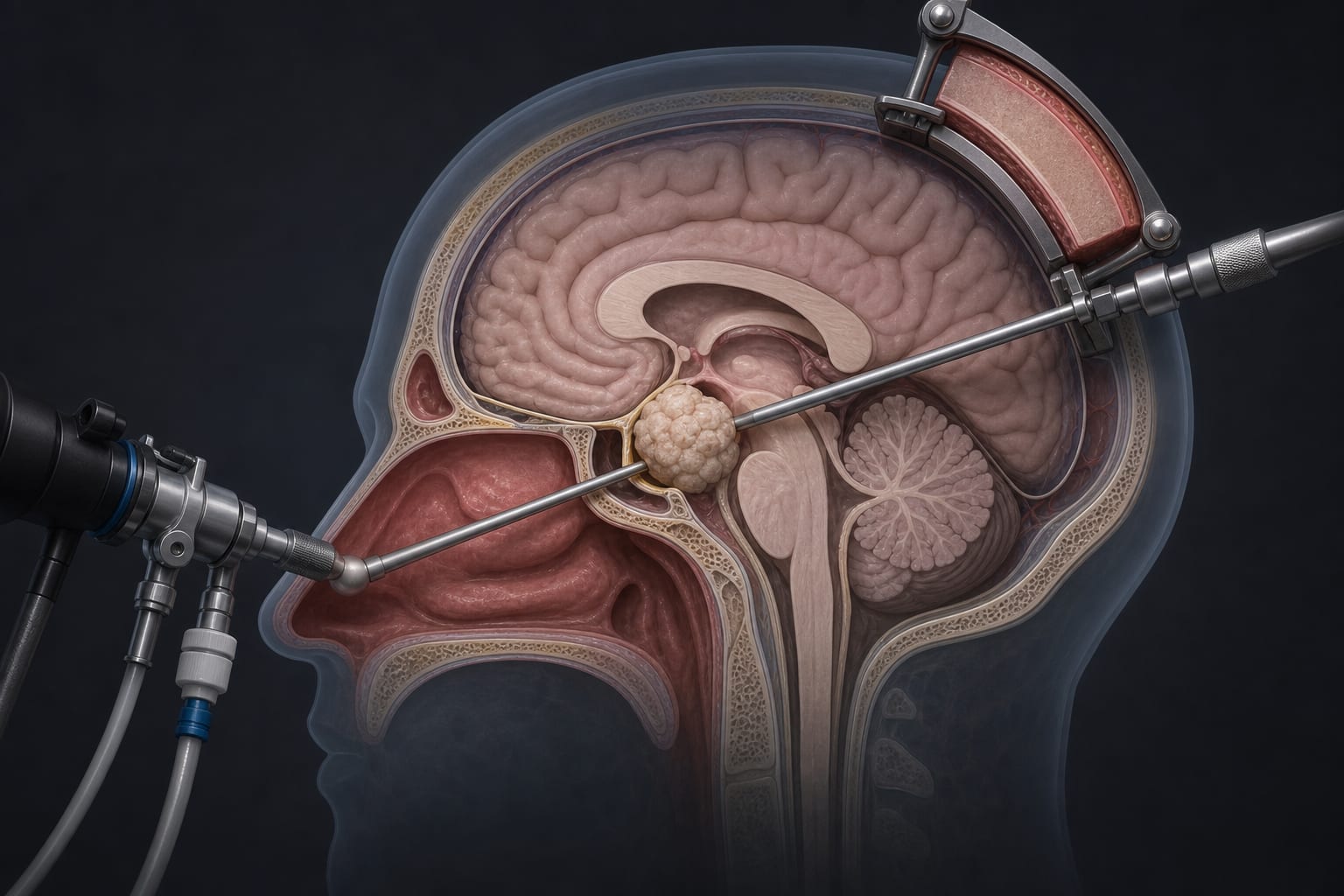
Comparative outcomes of transcranial craniotomy and endoscopic endonasal surgery for craniopharyngioma: a single-center retrospective cohort study - Report - MDSpire
Conexiant’s news site is now MDSpire News. Learn more
Advertisement
Outcomes of Endoscopic Endonasal Surgery Versus Transcranial Craniotomy for Craniopharyngioma: A Retrospective Cohort Analysis from a Single Institution
Outcomes of Endoscopic Endonasal Surgery Versus Transcranial Craniotomy for Craniopharyngioma
Overview
This study compares outcomes of endoscopic endonasal approach (EEA) and transcranial craniotomy (TCA) for craniopharyngioma resection.
Background
Craniopharyngiomas are benign tumors that can cause significant morbidity due to their location near critical neurovascular structures. Surgical resection is the primary treatment, but the optimal approach remains debated. Understanding the comparative outcomes of different surgical techniques is crucial for improving patient management.
Data Highlights
Outcome
EEA
TCA
p-value
Gross Total Resection Rate
82.4%
45.5%
0.002
Length of Stay (days)
16.19 ± 3.97
18.76 ± 4.23
0.019
Improvement in Symptoms
90.9%
76.5%
0.047
Best-Corrected Visual Acuity (logMAR)
0.30 [0.12, 0.45]
0.42 [0.22, 0.62]
0.041
Electrolyte Imbalance
17.6%
42.4%
0.021
Transient Diabetes Insipidus
20.6%
45.5%
0.028
Persistent Diabetes Insipidus
14.7%
30.3%
0.048
New Hypopituitarism
41.2%
69.7%
0.022
Recurrence/Progression Rate
8.8%
21.2%
0.047
Key Findings
EEA achieved a higher gross total resection rate (82.4% vs. 45.5%, p=0.002).
Patients undergoing EEA had a shorter hospital stay (16.19 ± 3.97 days vs. 18.76 ± 4.23 days, p=0.019).
Improvement in headache/ICP-related symptoms was observed in 90.9% of EEA patients compared to 76.5% of TCA patients (p=0.047).
Objective visual outcomes were better after EEA (BCVA logMAR 0.30 vs. 0.42, p=0.041).
EEA was associated with lower rates of electrolyte imbalance (17.6% vs. 42.4%, p=0.021) and transient diabetes insipidus (20.6% vs. 45.5%, p=0.028).
Recurrence/progression rates were lower in EEA patients (8.8% vs. 21.2%, p=0.047).
Clinical Implications
The findings provide comparative outcomes of EEA and TCA for craniopharyngioma.
Conclusion
This study presents outcomes of EEA and TCA in terms of resection rates and complications.
The largest study of former National Football League players found excess persisted even after accounting for the lower overall mortality associated with elite athletic participation.