The influence of age in the progression from pre-myopia to myopia onset: a 1 year retrospective analysis - Report - MDSpire

The influence of age in the progression from pre-myopia to myopia onset: a 1 year retrospective analysis

  • By

  • Shuang Wang

  • Keke Huang

  • Xingyu He

  • Zhanfeng Wang

  • July 7, 2026

  • 0 min

Share

Clinical Report: Age-Related Effects on the Transition from Pre-Myopia to Myopia

Overview

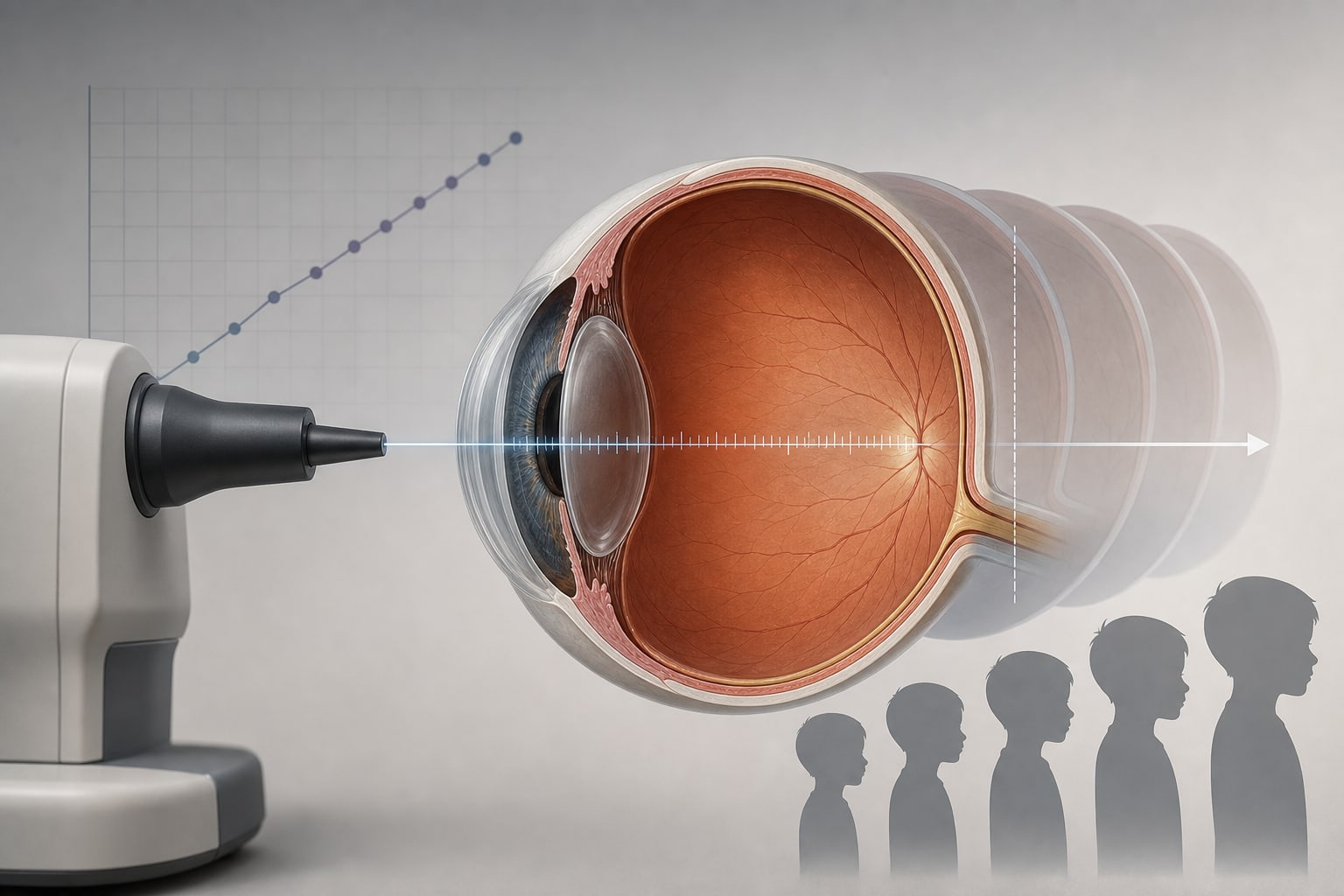
This study investigates the impact of age on axial elongation during the transition from pre-myopia to myopia in children aged 6-10 years. Findings indicate that younger children exhibit greater axial elongation.

Background

Myopia is a significant global public health concern, affecting a substantial portion of the population and leading to various eye diseases. Understanding the transition from pre-myopia to myopia is crucial, as accelerated axial growth during this period may predict future high myopia risk.

Data Highlights

Age (years)Annual Axial Elongation (mm)
60.76 ± 0.16
70.64 ± 0.17
80.54 ± 0.24
90.37 ± 0.14
100.38 ± 0.03

Key Findings

  • Younger age is associated with greater annual axial elongation during the transition from pre-myopia to myopia.
  • Children aged 6 and 7 years showed significantly greater axial elongation compared to those aged 9 years.
  • Each additional year of age correlates with a 0.093 mm decrease in annual axial elongation.
  • Significant differences in axial elongation were observed between the 6-7 year group and the 8-9 year group.

Clinical Implications

Healthcare professionals should consider the age of children when assessing the risk of myopia progression. Early monitoring and intervention strategies may be beneficial for younger children transitioning from pre-myopia to myopia.

Conclusion

The findings indicate a relationship between age and axial elongation during the pre-myopia to myopia transition.

Related Resources & Content

  1. Contact Lens Spectrum, 2026 -- Myopia Beyond 2025
  2. IMI 2025 Digest -- International Myopia Institute
  3. Low-dose atropine for myopia progression in children: a 2017–2024 systematic review and meta-analysis of randomized placebo-controlled trials
  4. FDA Authorizes Marketing of First Eyeglass Lenses to Slow Progression of Pediatric Myopia | FDA
  5. Contact Lens Spectrum — Myopia Beyond 2025
  6. Contact Lens Spectrum — Myopia Beyond 2025
  7. Contact Lens Spectrum — Myopia Beyond 2025
  8. IMI 2025 Digest
  9. Low-dose atropine for myopia progression in children: a 2017–2024 systematic review and meta-analysis of randomized placebo-controlled trials
  10. FDA Authorizes Marketing of First Eyeglass Lenses to Slow Progression of Pediatric Myopia | FDA

Original Source(s)

Related Content