Conexiant’s news site is now MDSpire News. Learn more
Advertisement
Expanding the Concept of Active Tunnels in Hidradenitis Suppurativa: Clinical Ultrasound Findings Indicate Greater Inflammatory Activity Beyond Drainage Criteria
Clinical Report: Expanding the Concept of Active Tunnels in Hidradenitis Suppurativa
Overview
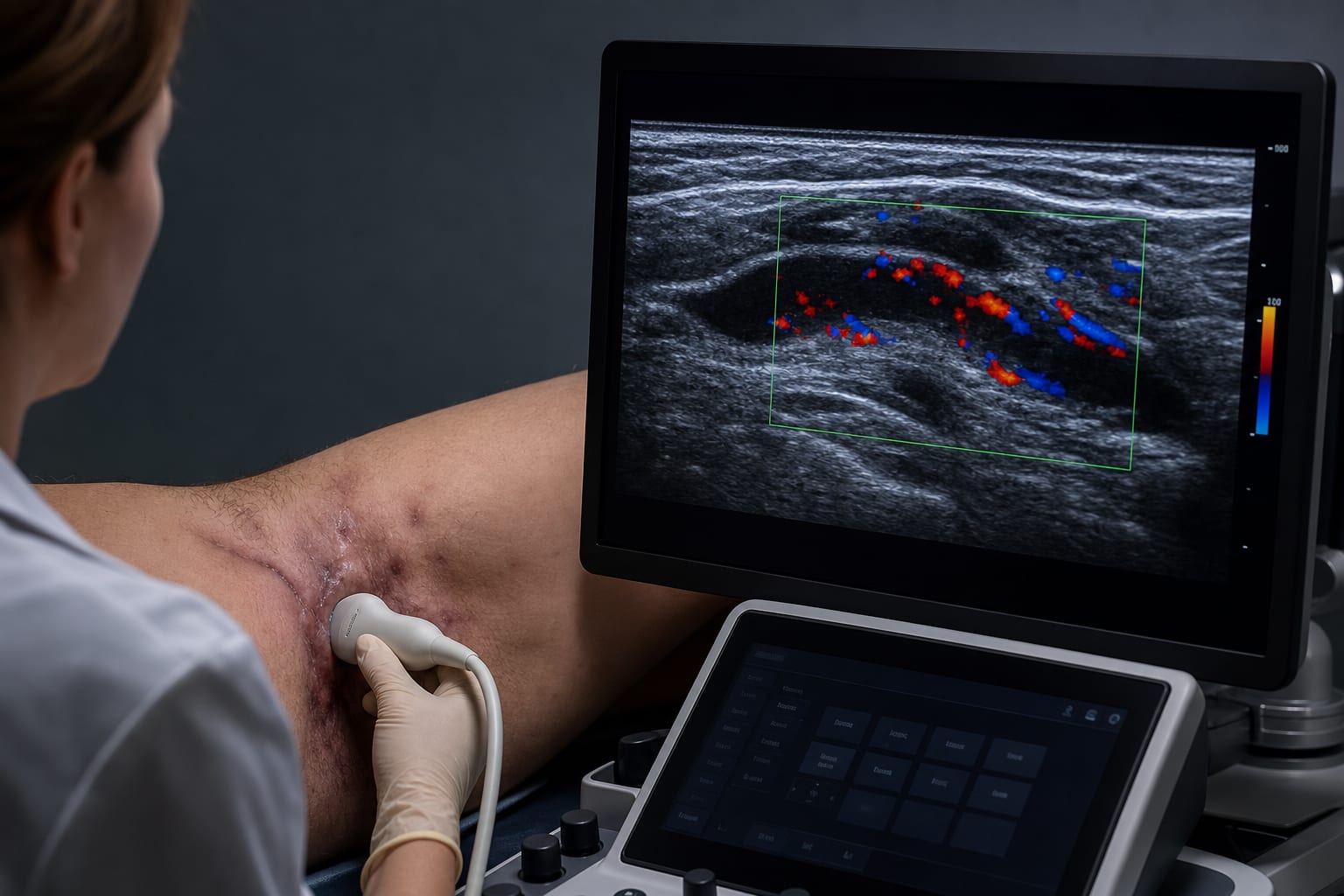
This study highlights that current definitions of active tunnels in hidradenitis suppurativa (HS) may overlook significant inflammatory activity in non-draining lesions. High-frequency colour Doppler ultrasound reveals persistent vascular activity in these tunnels, suggesting a need for revised clinical criteria for identifying active disease.
Background
Hidradenitis suppurativa (HS) is a chronic inflammatory skin condition that can lead to severe morbidity due to recurrent lesions and tissue damage. Traditional assessments often equate tunnel activity with purulent drainage, potentially missing early inflammatory changes in non-draining tunnels. Recognizing these changes is crucial for timely intervention and improved patient outcomes.
Patients with non-draining lesions exhibited inflammatory changes that were not identified through traditional assessment methods.
Clinical Relevance
Revised criteria for active disease could lead to earlier diagnosis and intervention, improving patient outcomes.
Key Findings
High-frequency Doppler ultrasound is effective in identifying vascular activity in non-draining tunnels, which may indicate active disease.
Traditional definitions of active tunnels may miss significant inflammatory activity, leading to delayed treatment.
Limitations of Doppler ultrasound include potential operator dependency and the need for specialized training to interpret results accurately.
Clinical Implications
Healthcare professionals should consider incorporating high-frequency ultrasound into routine assessments of HS to better identify active inflammation. Recognizing non-draining tunnels as potentially active may lead to earlier and more effective treatment strategies.
Conclusion
This study advocates for a broader definition of active tunnels in HS, emphasizing the importance of objective imaging in recognizing inflammatory activity. Adapting clinical criteria could enhance patient management and outcomes.
Related Resources & Content
Frontiers in Immunology, 2026 -- Meta-inflammation in Hidradenitis Suppurativa
JAMA Dermatology, 2023 -- Lutikizumab in Adults With Moderate to Severe Hidradenitis Suppurativa
Dermatology and Therapy, 2026 -- The Role of Inflammatory Biomarkers in Disease Severity
S2k guideline for the treatment of hidradenitis suppurativa, 2024
PubMed, 2023 -- Secukinumab in moderate-to-severe hidradenitis suppurativa
Frontiers in Immunology — Differentiation defects reposition sebaceous glands as inflammatory instigators in the early pathogenesis of hidradenitis suppurativa
International consensus statement on the use of ultrasound in hidradenitis suppurativa
S2k guideline for the treatment of hidradenitis suppurativa / acne inversa – Short version - Zouboulis - 2024 - JDDG: Journal der Deutschen Dermatologischen Gesellschaft - Wiley Online Library
Secukinumab in moderate-to-severe hidradenitis suppurativa (SUNSHINE and SUNRISE): week 16 and week 52 results of two identical, multicentre, randomised, placebo-controlled, double-blind phase 3 trials - PubMed