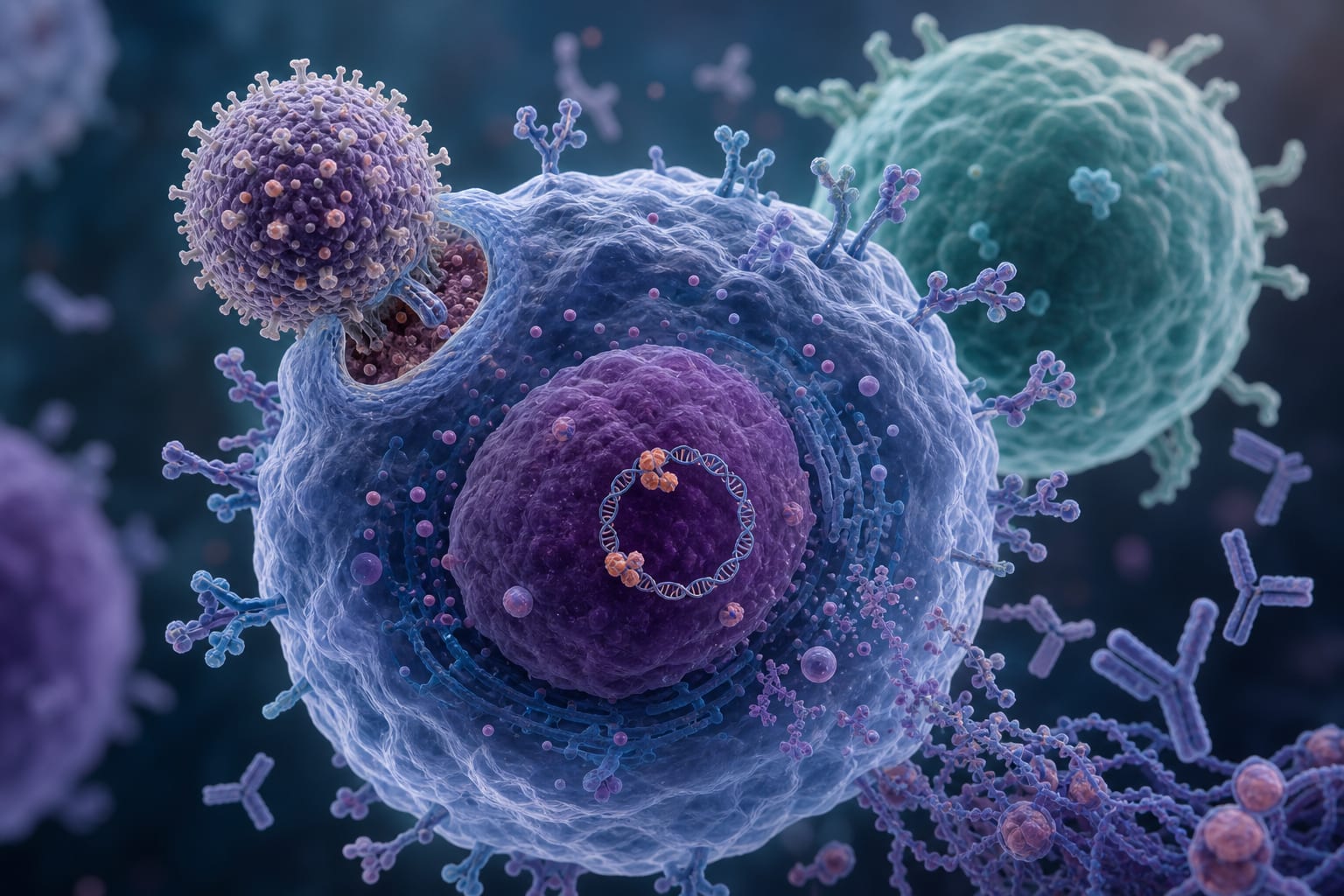
Spatial topology and competitive access differentially shape early T cell priming in the lymph node: an agent-based modeling approach - Report - MDSpire
Advertisement
Spatial topology and competitive access differentially shape early T cell priming in the lymph node: an agent-based modeling approach
Influence of Spatial Structure and Competitive Interactions on Initial T Cell Priming in Lymph Nodes
Overview
This study presents a spatially explicit agent-based model, COORDINATE, to analyze T cell priming in lymph nodes. It highlights how stromal architecture and competition for dendritic cell access significantly impact T cell activation and suggests that access to antigen may be a limiting factor in T cell priming.
Background
Understanding T cell priming in lymph nodes is crucial for developing effective immunotherapies. The lymph node microenvironment plays a vital role in facilitating T cell interactions with antigen-presenting cells. Insights into the mechanisms governing T cell activation can inform strategies to enhance immune responses in various clinical settings.
Data Highlights
No numerical data or trial results were provided in the source material.
Key Findings
The COORDINATE model integrates fibroblastic reticular cell topology and chemokine-guided migration.
Stromal architecture influences which T cells encounter antigen-bearing dendritic cells.
Competition for dendritic cell access can prevent many T cells from forming productive contacts.
Reduced T cell activation may result from limited access rather than solely from impaired signaling.
Improving early access to antigens could enhance adaptive immune responses.
Clinical Implications
The findings suggest that enhancing access to antigen-bearing dendritic cells may be a viable strategy to improve T cell priming. This approach could inform the design of future immunotherapies aimed at optimizing T cell activation.
Conclusion
The study emphasizes the importance of spatial structure and competition in T cell priming, suggesting that access to antigens is a critical factor in T cell activation.