Real-Time Patient Interaction With an Epilepsy Monitor Enhances Seizure Detection
-
October 13, 2026
Clinical Report: Real-Time Patient Interaction With an Epilepsy Monitor Enhances Seizure Detection
Overview
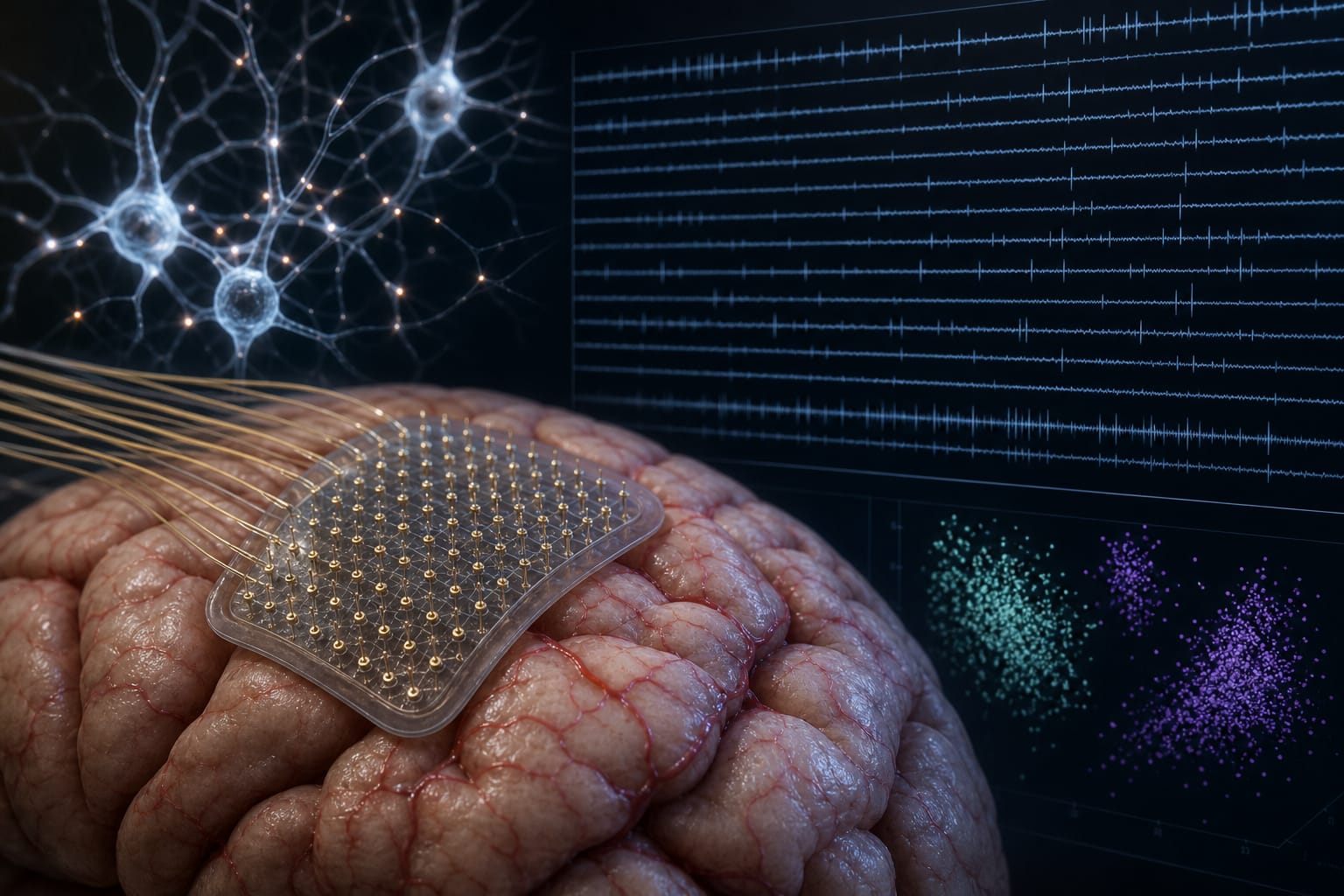
In a small NIH-funded study at the University of Pennsylvania, 13 epilepsy monitoring unit patients used a smartphone interface to ask questions about EEG data and respond to seizure alerts. The system answered more than 92% of patient inquiries accurately; patient feedback helped refine seizure detection and was associated with an approximately 80% reduction in false alarms over the study period.
Background
EEG monitoring captures brain activity that can signal seizures or elevated seizure risk, but data are commonly reviewed by experts daily or at intervals of several days. Automated systems can flag suspicious signals, including benign activity that may require expert review to dismiss. The study authors described a potential role for patients’ real-time feedback alongside access to their own monitoring data. Related clinical context emphasizes continuous video-EEG monitoring for seizure diagnosis and differentiation from mimicking events.
Data Highlights
| Measure | Study finding |
|---|---|
| Participants and setting | 13 patients in the Hospital of the University of Pennsylvania epilepsy monitoring unit, studied over several days |
| Messages exchanged | More than 1,300 |
| Accurate, relevant responses to patient questions | Over 92% |
| Real-time seizure detections receiving participant responses | More than 67% |
| Change in false-alarm rate with patient feedback | Approximately 80% reduction over the study period |
| Additional alarm reduction with expert feedback | 2% |
Key Findings
- Participants used a smartphone application to receive EEG-based alerts and notifications and to ask a conversational SI targeted questions about their brain activity.
- The system provided accurate, relevant information for over 92% of patient inquiries.
- Patients responded to more than 67% of real-time seizure detections, classifying events as true, false, or uncertain.
- According to the authors, incorporating patient feedback enabled the seizure-detection model to refine its performance and reduced the false-alarm rate by approximately 80% during the study.
- Adding expert feedback to SI learning produced a further 2% reduction in alarms.
- The study was small and conducted in a hospital setting; the authors reported plans for larger outpatient studies. A related UCI Health source describes multidisciplinary assessment and continuous EEG monitoring as important for distinguishing epilepsy from mimicking events.
Clinical Implications
The study demonstrates a proof of concept for two-way communication between patients and an EEG-based monitoring system in an inpatient epilepsy monitoring unit. The authors state that larger studies are needed and are planning research on outpatient use; the reported findings do not establish performance or clinical outcomes in that setting.
Conclusion
In this 13-patient hospital study, real-time patient interaction provided access to EEG-based information and feedback that was associated with fewer false alarms. Further evaluation is planned to assess the platform in larger and outpatient populations.
Related Resources & Content
- National Institutes of Health/National Institute of Neurological Disorders and Stroke, Article, 2026 -- Real-Time Patient Interaction With an Epilepsy Monitor Enhances Seizure Detection
- UCI Health, Clinical Connection -- Epilepsy monitoring unit delivers clarity and confidence in care
- International League Against Epilepsy, Position paper, 2025 -- Updated classification of epileptic seizures
- Journal of Medical Internet Research (JMIR) — Vision-Based Artificial Intelligence Technologies for Epilepsy Monitoring: Scoping Review and Taxonomy Development Study
- Frontiers in Neurology — Efficient EEG channel-and-frequency-band selection for epileptic seizure classification using multi-objective optimization
- Annals of Neurology — Continuous Versus Short EEG After Ischemic Stroke: What cEEG Adds for Detecting Abnormalities and Predicting Post-Stroke Epilepsy
- Epilepsy monitoring unit delivers clarity and confidence in care
- Updated classification of epileptic seizures: Position paper of the International League Against Epilepsy
- Automated seizure detection using wearable devices: updated systematic review and meta-analysis of tonic-clonic and focal seizure detection
- Updated classification of epileptic seizures: Position paper of the International League Against Epilepsy
Based on findings from:
Patients engage with epilepsy monitor in real time, improving seizure detection
National Institutes Of Health, 2026.
https://www.nih.gov/news-events/news-releases/patients-engage-epilepsy-monitor-real-time-improving-seizure-detection
This content is an AI-generated, fully rewritten summary based on a published scholarly article. It does not reproduce the original text and is not a substitute for the original publication. Readers are encouraged to consult the source for full context, data, and methodology.