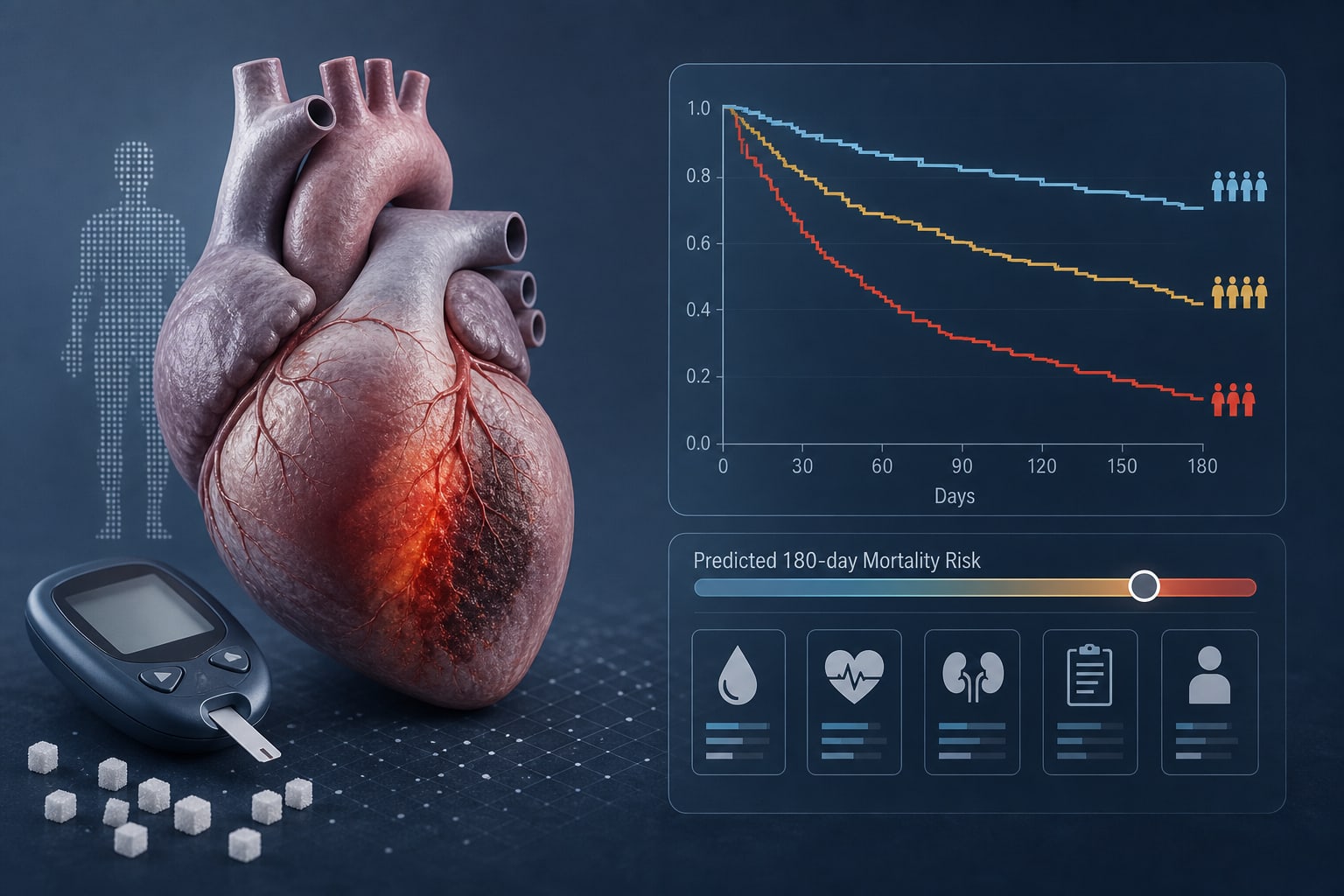
Clinical Report: Admission-Based Model for Predicting 180-Day Mortality in DM-AMI
Overview
This study developed and externally validated a model for predicting 180-day mortality in patients with diabetic acute myocardial infarction (DM-AMI) using routine admission variables.
Background
Diabetic patients experiencing acute myocardial infarction (AMI) are at a significantly higher risk of mortality, yet the risk varies widely within this subgroup. Understanding this risk heterogeneity is crucial for improving patient management and outcomes. Current risk assessment tools, such as the GRACE score, may not fully capture the complexities of this population.
Data Highlights
Variable
Value
C-index (development cohort)
0.848
AUC (development cohort)
0.857
AUC (external validation cohort)
0.744
ΔAUC (combined model vs GRACE)
0.014
P-value for ΔAUC
0.031
Calibration slope (MIMIC-IV)
0.527
Observed/Expected (O/E) ratio
0.652
Key Findings
The model included eight variables: age, heart rate, SBP, glucose, BUN, hemoglobin, RDW, and WBC.
In the development cohort, there were 1,514 patients with DM-AMI and 90 deaths at 180 days.
The model showed good discrimination with a C-index of 0.848 and an AUC of 0.857 in the development cohort.
External validation maintained performance with an AUC of 0.744.
The combined model improved performance compared to GRACE with a statistically significant ΔAUC of 0.014 (P = 0.031).
Calibration analysis indicated risk overestimation in the external cohort (slope 0.527; O/E 0.652).
Clinical Implications
The admission-based model can assist clinicians in identifying high-risk DM-AMI patients.
Conclusion
The study highlights the significant risk heterogeneity among DM-AMI patients.
Nearly 90% of patients who met algorithmic criteria for postacute sequelae of SARS-CoV-2 infection had at least 1 chronic or potentially chronic condition requiring ongoing clinical management.
National survey findings suggest many US adults report making health decisions based on social media despite widespread concerns about the accuracy of health information shared to the platforms.