Cardiovascular safety and early myocardial deformation signal after upadacitinib initiation in immune-mediated inflammatory disorders - Report - MDSpire
Advertisement
Cardiovascular safety and early myocardial deformation signal after upadacitinib initiation in immune-mediated inflammatory disorders
Clinical Report: Cardiovascular Safety and Myocardial Deformation Indicators Following Upadacitinib Treatment
Overview
This study assessed the cardiovascular safety and myocardial deformation indicators following upadacitinib initiation in patients with immune-mediated inflammatory conditions.
Background
The cardiovascular safety of Janus kinase (JAK) inhibitors is a significant concern due to class-wide warnings from regulatory agencies regarding major adverse cardiovascular events. Patients with immune-mediated inflammatory disorders have an elevated cardiovascular risk that is not fully explained by traditional factors. Understanding the cardiovascular implications of JAK inhibitors, particularly upadacitinib, is crucial for informed clinical decision-making.
Data Highlights
Parameter
Baseline
1 Month
3 Months
6 Months
LVEF (%)
56.0 (IQR 55.0–61.0)
No change
No change
No change
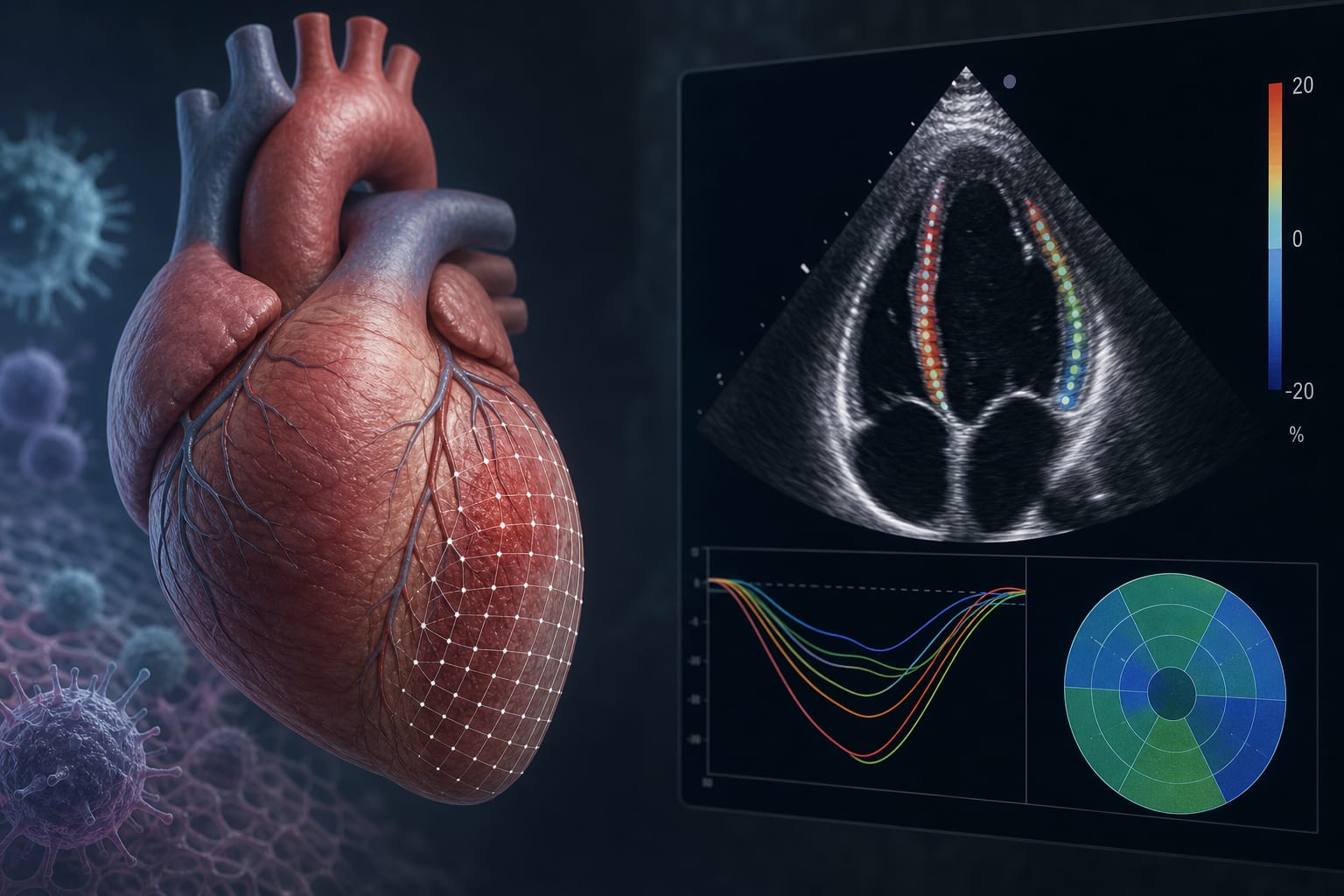
GLS (%)
-18.4 (IQR -19.8 to -16.2)
Improved (p=0.003)
Sustained (p=0.007)
Sustained (p=0.007)
E/e′
Not reported
Not reported
Not reported
Increased (p=0.008)
Key Findings
Upadacitinib initiation did not lead to early structural or systolic myocardial impairment.
Global longitudinal strain (GLS) showed a significant overall time effect with improvement at 1 month, sustained through 6 months.
No significant changes were observed in left ventricular ejection fraction (LVEF), left ventricular mass index, or epicardial fat thickness.
E/e′ increased modestly at 6 months without evidence of structural remodeling.
Clinical Implications
The results indicate that upadacitinib does not appear to cause early myocardial harm in patients with immune-mediated inflammatory conditions.
Conclusion
The initiation of upadacitinib was associated with no early myocardial harm and a favorable GLS trajectory.