The NLRP3 inflammasome in gynecological cancers: a double-edged sword shaping the immune microenvironment and immunotherapy response - Report - MDSpire

The NLRP3 inflammasome in gynecological cancers: a double-edged sword shaping the immune microenvironment and immunotherapy response

  • By

  • Yibo He

  • Shiyue Wu

  • Zian Shou

  • Qian Guo

  • Yaonan Hong

  • Lianfang Zhao

  • Jie Wang

  • June 24, 2026

  • 0 min

Share

Clinical Report: The Role of the NLRP3 Inflammasome in Gynecological Cancers

Overview

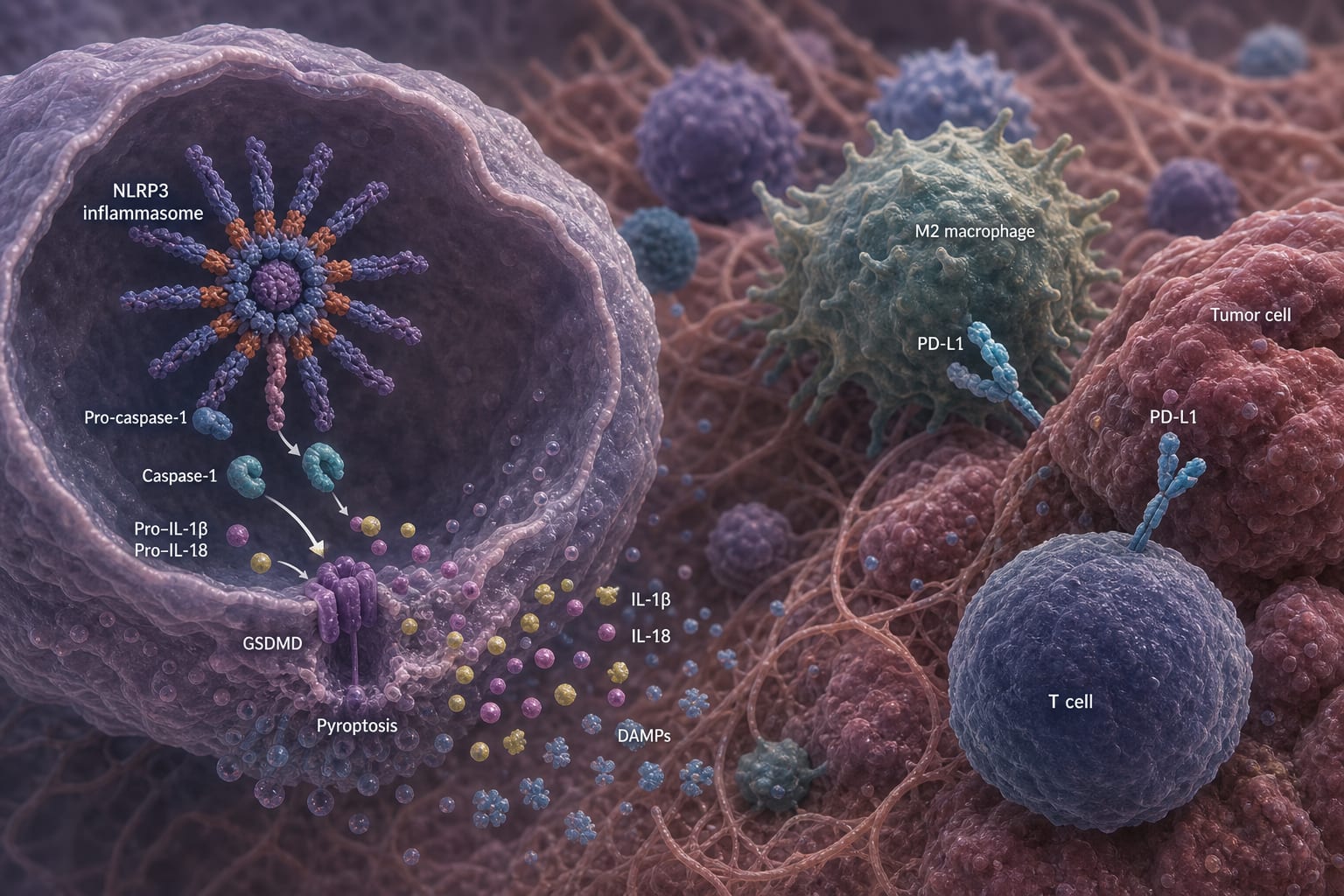
This mini-review evaluates the dual role of the NLRP3 inflammasome in gynecological cancers, highlighting its impact on immune suppression and responses to immunotherapy. NLRP3's functions vary across ovarian, endometrial, and cervical cancers.

Background

Gynecological cancers, including ovarian, endometrial, and cervical cancers, have high mortality rates and limited treatment options. The immune microenvironment and the role of the NLRP3 inflammasome are important for therapeutic strategies in immunotherapy.

Data Highlights

No numerical data or trial results were provided in the source material.

Key Findings

  • The NLRP3 inflammasome drives immune suppression in ovarian cancer via PD-L1 upregulation and M2 macrophage polarization.
  • In endometrial cancer, the ERRα-NLRP3-GSDMD pathway regulates pyroptosis, showing pro-immune effects in MSI-H tumors.
  • Cervical cancer utilizes HPV oncoproteins to silence NLRP3, evading immune surveillance.
  • The PD-L1/NLRP3 axis contributes to resistance against anti-PD-1 immunotherapy across various cancers.
  • NLRP3-activating nanovaccines and small-molecule agonists may convert immunologically cold tumors into immunoresponsive ones.
  • Combination approaches integrating NLRP3 modulators with immune checkpoint inhibitors are discussed.

Clinical Implications

Understanding the context-dependent functions of NLRP3 may inform the development of treatment combinations for gynecological cancers.

Conclusion

The NLRP3 inflammasome plays a complex role in gynecological cancers, influencing immune responses and treatment outcomes.

Related Resources & Content

  1. Frontiers in Immunology, 2026 -- NLRP3 inflammasomes at the ARDS-cancer interface: mechanisms and translational hypotheses
  2. Frontiers in Immunology, 2026 -- Immune heterogeneity and therapeutic resistance in gynecological malignancies
  3. Frontiers in Immunology, 2026 -- The regulatory mechanism of NLRP3 inflammasome in the “immune paralytic-overactivation” imbalance in sepsis
  4. Frontiers in Immunology — Autophagy modulation in gynaecologic oncology: insights into immune regulation and therapeutic potential
  5. ESGO-ESTRO-ESP guidelines for the management of patients with endometrial carcinoma: update 2025
  6. FDA approves pembrolizumab with chemotherapy for primary advanced or recurrent endometrial carcinoma
  7. Cervical Cancer, Version 2.2026, NCCN Clinical Practice Guidelines In Oncology
  8. Overview | Dostarlimab with platinum-based chemotherapy for treating primary advanced or recurrent endometrial cancer with high microsatellite instability or mismatch repair deficiency | Guidance | NICE
  9. Pembrolizumab plus chemotherapy in advanced or recurrent endometrial cancer: overall survival and exploratory analyses of the NRG GY018 phase 3 randomized trial - PMC
  10. Pembrolizumab or placebo with chemoradiotherapy followed by pembrolizumab or placebo for newly diagnosed, high-risk, locally advanced cervical cancer (ENGOT-cx11/GOG-3047/KEYNOTE-A18): overall survival results from a randomised, double-blind, placebo-controlled, phase 3 trial - ScienceDirect
  11. Pembrolizumab plus chemotherapy for advanced and recurrent cervical cancer: final analysis according to bevacizumab use in the randomized KEYNOTE-826 study - ScienceDirect
  12. Atezolizumab plus chemotherapy and bevacizumab in cervical cancer
  13. Immunotherapy with anti-PD-1 or PD-L1 in advanced ovarian cancer: A meta-analysis of randomized trials - ScienceDirect
  14. Newly diagnosed and relapsed epithelial ovarian cancer: ESMO Clinical Practice Guideline for diagnosis, treatment and follow-up - PubMed
  15. Frontiers | The NLRP3 inflammasome in urogenital cancers: structure, dual function, and therapeutic potential
  16. Inflammasomes and pyroptosis in cancer: mechanisms and therapeutic advances | Journal of Hematology & Oncology | Springer Nature Link
  17. Targeting the NLRP3 inflammasome for inflammatory disease therapy - ScienceDirect
  18. Bioinformatic and experimental data pertaining to the role of the NLRP3 inflammasome in ovarian cancer | Journal of Cancer Research and Clinical Oncology | Springer Nature Link

Original Source(s)

Related Content