Robotic intracorporeal anastomosis enhances technical precision while reducing surgeon cognitive load: a prospective multicentre study - Report - MDSpire

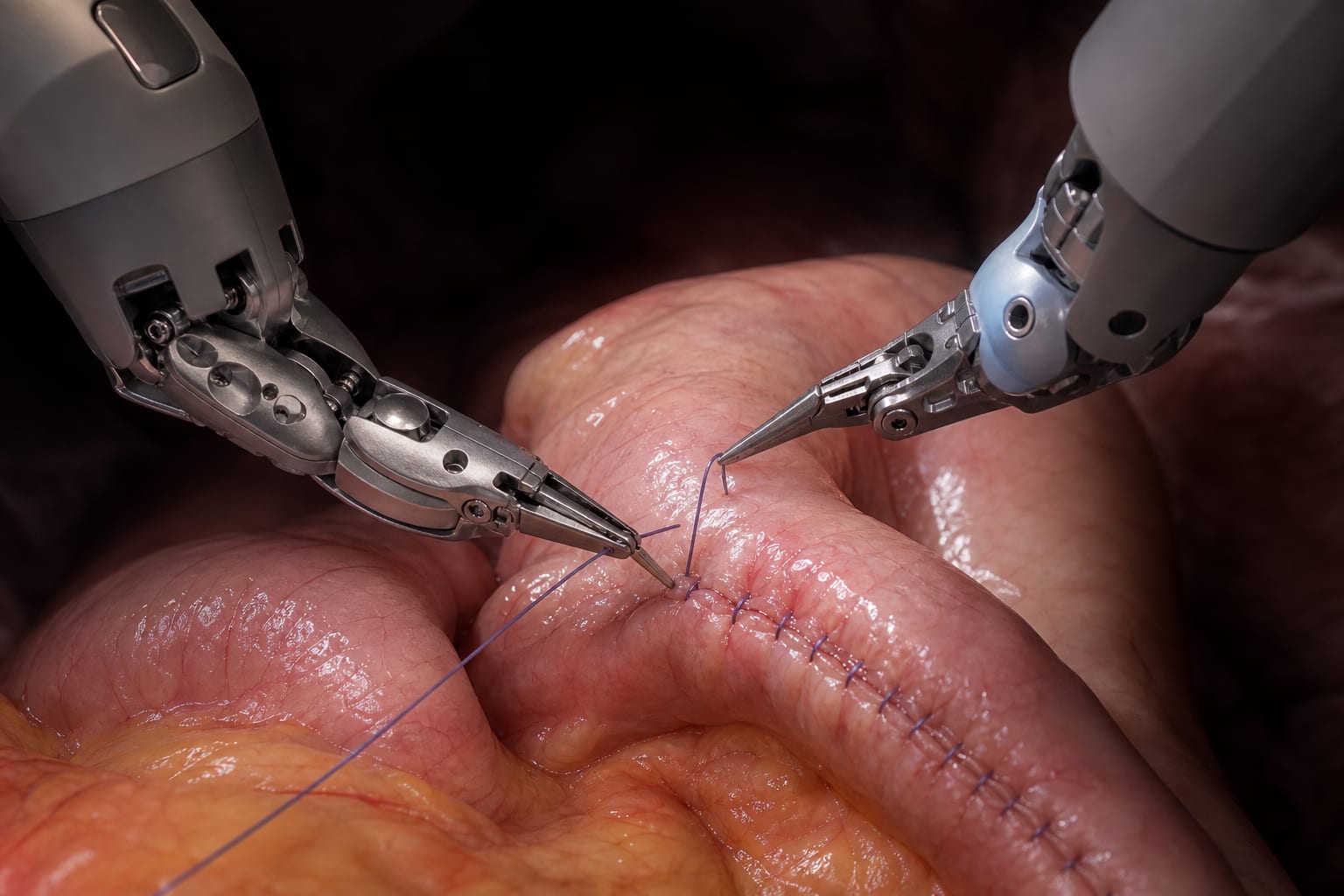
Robotic intracorporeal anastomosis enhances technical precision while reducing surgeon cognitive load: a prospective multicentre study

  • By

  • Yit J. Leang

  • Kaleb R. Lourensz

  • Maria K. Vanguardia

  • Chrys S. Hensman

  • Damien Loh

  • Richard Chen

  • Andrew J. Packiyanathan

  • Joseph C. H. Kong

  • Wendy A. Brown

  • Paul R. Burton

  • July 9, 2026

  • 0 min

Share

Clinical Report: Robotic Intracorporeal Anastomosis Improves Surgical Accuracy

Overview

This study evaluates the impact of robotic assistance on the construction of gastrojejunal anastomosis in bariatric surgery.

Background

Robotic surgical platforms have introduced new possibilities in minimally invasive bariatric surgery, offering enhanced dexterity and visualization. Evidence regarding their impact on surgical outcomes and surgeon workload remains limited.

Data Highlights

No numerical data or trial results were provided in the source material.

Key Findings

  • Robotic-assisted surgery may enhance technical precision during complex procedures like gastrojejunal anastomosis.
  • Surgeons using robotic platforms reported lower cognitive workload compared to laparoscopic techniques.
  • Prior studies have not consistently demonstrated superior clinical outcomes for robotic surgery in bariatric procedures.
  • Surgeon experience and case complexity may influence the outcomes of robotic versus laparoscopic techniques.
  • Current metrics may not adequately capture subtle differences in surgical performance.

Clinical Implications

Further studies are needed to establish definitive clinical outcomes associated with robotic techniques.

Conclusion

Robotic assistance in bariatric surgery warrants further investigation into its clinical efficacy.

Related Resources & Content

  1. Comparison of short-term outcomes of intracorporeal and extracorporeal anastomosis in robotic right colectomy using the da Vinci SP system: a multi-center cohort study
  2. Technical proficiency assessment of robotic intracorporeal single-stapling colorectal anastomosis using video-based RA-CUSUM
  3. A Comparative Study of Robotic-Assisted and Laparoscopic Techniques for Bowel Anastomosis: A Randomized Crossover In Vivo Investigation
  4. Comparative Analysis of Intracorporeal and Extracorporeal Anastomosis Techniques in Robotic-Assisted and Laparoscopic Right Colectomy: Short-Term Results from a Multi-Center Prospective Study
  5. International Federation for the Surgery and Other Therapies for Obesity (IFSO) global consensus recommendations for optimizing outcomes after sleeve gastrectomy | BJS | Oxford Academic
  6. Global trends and outcomes in robotic vs. laparoscopic Roux-en-Y gastric bypass: a 25-year meta-analysis of 38,647 patients across 27 countries - PubMed
  7. International Federation for the Surgery and Other Therapies for Obesity (IFSO) global consensus recommendations for optimizing outcomes after sleeve gastrectomy | BJS | Oxford Academic
  8. Global trends and outcomes in robotic vs. laparoscopic Roux-en-Y gastric bypass: a 25-year meta-analysis of 38,647 patients across 27 countries - PubMed
  9. Minimally invasive Distal Pancreatectomy eRgonOMic analysis - the DP-ROM trial: An explorative, prospective, observational, cohort study trial - PubMed

Original Source(s)

Related Content