Association of APOBEC mutagenesis with stromal and endothelial niche remodeling and PCDH9-linked signaling alterations in colorectal cancer - Report - MDSpire

Association of APOBEC mutagenesis with stromal and endothelial niche remodeling and PCDH9-linked signaling alterations in colorectal cancer

  • By

  • Junting Chen

  • Jiaming Cao

  • Baosen Zhou

  • Lianshuang Zhao

  • Chang Zheng

  • July 16, 2026

Share

Clinical Report: Linking APOBEC-Induced Mutagenesis to Changes in Microenvironments

Overview

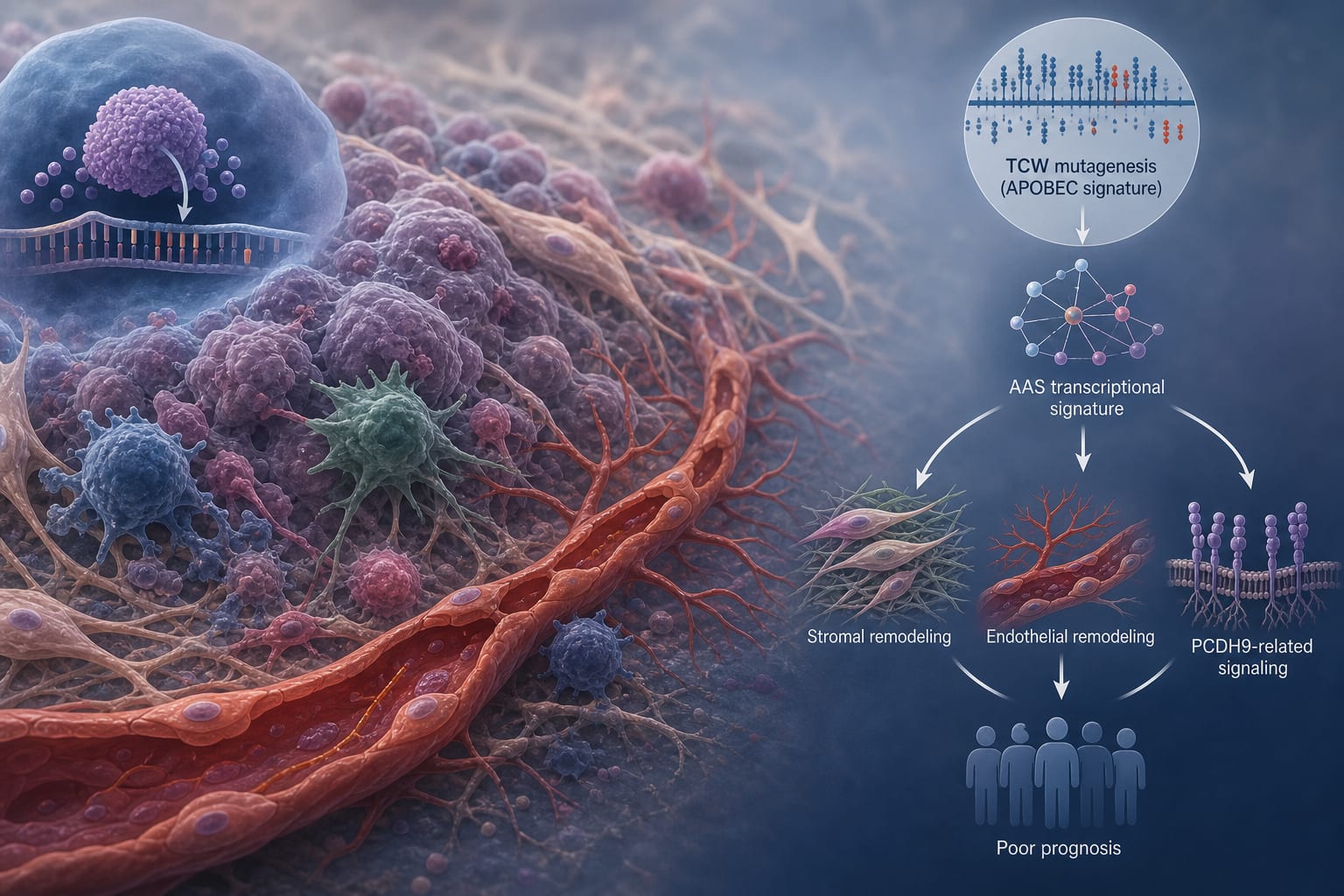
This study identifies APOBEC activity in colorectal cancer (CRC) and its association with stromal and endothelial remodeling.

Background

APOBEC cytidine deaminases contribute to genomic diversity in cancers, including colorectal cancer (CRC), through mutagenesis. This study aims to clarify the role of APOBEC in CRC and its association with TME alterations.

Data Highlights

No numerical data or trial data provided in the source material.

Key Findings

  • APOBEC activation is linked to a distinct CRC subtype characterized by TCW mutagenesis.
  • High APOBEC activation is associated with worse survival outcomes in CRC patients.
  • High AAS tumors exhibit increased fibroblast and endothelial signatures with reduced cytotoxic immune infiltration.
  • Single-cell analyses reveal enrichment of endothelial states with arterial and pro-angiogenic features in high AAS tumors.
  • PCDH9 is identified as a candidate target linked to alterations in Hippo, Wnt/β-catenin, and TGF-β signaling pathways.

Clinical Implications

The identification of APOBEC activity in CRC suggests areas for further investigation.

Conclusion

This study identifies APOBEC-induced mutagenesis in CRC and its association with tumor microenvironment remodeling.

Related Resources & Content

  1. Journal of Gastroenterology, 2026 -- Stage-associated remodeling of CD169 macrophage states is linked to immune regulation in colitis-associated colorectal cancer
  2. Archives of Toxicology, 2021 -- Discovery of Potential New Mechanisms of Drug Resistance Through Genomic and Transcriptomic Analysis of Colon Cancer Cells Lacking p53
  3. Frontiers in Oncology, 2026 -- Immune microenvironment evolution across the serrated neoplasia pathway and its relevance to immunotherapy
  4. Metastatic colorectal cancer: ESMO Clinical Practice Guideline for diagnosis, treatment and follow-up - PubMed
  5. Pembrolizumab versus chemotherapy in microsatellite instability-high or mismatch repair-deficient metastatic colorectal cancer: 5-year follow-up from the randomized phase III KEYNOTE-177 study - ScienceDirect
  6. Archives of Toxicology — Influence of microRNAs on the response to cadmium chloride in pancreatic ductal adenocarcinoma
  7. Metastatic colorectal cancer: ESMO Clinical Practice Guideline for diagnosis, treatment and follow-up - PubMed
  8. Pembrolizumab versus chemotherapy in microsatellite instability-high or mismatch repair-deficient metastatic colorectal cancer: 5-year follow-up from the randomized phase III KEYNOTE-177 study - ScienceDirect
  9. Abstract LB134: Mutational signatures in colorectal cancer from 11 countries reveal new insights in early-onset colorectal cancer | Cancer Research | American Association for Cancer Research

Original Source(s)

Related Content