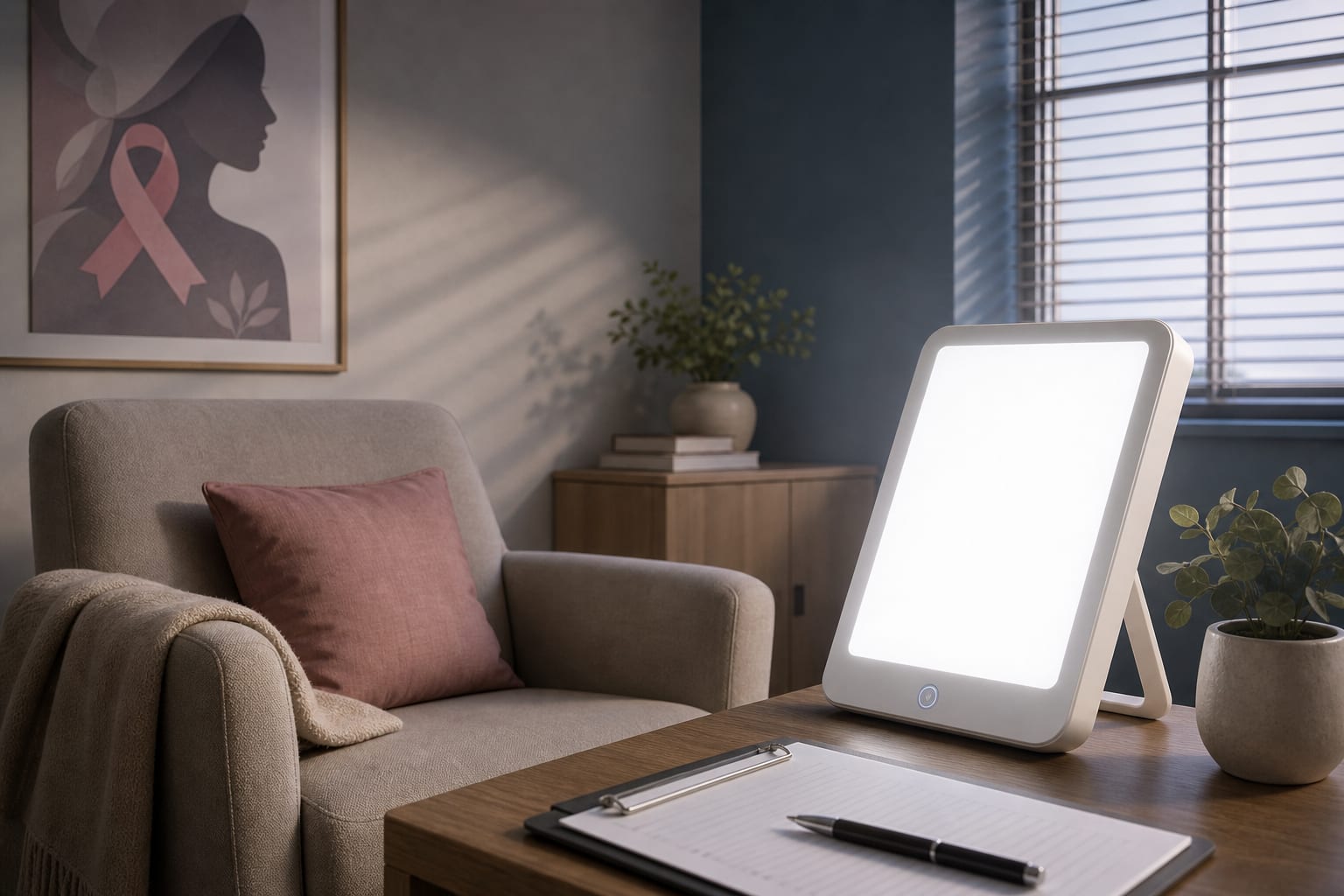
Cognitive Behavior vs Bright Light Therapy for Insomnia in Women Undergoing Chemotherapy for Breast Cancer: A - Report - MDSpire
Coming Soon: Introducing MDSpire News. Learn more
Conexiant’s news site is now MDSpire News. Learn more

Comparative Effectiveness of Cognitive Behavioral Therapy and Bright Light Treatment for Insomnia in Women with Breast Cancer Undergoing Chemotherapy

  • By

  • Trang Thuy Do

  • Jordan Maccora

  • Rebecca Wallace

  • Veronica Aedo-Lopez

  • Marliese Alexander

  • Sonia Ancoli-Israel

  • Bei Bei

  • Robert Blum

  • Frances Boyle

  • Daphne Day

  • Justine Diggens

  • Prudence A. Francis

  • Maria Ftanou

  • Sheila N. Garland

  • Alysia Kepert

  • Duncan Mortimer

  • Andrew J. K. Phillips

  • Sharad Sharma

  • Lesley Stafford

  • Michelle White

  • Joshua F. Wiley

  • August 27, 2026

Share

Clinical Report: Comparative Effectiveness of CBT and Bright Light Treatment for Insomnia

Overview

This study evaluates the efficacy of cognitive behavioral therapy for insomnia (CBT-I) and bright light therapy (BLT) in reducing insomnia and fatigue among women with breast cancer undergoing chemotherapy.

Background

Insomnia and cancer-related fatigue are prevalent and distressing symptoms among women with breast cancer, particularly during chemotherapy. With an estimated 2.3 million new breast cancer cases in 2022, effective management of these symptoms is crucial. CBT-I is the first-line treatment for insomnia, while BLT targets circadian rhythms.

Data Highlights

No numerical data is available from the provided source material.

Key Findings

  • Insomnia affects 62% and moderate to severe fatigue affects 43% of women with breast cancer.
  • During chemotherapy, insomnia symptoms can reach a prevalence of 70%.
  • CBT-I is recognized as the first-line treatment for insomnia in cancer patients.
  • BLT may improve sleep and reduce fatigue by aligning circadian rhythms.
  • There is a lack of randomized clinical trials comparing CBT-I and BLT during chemotherapy.
  • Ethics approval for the study was granted by the Peter MacCallum Cancer Centre Human Research Ethics Committee.

Clinical Implications

The findings highlight the need for effective interventions for insomnia and fatigue in women undergoing chemotherapy for breast cancer. Understanding the comparative effectiveness of CBT-I and BLT may inform treatment decisions and improve patient outcomes.

Conclusion

This study examines the efficacy of CBT-I and BLT for managing insomnia and fatigue in women with breast cancer undergoing chemotherapy.

Related Resources & Content

  1. Cognitive Behavior vs Bright Light Therapy for Insomnia in Women Undergoing Chemotherapy for Breast Cancer: A Randomized Clinical Trial | Oncology | JAMA Network Open | JAMA Network, 2024
  2. the asco post — Effect of Virtually Delivered CBT for Insomnia on Cancer-Related Cognitive Impairment
  3. MDSpire News — Voice-Activated CBT-I Reduces Insomnia in Breast Cancer Survivors
  4. The ASCO Post — Two Behavioral Interventions Help Cancer Patients Struggling With Sleep Issues, Penn Medicine Study Finds
  5. the asco post — Tai Chi vs Cognitive Behavioral Therapy: Measuring Inflammatory Biomarkers in Breast Cancer Survivors With Insomnia
  6. Effect of Virtually Delivered CBT for Insomnia on Cancer-Related Cognitive Impairment
  7. Voice-Activated CBT-I Reduces Insomnia in Breast Cancer Survivors
  8. Two Behavioral Interventions Help Cancer Patients Struggling With Sleep Issues, Penn Medicine Study Finds
  9. Insomnia in adult patients with cancer: ESMO Clinical Practice Guideline
  10. Combination treatment for chronic insomnia disorder in adults: an American Academy of Sleep Medicine clinical practice guideline
  11. Cognitive Behavior vs Bright Light Therapy for Insomnia in Women Undergoing Chemotherapy for Breast Cancer: A Randomized Clinical Trial | Oncology | JAMA Network Open | JAMA Network

Original Source(s)

Related Content