Association of the TyG index and its body fat distribution composites with CHD and MACE risk in adults with OSAHS: incremental discrimination and exploratory mediation analysis - Report - MDSpire
Advertisement
Association of the TyG index and its body fat distribution composites with CHD and MACE risk in adults with OSAHS: incremental discrimination and exploratory mediation analysis
Clinical Report: TyG Index and Cardiovascular Risk in OSAHS Patients
Overview
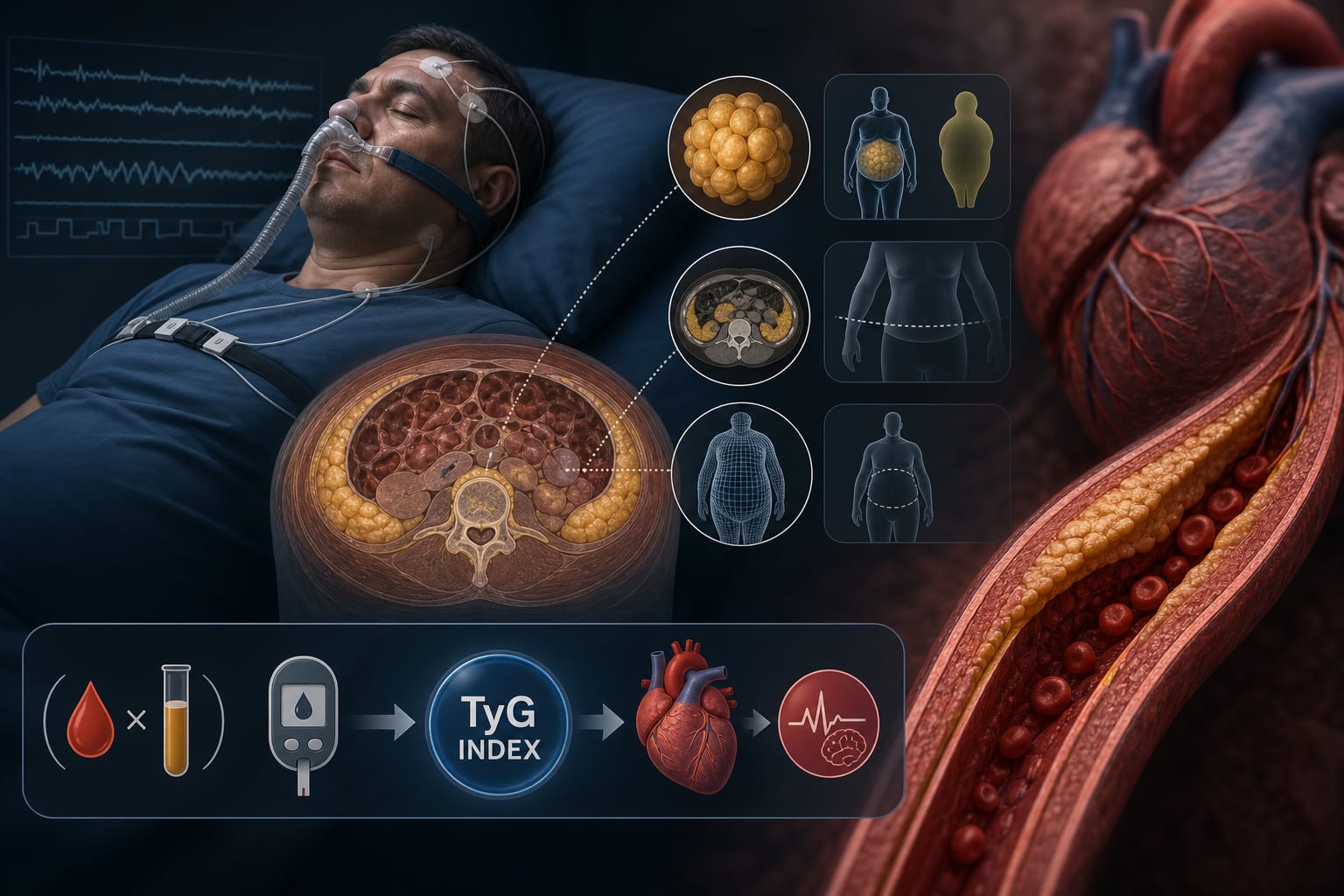
This study investigates the relationship between the triglyceride-glucose (TyG) index and body fat distribution metrics with coronary heart disease (CHD) and major adverse cardiovascular events (MACE) in adults with obstructive sleep apnea-hypopnea syndrome (OSAHS). Findings indicate that TyG-related indices, particularly the TyG-weight-adjusted waist index (TyG-WWI), are significantly associated with both prevalent CHD and incident MACE.
Background
Obstructive sleep apnea-hypopnea syndrome (OSAHS) is a common condition linked to various cardiovascular diseases, including coronary heart disease (CHD). Identifying individuals at high cardiovascular risk within the OSAHS population is crucial for effective management and prevention strategies. The triglyceride-glucose (TyG) index serves as a valuable marker for insulin resistance, which is a significant contributor to cardiovascular risk in this population.
Data Highlights
Metric
Odds Ratio (OR)
Hazard Ratio (HR)
TyG-WWI
3.21 (95% CI: 2.68-3.89)
1.545 (95% CI: 1.217-1.961)
Key Findings
All TyG-related indices were independently associated with prevalent CHD.
TyG-WWI showed the strongest association with prevalent CHD (OR 3.21).
Adding TyG-WWI to conventional risk factors significantly improved CHD discrimination.
During follow-up, TyG-WWI was also strongly associated with incident MACE (HR 1.545).
Exploratory analysis suggested indirect pathways involving TyG-WWI and TyG-CVAI.
Clinical Implications
The findings suggest that the TyG-WWI may serve as a valuable tool for cardiovascular risk stratification in patients with OSAHS. Clinicians should consider incorporating TyG-related indices into routine assessments to identify high-risk individuals and tailor management strategies accordingly.
Conclusion
The study highlights the potential of TyG-related indices, particularly TyG-WWI, as important markers for cardiovascular risk in adults with OSAHS. Further validation in prospective studies is warranted to confirm these findings.