Case Study of Polymorphous Low-Grade Neuroepithelial Tumor in a Young Patient
-
By
-
Haitao Wu
-
Youyuan Chen
-
Peng Sun
-
Wenshuai Deng
-
June 5, 2026
Clinical Report: Case Study of Polymorphous Low-Grade Neuroepithelial Tumor
Overview
This report details a case of polymorphous low-grade neuroepithelial tumor of the young (PLNTY) in a 30-year-old male, highlighting the clinical, imaging, and pathological characteristics. The patient achieved complete seizure control following surgical intervention, emphasizing the importance of accurate diagnosis and treatment.
Background
Polymorphous low-grade neuroepithelial tumor of the young (PLNTY) is a rare tumor primarily affecting adolescents and young adults, often presenting with drug-resistant epilepsy. Accurate diagnosis is crucial as PLNTY can exhibit atypical imaging features, leading to potential misdiagnosis. Understanding its clinical and molecular characteristics is essential for effective management and treatment outcomes.
Data Highlights
No numerical data available in the article.
Key Findings
- The patient presented with a 6-year history of drug-resistant epilepsy.
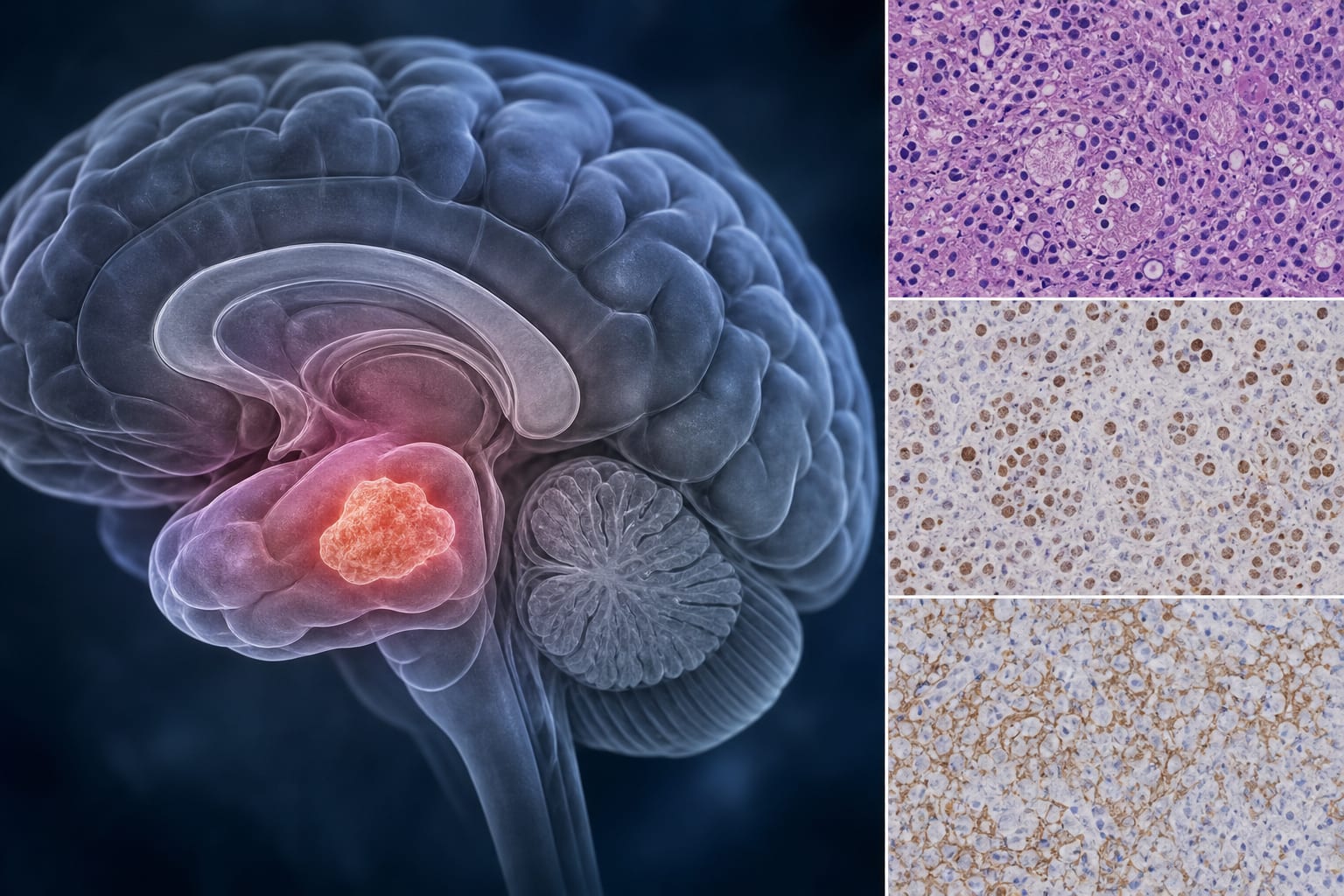
- Cranial MRI revealed an ovoid area of abnormal signal intensity in the left temporal pole.
- Pathological examination confirmed PLNTY, CNS WHO Grade 1, after left temporal lobe lesionectomy.
- Immunohistochemical analysis showed diffuse CD34 positivity and a low Ki-67 proliferation index of 1%.
- Molecular testing confirmed BRAF mutation positivity, indicating potential for targeted therapy.
- Postoperative follow-up indicated complete seizure control with an uneventful recovery.
Clinical Implications
Maximal safe resection is the first-line treatment for PLNTY, significantly improving seizure control and prognosis. Clinicians should be aware of the potential for atypical imaging features to avoid misdiagnosis and ensure timely intervention.
Conclusion
PLNTY is characterized by long-standing drug-resistant epilepsy and requires a multidisciplinary approach for diagnosis and treatment. Early surgical intervention can lead to favorable outcomes, including seizure freedom.
Related Resources & Content
- Huse JT, et al., Acta Neuropathologica, 2016 -- Polymorphous Low-Grade Neuroepithelial Tumor in Young Patients: An Epileptogenic Tumor Featuring Oligodendroglioma-like Characteristics, Unusual CD34 Expression, and Genetic Changes in the MAP Kinase Pathway
- Journal of Neuro-Oncology, 2022 -- Methylation Profiling's Impact on Histologically Confirmed Neurocytoma: A Case Series Analysis
- Acta Neuropathologica, 2010 -- Diagnostic Challenges in Oligodendroglial Tumors Exhibiting Ganglioglioma-like Features
- PMC, 2021 -- The 2021 WHO Classification of Tumors of the Central Nervous System: An update on pediatric low‐grade gliomas and glioneuronal tumors
- New England Journal of Medicine -- Dabrafenib plus Trametinib in Pediatric Glioma with BRAF V600 Mutations
- The Journal of Clinical Endocrinology & Metabolism — Evaluating Pediatric Patients with Potential Pheochromocytoma or Paraganglioma in Comparison to Neuroblastoma
- The 2021 WHO Classification of Tumors of the Central Nervous System: An update on pediatric low‐grade gliomas and glioneuronal tumors - PMC
- https://academic.oup.com/neuro-oncology/article/26/1/7/7271494
- Dabrafenib plus Trametinib in Pediatric Glioma with BRAF V600 Mutations | New England Journal of Medicine
Based on findings from:
Polymorphous low-grade neuroepithelial tumor of the young: a case report
Haitao Wu, Youyuan Chen, Peng Sun, Wenshuai Deng. Frontiers In Oncology, 2026.
https://www.frontiersin.org/journals/oncology/articles/10.3389/fonc.2026.1802067/full
This content is an AI-generated, fully rewritten summary based on a published scholarly article. It does not reproduce the original text and is not a substitute for the original publication. Readers are encouraged to consult the source for full context, data, and methodology.