Precision treatment of chalazion based on AI-driven risk stratification: a prospective study of triamcinolone acetonide combined with intense pulsed light therapy - Report - MDSpire
Conexiant’s news site is now MDSpire News. Learn more
Advertisement
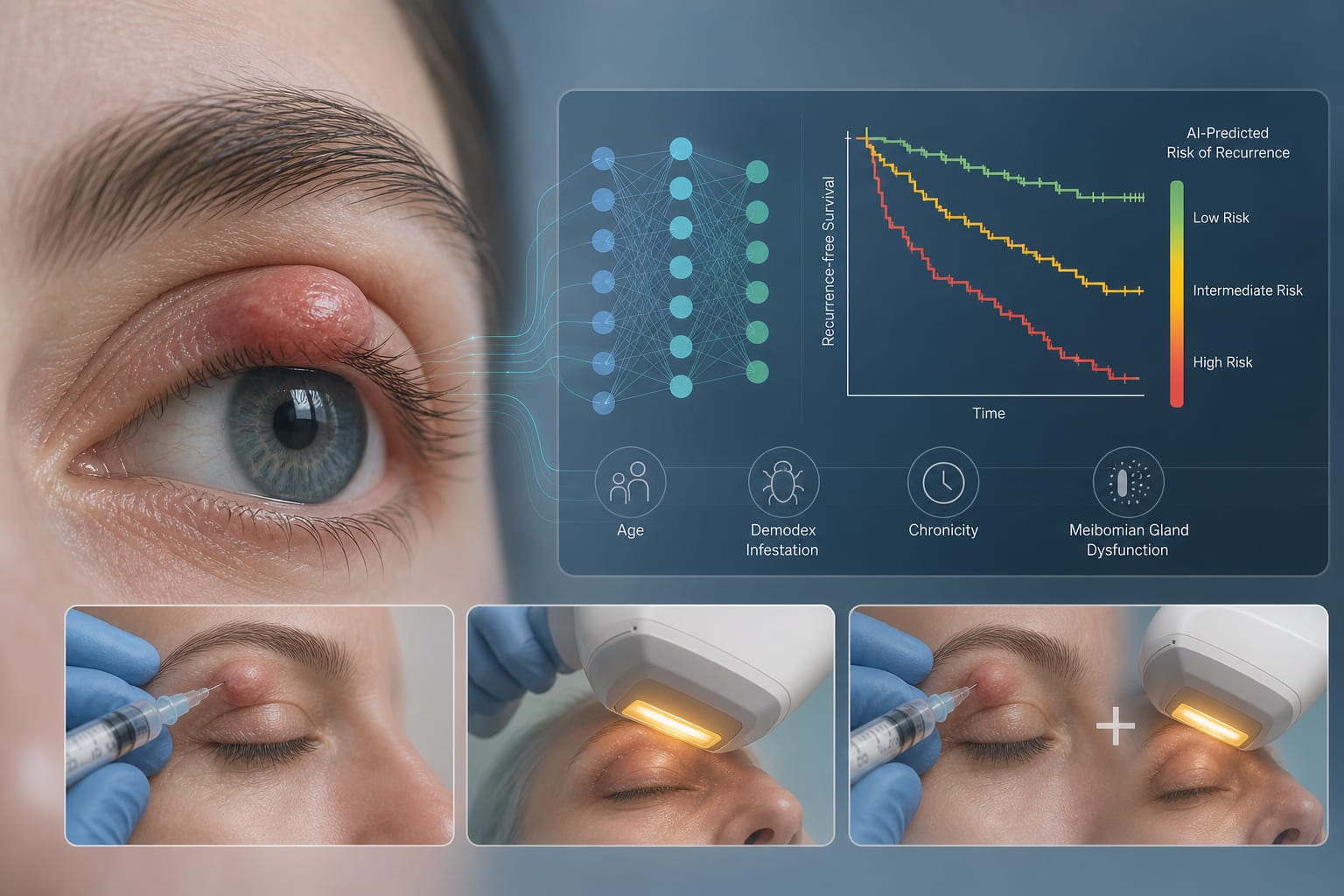
AI-Enhanced Risk Stratification for Targeted Chalazion Management: A Prospective Study on the Efficacy of Triamcinolone Acetonide and Intense Pulsed Light Therapy
Clinical Report: AI-Enhanced Risk Stratification for Targeted Chalazion Management
Overview
This study evaluates the efficacy of intralesional triamcinolone acetonide (TA), intense pulsed light (IPL), and their combination in managing chalazion recurrence. A hybrid AI-clinical model was developed to enhance risk stratification and predict recurrence rates more accurately.
Background
Chalazion is a common eyelid disorder that can lead to significant ocular discomfort and visual disturbances. Understanding the factors influencing chalazion recurrence is crucial for optimizing treatment strategies, particularly in high-risk populations. This study introduces an AI-enhanced model to improve prediction and management of chalazion recurrence.
Data Highlights
Group
3-Month Resolution Rate
Recurrence Rate
TA + IPL
95.2%
8.3%
TA Only
90.8%
15.4%
IPL Only
79.4%
38.2%
Key Findings
The combined TA + IPL group showed a significantly higher resolution rate (95.2%) compared to TA-only (90.8%) and IPL-only (79.4%) groups (p < 0.001).
Recurrence rates were significantly different among groups: IPL (38.2%), TA (15.4%), and TA + IPL (8.3%) (χ2 = 31.73, p < 0.001).
Demodex infection, age, chronicity, and meibomian gland dysfunction were identified as independent risk factors for recurrence.
The hybrid AI-clinical model achieved an AUC of 0.822, outperforming clinical and XGBoost models (p < 0.05).
AI integration refined risk estimates with a net reclassification improvement (NRI) of 0.365 (p < 0.001).
In high-risk patients, recurrence rates with monotherapy ranged from 83.3% to 91.7%, while combined therapy reduced this to 60.0%.
Clinical Implications
The findings suggest that combined TA + IPL therapy may be more effective in reducing chalazion recurrence, particularly in high-risk patients. The AI-enhanced risk stratification model can assist clinicians in making informed treatment decisions.
Conclusion
The study demonstrates that a hybrid AI-clinical model can significantly improve predictions of chalazion recurrence, highlighting the efficacy of combined TA + IPL therapy in managing this condition.
Interventional treatment for DED before refractive surgery biometry allows practices to offer options like advanced-technology intraocular lenses to more patients.